
The Secret Behind Korean Ceramics Beauty
In This Article
A Country That Turned Clay Into Art
Korea has a pottery tradition that goes back more than a thousand years. But Korean ceramics are not just old objects in a museum. They represent a way of thinking about beauty that is still relevant today. Two types of ceramic stand above the rest: Goryeo celadon and Joseon white porcelain. Each one came from a different era, a different philosophy, and a different vision of what beauty should look like.
What Is Celadon?
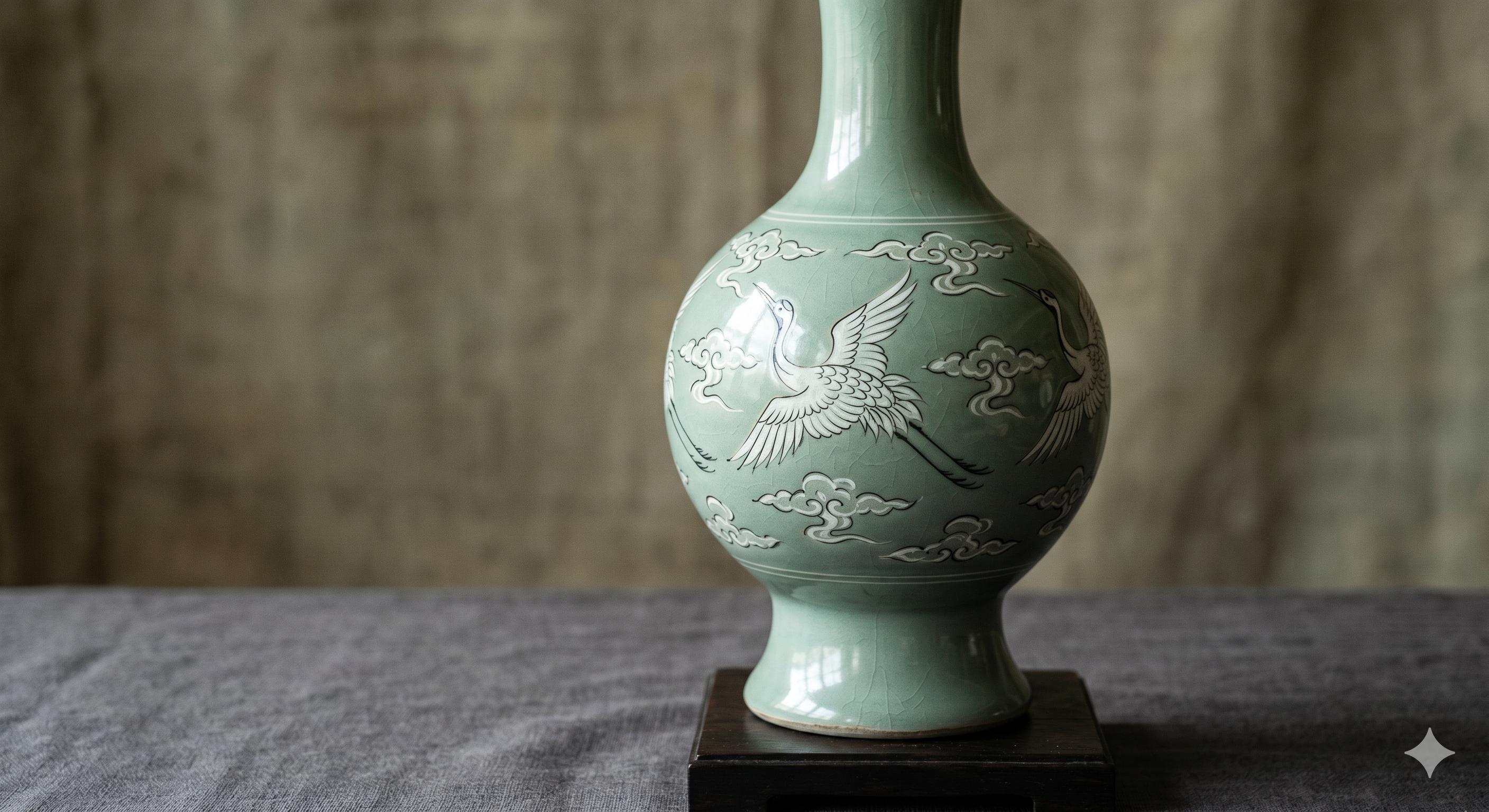
Celadon, known in Korean as CHEONGJA, is a type of ceramic with a distinctive blue-green glaze. Korea developed its own version of celadon during the Goryeo Dynasty, roughly between the 10th and 14th centuries. Korean celadon became so refined that even Chinese potters of the time recognized it as exceptional. The color is often described as "jade green," and achieving it required precise control of kiln temperature and atmosphere. A small shift in either direction would produce an entirely different result.
What made Korean celadon unique was a technique called SANGGAM. Potters would carve a design into the surface of the clay, fill the carved grooves with white or black slip, and then apply the glaze over the top. After firing, the inlaid design would appear beneath the surface of the glaze like a painting seen through water. Cranes, clouds, lotus flowers, and willow trees were common motifs. Each piece required enormous skill and patience to produce.
The Crane and Cloud Pattern You Keep Seeing
If you have ever seen a Korean celadon piece with flying cranes against a cloud background, that is one of the most iconic patterns in Korean ceramic history. It is called the UNHAKMUN pattern, meaning "cloud and crane." The crane symbolizes longevity and virtue in Korean culture, and the pattern appears on some of the most celebrated celadon pieces from the Goryeo period. Today, this same pattern appears on museum merchandise, fabric, and packaging across Korea. Once you know what it is, you will start seeing it everywhere.
What Is White Porcelain?
When the Joseon Dynasty replaced the Goryeo Dynasty in 1392, the aesthetic completely changed. Joseon society was shaped by Confucian values that emphasized simplicity, restraint, and moral seriousness. The elaborate and decorative celadon fell out of favor. In its place came BAEKJA, white porcelain. Pure white, clean, and unadorned.
Joseon white porcelain is remarkable precisely because of what it does not have. No heavy decoration. No complex inlay work. The beauty comes from the form of the vessel itself and the subtle variations in the white glaze. Some pieces have a faint blue tint. Others have a soft warmth. The whiteness was not seen as empty but as honest. It reflected the Joseon ideal of a life lived without excess.
The Moon Jar
The most iconic object in Joseon white porcelain is the DALHANGARI, or Moon Jar. It is a large, round jar made by joining two bowl-shaped halves together. Because the two halves were never perfectly aligned, every Moon Jar is slightly asymmetrical. The surface is never perfectly smooth. No two are identical. For centuries, this was considered a flaw. Today, it is considered the essence of Korean beauty. The imperfection is the point. The Moon Jar looks full, calm, and quietly confident. It does not try to impress anyone.
Moon Jars have influenced generations of artists and designers in Korea and around the world. Contemporary Korean designers regularly reference the Moon Jar in product design, packaging, and architecture. If you visit a modern Korean design exhibition, you will almost certainly see its influence somewhere.
Why Korean Ceramics Matter Today
Korean ceramics are not a relic. They are a living reference point for Korean aesthetics. The values embedded in Goryeo celadon and Joseon white porcelain, refinement, restraint, and the acceptance of imperfection, continue to shape how Korean designers, artists, and craftspeople work today. When you see a Korean cosmetics brand use a white porcelain-inspired bottle, or a cafe serve coffee in a matte celadon-colored cup, that connection is intentional. Understanding Korean ceramics gives you a key to understanding a large part of Korean visual culture.