
The Korean Jewelry Box That Comes Alive
In this article
The Korean Jewelry Box That Comes Alive
A Surface That Moves
People who encounter Najeonchilgi for the first time tend to notice the same thing: the color changes without the object moving. This is not an optical illusion. Mother-of-pearl — shell ground to under 1mm thin — reflects light differently depending on the viewing angle. The same surface appears green under direct light and shifts to violet in the shade. No print, no digital pattern can replicate this. It is a purely physical phenomenon.
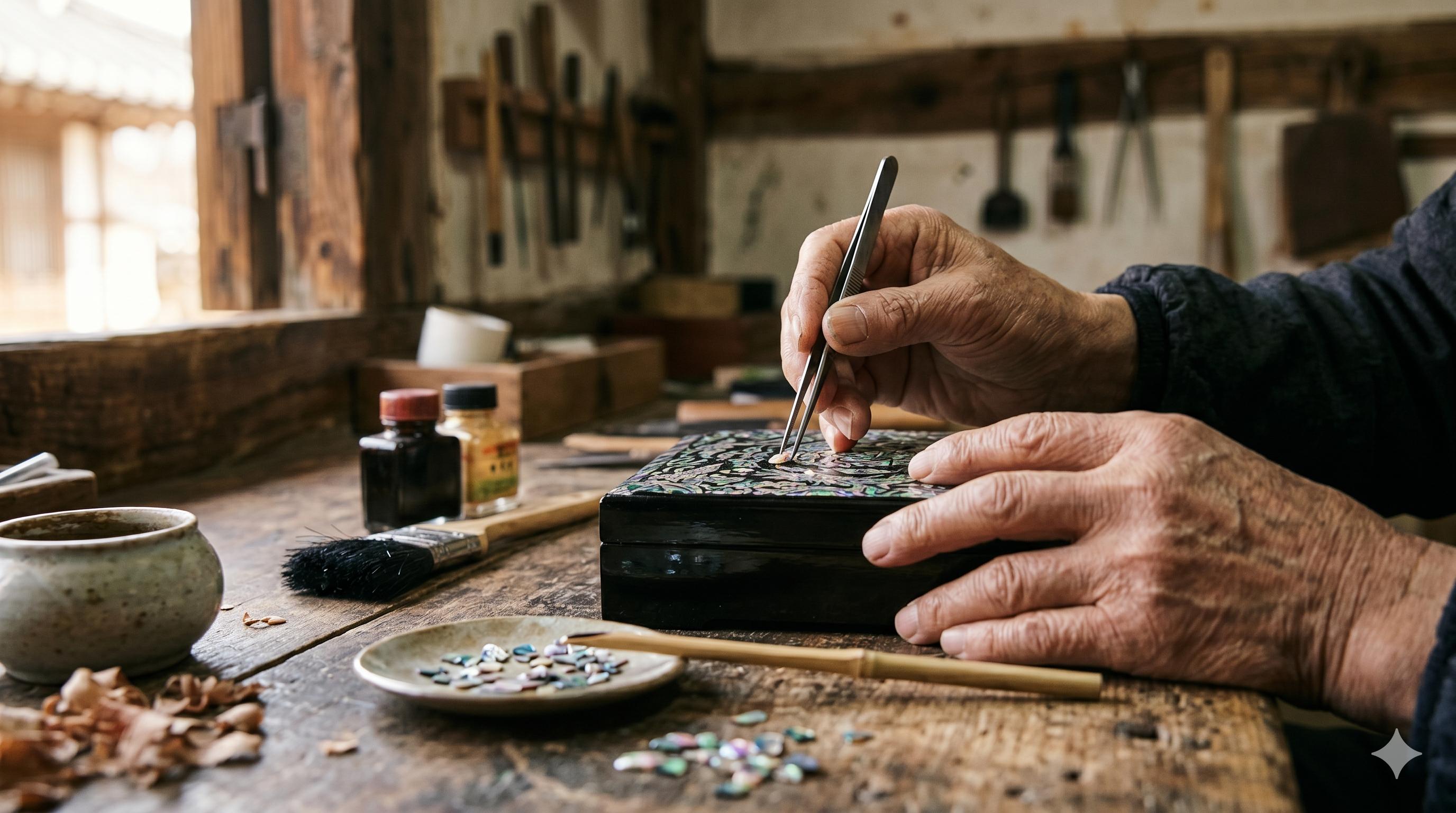
Before the shell becomes mother-of-pearl, the limestone layer of the abalone's exterior must be ground away by hand on a millstone, then filed down with a metal rasp to produce a flat sheet under 1mm thick. Each fragment is then cut into pattern pieces and placed one by one onto a lacquer-coated wooden base. The entire process is manual. No stage can be mechanized.
The Craft That Impressed a Chinese Envoy
During the Goryeo dynasty, individual pattern units in Najeonchilgi measured no more than 1cm — some as small as 2 to 3mm. Cutting abalone shell to that precision without modern cutting tools required extraordinary skill. Xu Jing, a Song dynasty envoy who visited Goryeo and wrote a detailed report of what he observed, noted that "Goryeo's mother-of-pearl technique is so refined it is truly rare" — remarkable praise from a writer who was otherwise broadly dismissive of Goryeo. During the reign of King Munjong, Najeonchilgi was sent as a diplomatic gift to both Song China and Khitan. In the 13th century, when the Mongol empress demanded lacquerware scripture boxes, a dedicated government office was established solely to fulfill the order. Fewer than 20 Goryeo-period Najeonchilgi pieces survive worldwide today.
A Heritage on the Verge of Disappearing
With the modernization of Korean society, demand for traditional lacquerware declined sharply. The spread of Western-style furniture and the emergence of synthetic substitutes eroded the craft's place in everyday life. In 1966, the Korean government designated Najeonchilgi as National Intangible Cultural Heritage to prevent the tradition from being lost. Historically, production was divided among three specialists — the woodworker, the lacquer artisan, and the mother-of-pearl inlayer — but these roles have since merged as the number of practitioners has dwindled. The southern coastal regions, particularly Tongyeong in South Gyeongsang Province, remain the primary centers of production, where abalone from the nearby sea is considered the finest in quality.
An Object That Carries a Story
On April 15, tvN's You Quiz on the Block presented Meryl Streep and Anne Hathaway with Najeonchilgi jewelry boxes. The colors were not chosen at random: deep purple for Miranda, the character played by Streep; cerulean blue for Andy, played by Hathaway — drawn directly from the world of The Devil Wears Prada. No explanation was needed. The object communicated the story on its own. It was a moment that demonstrated how Najeonchilgi can function not merely as a decorative craft, but as a medium for cultural storytelling.