
The ritual seen in K-dramas actually exists.
In This Article
Singing, Dancing, and Speaking With Spirits: Korea's Traditional Ritual "Gut"
A centuries-old Korean ritual where music, trance, and the spirit world converge — and one that still appears in modern Korean dramas and films.
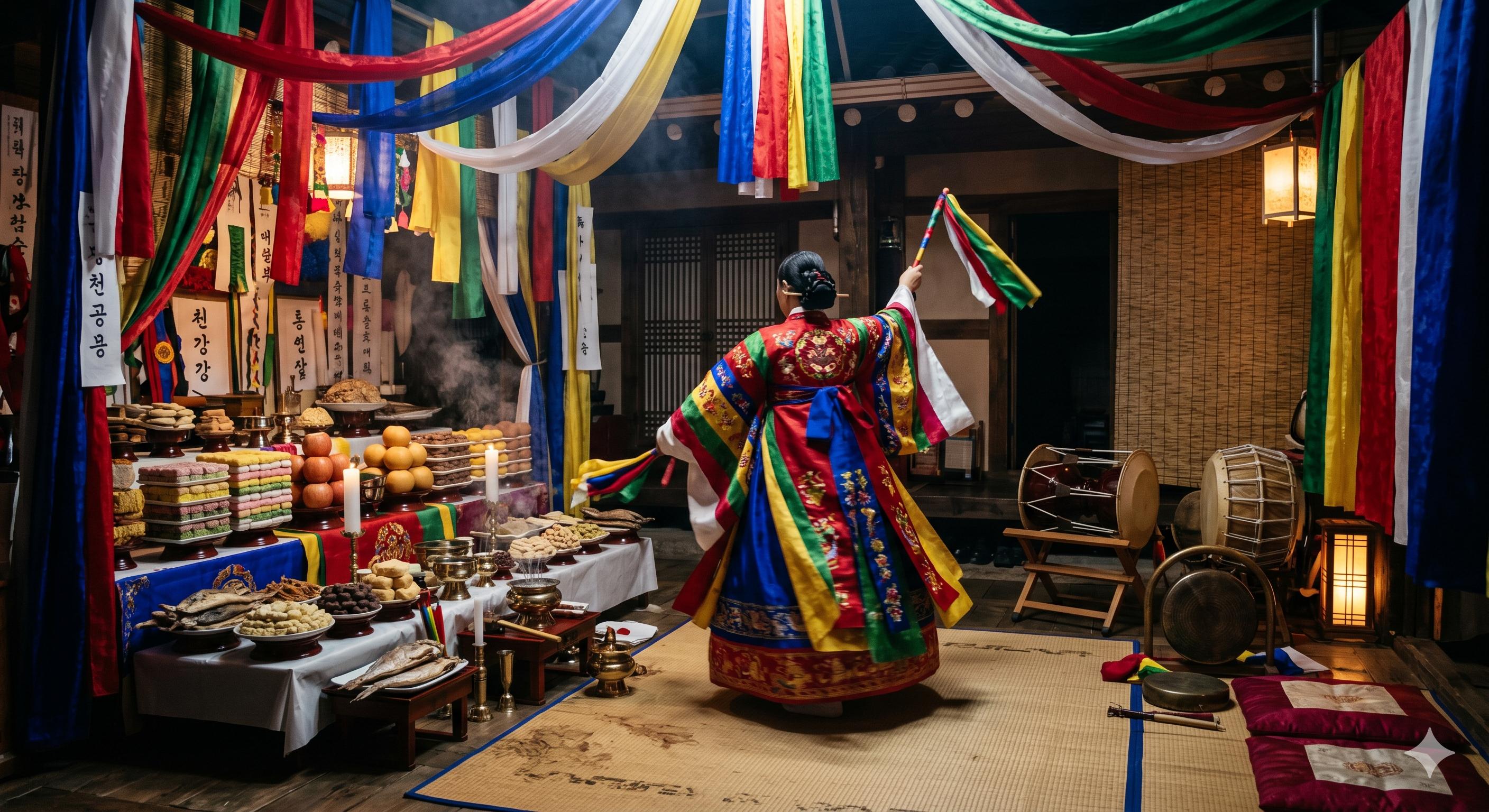
A figure dressed in colorful hanbok dances to the rhythm of traditional Korean drums and percussion. They sing, call out names, and at times laugh, cry, and move in intense, emotional expressions. This unfamiliar scene is not a performance, but a traditional Korean ritual known as Gut (굿).
The Dangerous Yet Mysterious "Jwadu-tagi" (Walking on Knife Blades)
One of the most striking scenes in Gut is jwadu-tagi (작두 타기). It involves the mudang standing or walking on sharp blade-like platforms, balancing their body in a way that appears extremely dangerous to outsiders.
For first-time viewers, it naturally raises the question: "How is it possible not to get injured?"
However, this act is not considered a mere performance or stunt. Traditionally, it is interpreted as a symbolic moment representing a connection with spiritual beings during the ritual.
※ This practice has not been scientifically verified. Its meaning is understood primarily within cultural and ritual contexts passed down over generations.
The Changing Voice During the Ritual
During Gut, the mudang's behavior can change dramatically. Their voice may shift in tone, speech patterns may change, and they may appear to become a completely different presence.
This transformation is traditionally understood as the moment when a spiritual entity has "descended" into the mudang. From an outside perspective, it may appear theatrical or unreal, but within tradition, it is regarded as a key expression of communication with the spiritual world.
Between Belief and Interpretation
These phenomena have not been scientifically explained, and interpretations vary widely. Nevertheless, Gut is not viewed simply as a matter of belief, but as a cultural practice with deep symbolic structure and ritual meaning.
Gut in Modern Korean Content
Gut continues to exist in modern Korean society in evolving forms, and it has not disappeared. In particular, it frequently appears in contemporary Korean media.
Gut scene from the Korean film Exhuma (파묘, 2024)
For international audiences, such scenes often leave a strong impression and raise questions: Is this dramatic fiction, or a reflection of real cultural practice?
Gut as Cultural Heritage
Experts view Gut not merely as a matter of belief, but as a long-standing cultural tradition. It has historically functioned as a way for communities to relieve anxiety and reinforce social bonds, while also combining music, dance, and costume into a complex performative art form.
The Cultural Heritage Administration of Korea protects traditions related to Gut as part of intangible cultural heritage, documenting its transmission and ritual forms. Similarly, UNESCO recognizes traditional rituals and performances worldwide as part of humanity's intangible cultural heritage.
A Living Tradition
Even within a highly modernized and technologically advanced society, Gut continues to survive in transformed ways. It remains one of the cultural layers that reflects Korea's past and present simultaneously — a living cultural heritage still present today.