
DOENJANG (된장): Korea’s Fermented Paste That Tastes Like Home
In This Article
The Paste That Smells Strange and Tastes Like Home
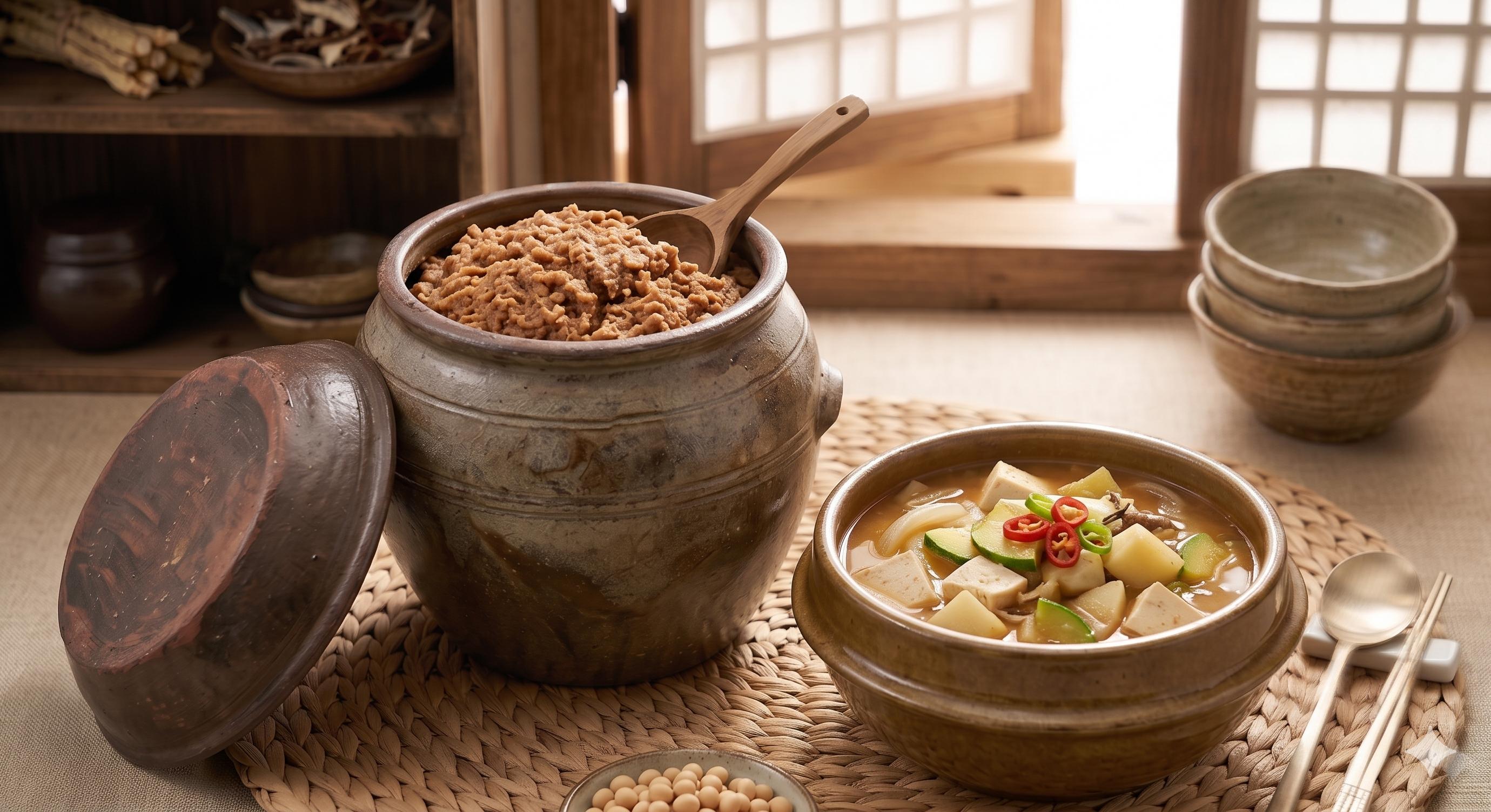
Ask any Korean living abroad what food they miss the most, and the answer is rarely something glamorous. It is usually DOENJANG jjigae. A pot of fermented soybean paste stew, boiled with tofu and zucchini, served in a stone bowl that keeps it bubbling at the table. It is one of the simplest dishes in Korean cooking. It is also the one that carries the most weight. DOENJANG (된장) is the fermented soybean paste at the center of Korean cuisine, and understanding it means understanding something essential about how Koreans relate to food, memory, and time.
It Starts With MEJU
Everything begins with MEJU (메주). MEJU is a block of compressed, cooked soybeans that has been left to ferment naturally, traditionally wrapped in rice straw. The rice straw is not decorative. It carries Bacillus subtilis, a naturally occurring bacteria that colonizes the surface of the MEJU block and begins breaking down the soy proteins into amino acids. This is where the flavor starts. The MEJU blocks are hung in a well-ventilated space, usually from late autumn through winter, and left to dry and ferment over several months. By the time they are ready, the outside is covered in white mold and the inside has transformed completely. The raw material that goes into JANG is not just cooked soybeans. It is a living block of concentrated microbial activity.
One Pot, Two Products
In early spring, traditionally between the first and third lunar months, the MEJU blocks are placed into large ONGGI (옹기) earthenware pots and submerged in saltwater at a concentration of around 18 to 20 percent. Charcoal and dried red peppers are added to the pot. The charcoal absorbs impurities. The peppers add antimicrobial properties. The pot is then sealed and left to ferment for 40 to 60 days. When the fermentation is complete, the pot is opened and separated. The liquid that has formed on top is ladled out. That liquid becomes GANJANG, Korean soy sauce. The solid blocks of MEJU that remain are pressed and salted, then packed into a separate pot. That becomes DOENJANG. One process, one pot, two completely different products. This is the part that most people outside Korea do not know, and it is the part that makes Korean JANG culture genuinely unlike anything else in the world.
Why It Smells Like That
The smell of DOENJANG is confronting to people who did not grow up with it. It is pungent, earthy, and dense in a way that demands a reaction. That smell comes from the breakdown of soy proteins into amino acids and the production of volatile compounds during fermentation, including pyrazines, furans, and organic acids. These are the same classes of compounds responsible for the complex aromas in aged cheese, dark roasted coffee, and fermented meats. The smell is not a sign of something gone wrong. It is a sign of something working exactly as it should. For Koreans, that smell is so deeply associated with comfort and familiarity that it functions as a sensory trigger for memory. Smell is the sense most directly connected to the brain's memory centers, and for many Koreans, the smell of DOENJANG jjigae is among the first things that comes to mind when they think of home.
What Science Found Inside
Traditionally fermented DOENJANG is not just flavorful. It is chemically complex in ways that factory-produced versions cannot replicate. Studies have identified over 200 volatile compounds in traditionally made DOENJANG, each contributing to its layered flavor profile. The probiotic content is also significant. DOENJANG made through traditional methods contains live cultures of Bacillus subtilis, which supports gut health and immune function. Research conducted in Korea has identified compounds in DOENJANG with potential anti-inflammatory and anticancer properties, though this remains an area of ongoing study. What is clear is that the microbial diversity in traditionally fermented DOENJANG is vastly greater than in commercially produced versions, which use standardized starter cultures and shortened fermentation times. The longer DOENJANG ages, the more complex it becomes. Some families age their DOENJANG for three, five, or even ten years. The result tastes nothing like the version from a supermarket.
DOENJANG Is Not Miso
The comparison comes up constantly, and it is understandable. Both are fermented soybean pastes. Both are used as a base for soups. But the differences are fundamental. Japanese miso is made using a controlled fermentation process with Aspergillus oryzae inoculated into rice or barley, which is then mixed with soybeans. Korean DOENJANG is made from pure soybean MEJU fermented through wild, naturally occurring microorganisms. No added grain. No controlled starter culture. The microbial community in traditional DOENJANG is therefore far more diverse and less predictable than miso. The flavor is also different in a way that is immediately apparent side by side. DOENJANG is earthier, more pungent, and more intense. Miso tends toward a cleaner, rounder sweetness. Neither is better. They are simply the products of two different fermentation philosophies developed in two different countries over thousands of years.
The Dish That Carries Everything
DOENJANG jjigae is the most common vehicle for DOENJANG in everyday Korean cooking. The basic version requires almost nothing. DOENJANG, water, tofu, zucchini, and a dried anchovy stock. It comes together in under twenty minutes and tastes like it took all day. Beyond jjigae, DOENJANG is used as a dipping paste for raw vegetables, as a seasoning for NAMUL (나물) vegetable side dishes, and as a marinade base for grilled meats. SSAMJANG (쌈장), the paste used for wrapping grilled pork belly in lettuce leaves, is a mixture of DOENJANG and GOCHUJANG. Almost every savory application in traditional Korean cooking either uses DOENJANG directly or uses it in combination with something else. It is less an ingredient than a foundation.
Why Koreans Miss It Most
There is a reason DOENJANG jjigae tops every survey of foods Koreans miss when living abroad. It is not the most visually impressive dish in Korean cuisine. It does not have the drama of Korean barbecue or the viral appeal of buldak. What it has is something harder to manufacture. It has the kind of familiarity that only comes from eating something regularly from childhood, from watching it be made by someone who made it before you and will make it again. DOENJANG carries memory in a way that more decorated dishes do not. It is the food that reminds Koreans of early mornings, of school lunches, of coming home. That is not a quality that can be engineered in a factory or recreated in a fusion restaurant. It lives in the paste itself, and in the people who grew up knowing exactly what it smells like when it is ready.