
CHEONGGUKJANG (청국장): The 2-Day Fermentation That Smells Stronger Than It Tastes
In This Article
The Fermented Food That Takes Two Days and Smells Like Nothing Else
Most fermented foods require patience. DOENJANG takes months. GANJANG takes longer. GOCHUJANG ferments for up to three years in outdoor earthenware pots. CHEONGGUKJANG (청국장) takes two to three days. It is the fastest fermented soybean product in Korean cuisine — and arguably the most pungent. The smell is immediate, dense, and unmistakable. For people who grew up eating it, that smell means warmth, winter, and a bowl of something deeply restorative. For people encountering it for the first time, the reaction is usually something else entirely.
That contrast — between the intensity of the smell and the depth of the flavor — is exactly what makes CHEONGGUKJANG worth understanding.
How It Is Made
The process is straightforward by fermentation standards. Soybeans are soaked in warm water for 10 to 20 hours, then cooked until fully soft. The cooked soybeans are transferred into a container lined with rice straw, which carries naturally occurring Bacillus bacteria on its surface. The container is kept at around 40 to 45 degrees Celsius — traditionally by wrapping it in blankets in a warm room — and left to ferment for 48 hours or more.
That is the entire process. No salt is added during fermentation. No mold cultivation. No months of waiting. The warmth and the bacteria from the rice straw do the work. In roughly two days, plain cooked soybeans become one of the most microbiologically active foods in the Korean kitchen. After fermentation, salt, garlic, and sometimes gochugaru are mixed in before the paste is used or stored.
Why It Smells the Way It Does
The smell of CHEONGGUKJANG is the first thing most people notice and the last thing they forget. It is stronger than DOENJANG, stronger than most aged cheeses, and entirely distinct from anything else in the fermented food landscape. That smell comes primarily from the rapid and intensive protein breakdown that occurs during the short but highly active fermentation period.
Bacillus bacteria produce powerful proteolytic enzymes that break down soy proteins into free amino acids at a faster rate than the slower mold-based fermentation used in DOENJANG. This rapid breakdown releases volatile compounds including ammonia, pyrazines, and various sulfur-containing molecules — the same classes of compounds responsible for the sharp aromas in aged blue cheese or fermented shrimp paste, but produced in concentrated form over a compressed timeframe. The result is a smell that announces itself before the food reaches the table.
For Koreans, the smell of CHEONGGUKJANG jjigae simmering on the stove is strongly associated with cold weather and home cooking. It is a sensory memory that many Koreans living abroad describe as one of the hardest to replicate — not because the dish is technically difficult, but because the smell itself carries a context that is difficult to separate from the experience of eating it.
The Bacteria Behind It
The primary microorganism in CHEONGGUKJANG fermentation is Bacillus subtilis, the same species involved in DOENJANG and MEJU production. But the way it operates in CHEONGGUKJANG is different. In DOENJANG, fermentation involves a diverse community of molds, yeasts, and bacteria working over months. In CHEONGGUKJANG, Bacillus bacteria dominate almost entirely, working quickly at elevated temperatures with minimal competition from other microorganisms.
Research has identified six to seven distinct Bacillus strains active in traditionally made CHEONGGUKJANG, including Bacillus subtilis, Bacillus coagulans, and Bacillus licheniformis, among others. Each contributes different enzymes and metabolic byproducts to the final fermented product. This microbial diversity in traditional CHEONGGUKJANG is one of the key differences from commercially produced versions, which typically use a single standardized Bacillus strain for consistency and a shorter fermentation window.
Bacillus subtilis spores are notably heat-resistant — studies have shown survival at temperatures above 100 degrees Celsius for extended periods — which means that some of the beneficial bacteria in CHEONGGUKJANG may remain viable even after cooking.
CHEONGGUKJANG vs. Natto
The comparison between CHEONGGUKJANG and Japanese natto is unavoidable and, to a point, useful. Both are short-fermented soybean products. Both involve Bacillus subtilis. Both are sticky, pungent, and polarizing to people unfamiliar with fermented foods. Beyond those surface similarities, the differences are meaningful.
Japanese natto is produced using a single purified Bacillus subtilis strain — commonly known as natto-kin — inoculated under controlled conditions and fermented for around 20 hours. The result is consistent, sticky, and relatively mild compared to CHEONGGUKJANG. Traditional CHEONGGUKJANG uses wild fermentation via rice straw, involves multiple Bacillus strains, ferments for longer at similar temperatures, and produces a stronger, more complex flavor and a more pronounced smell. The sticky threads in natto tend to be longer and more visible; CHEONGGUKJANG's stickiness is present but less dominant in the texture.
In terms of eating context, natto is typically consumed cold, directly on rice, with mustard and soy sauce. CHEONGGUKJANG is almost always cooked — most commonly simmered into jjigae — rather than eaten raw. The two products reflect the different culinary philosophies of their respective cultures: natto optimized for convenience and consistency, CHEONGGUKJANG for depth and integration into cooked dishes.
CHEONGGUKJANG vs. DOENJANG: Same Bean, Completely Different Path
Because both are fermented soybean pastes, CHEONGGUKJANG and DOENJANG are easy to conflate. They are not the same product, and they are not made from each other. They share a starting ingredient — the soybean — but the fermentation paths diverge immediately and produce results with different textures, smells, flavors, and culinary uses.
DOENJANG begins with MEJU: cooked soybeans shaped into blocks and left to ferment naturally for several months, during which molds, wild yeasts, and bacteria colonize the surface and interior. Those MEJU blocks are then submerged in brine and aged for 40 to 60 days before the liquid is separated as GANJANG and the solids are pressed and aged further as DOENJANG. The entire process from soybean to finished DOENJANG takes a minimum of several months, and traditionally aged DOENJANG can continue improving for years.
CHEONGGUKJANG skips all of that. Cooked soybeans go directly into a rice-straw-lined container, are kept warm, and ferment through Bacillus bacteria alone — no mold cultivation, no brine, no separation process, no extended aging. Where DOENJANG is the result of a slow, layered transformation involving multiple microbial communities over months, CHEONGGUKJANG is the result of a single, fast, bacteria-driven process over two to three days.
The flavor difference reflects this. DOENJANG has a deep, complex, rounded savoriness built up through extended enzymatic activity and the interactions of many microorganisms. CHEONGGUKJANG is sharper, more immediate, and more pungent — a product of intense bacterial activity compressed into a short window. DOENJANG is often described as having the kind of depth that develops over time. CHEONGGUKJANG is fermentation at full speed, and the flavor makes that apparent.
What Science Found Inside
CHEONGGUKJANG has attracted significant research attention in Korea, particularly around its potential health effects. The Bacillus bacteria active during fermentation produce an enzyme called nattokinase, which has been studied for its ability to break down fibrin — a protein involved in blood clot formation. Research suggests nattokinase may have thrombolytic properties, meaning it may help dissolve existing clots and support cardiovascular health, though this remains an active area of study and the clinical evidence in humans is still developing.
Beyond nattokinase, CHEONGGUKJANG fermentation produces polyglutamic acid and fructan, the sticky compounds responsible for the characteristic texture. These compounds have shown antimicrobial activity, potential for slowing glucose absorption, and possible benefits for gut microbiome diversity in laboratory and animal studies. The Bacillus strains in CHEONGGUKJANG also generate vitamin K2, which plays a role in bone metabolism and cardiovascular function.
The heat resistance of Bacillus spores means that even when CHEONGGUKJANG is cooked into jjigae, a portion of the active bacteria may survive the process — a property that distinguishes it from many other fermented foods, where the beneficial microorganisms are destroyed by heat.
How Koreans Use It
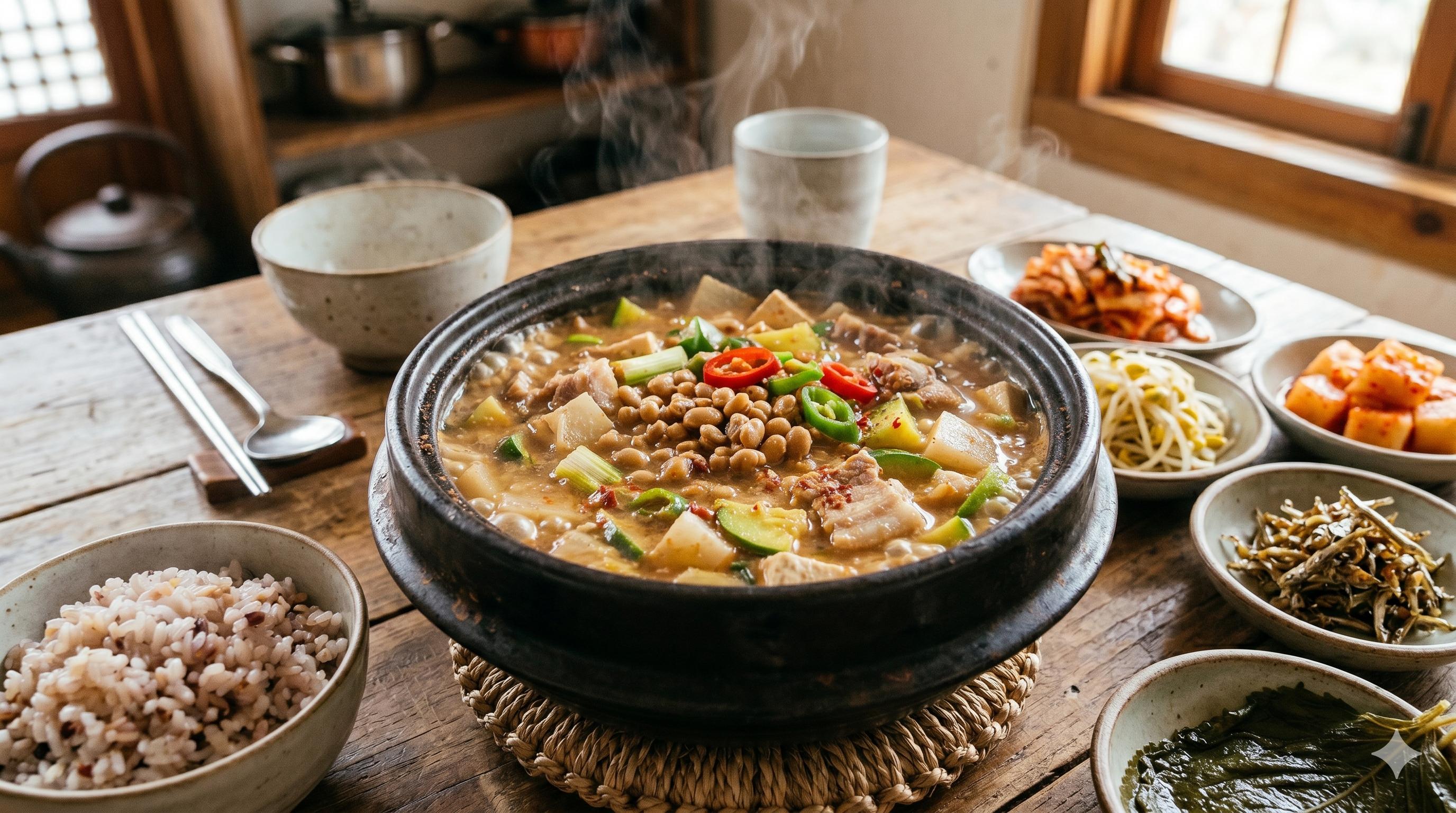
The dominant use of CHEONGGUKJANG in Korean cooking is CHEONGGUKJANG JJIGAE (청국장찌개) — a thick, strongly flavored stew made by dissolving the paste in water or stock, then simmering it with tofu, kimchi, pork, and vegetables. The stew is typically served in a stone bowl that keeps it bubbling at the table. It is considered quintessential cold-weather food: warming, deeply savory, and filling in a way that lighter dishes are not.
Outside of jjigae, CHEONGGUKJANG is used in smaller quantities as a seasoning paste — mixed with garlic and gochugaru to season vegetables or used as a base flavor in certain braised dishes. Some Korean households eat it as a simple condiment alongside rice, similar to how DOENJANG might be used. In recent years, it has also appeared in powdered supplement form, marketed domestically and internationally for its probiotic and nutritional properties.
It is not a universally loved food within Korea itself. Its smell is strong enough that some apartment buildings have informal rules about cooking it during shared ventilation hours. The intensity that makes it nutritionally interesting is the same intensity that limits how widely it travels on a dinner table with mixed company.