
SAEUJEOT (새우젓): The Fermented Shrimp Inside Your Kimchi
In This Article
The Ingredient Nobody Mentions When They Talk About Kimchi
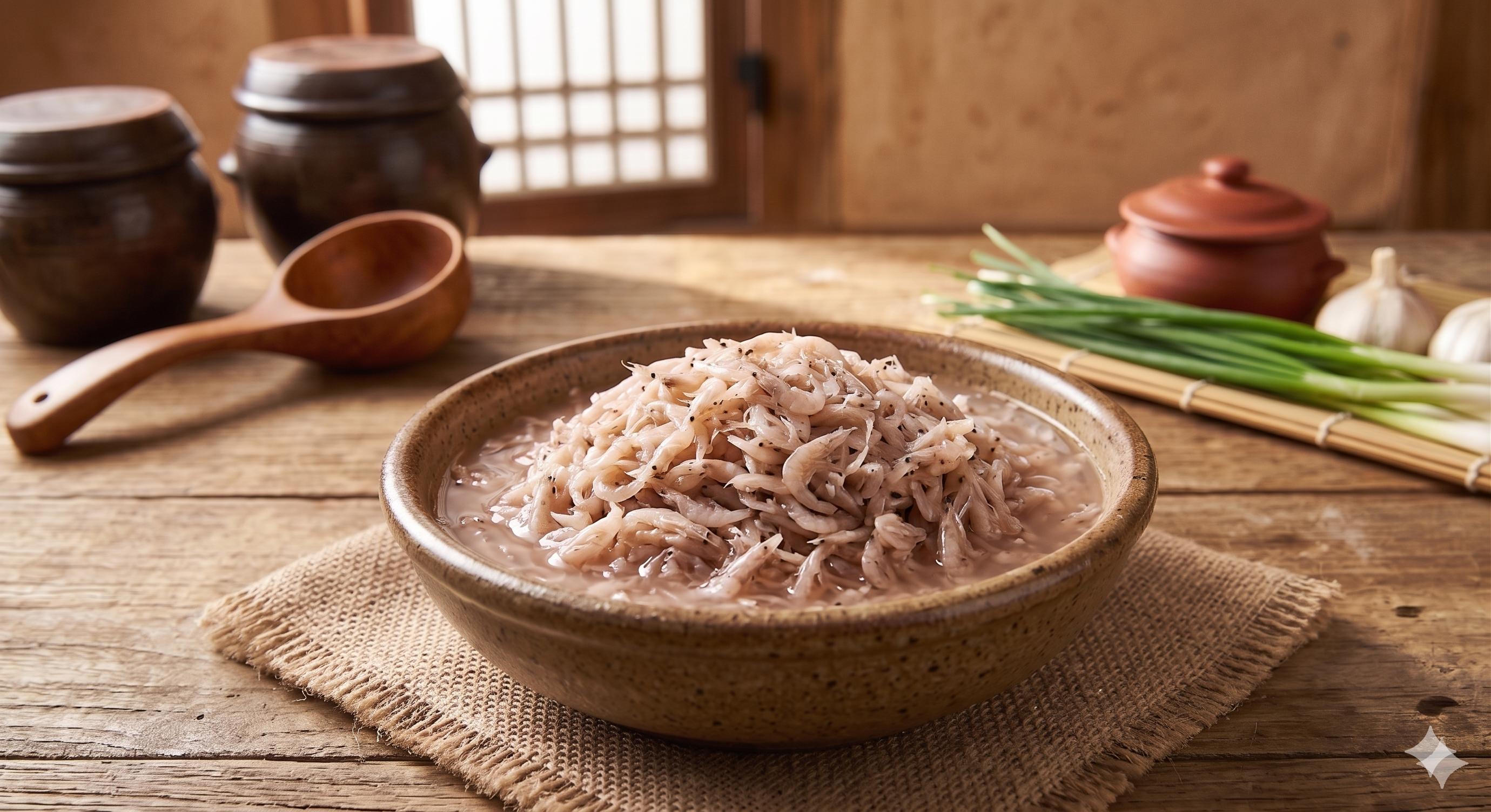
Every explanation of kimchi starts with cabbage, chili, and garlic. Almost none of them lead with SAEUJEOT (새우젓). That is an omission worth correcting. SAEUJEOT — salted and fermented small shrimp — is one of the core ingredients in most traditional kimchi recipes, and one of the primary reasons kimchi tastes the way it does. It is not a background note or an optional addition. It is a structural component that contributes salt, umami, fermentation enzymes, and a depth of flavor that cannot be substituted with anything that has not itself been fermented.
It also happens to be one of the most widely used condiments in Korean cooking outside of kimchi — a fact that surprises most people who encounter it for the first time.
What SAEUJEOT Is
SAEUJEOT is jeotgal made from jeot-saeu (젓새우) — a category of small, thin-shelled shrimp specifically used for fermentation rather than direct eating. These are not the shrimp found in most seafood dishes. They are smaller, softer, and lower in fat, which produces a cleaner, lighter flavor profile than fermented versions of larger shrimp would. The varieties used include joong-ha (중하), jan-saeu (잔새우), and gon-jaengi (곤쟁이), a particularly small crustacean that ferments almost entirely into a smooth paste.
The shrimp are mixed with salt at a concentration of roughly 15 to 40 percent depending on the season and intended storage duration, then left to ferment in cool conditions for two to three months. The result is a paste of whole small shrimp that is intensely salty, faintly sweet, and rich in the free amino acids that give fermented seafood its characteristic savory depth. The color shifts from translucent gray-pink to a settled white or pale pink as fermentation progresses.
How It Is Made
The production method for SAEUJEOT is straightforward but sensitive to timing and conditions. Freshly caught shrimp are mixed immediately with coarse sea salt — in warmer months, salting begins at the point of catch to prevent deterioration before the shrimp reach shore. The salted shrimp are packed into large earthenware or food-grade containers and stored in a cool environment, traditionally underground or in a cellar, where temperatures stay consistently low.
Over two to three months, the shrimp undergo the same dual process of autolysis and microbial fermentation that drives jeotgal production broadly: the shrimp's own endogenous enzymes break down proteins into amino acids, while salt-tolerant bacteria contribute lactic acid and additional flavor compounds. The intestines of the shrimp are not removed before fermentation. If left intact, they contribute to flavor complexity but can also introduce a slight bitterness — a trade-off that producers and home fermenters manage through salt ratio and fermentation time.
Quality is closely tied to the freshness of the raw shrimp, the quality of the salt used, and the consistency of the storage temperature. Korean producers generally consider sea salt from the western coast — particularly from the tidal flats of South Chungcheong Province — to be optimal for saeujeot production, as its mineral profile contributes to flavor in ways that heavily processed salt does not.
The Seasonal Calendar
SAEUJEOT is one of the most seasonally differentiated products in Korean fermentation. The name of each variety reflects the month or season in which the shrimp were caught, and those seasonal differences produce meaningfully different products in terms of size, fat content, texture, and flavor.
YUKJEOT (육젓), made from shrimp caught in June during spawning season, is considered the premium grade. The shrimp are larger and fattier than at other times of year, with visible yellow roe in females. The flavor is richer and more rounded, and it is the preferred variety for kimjang — the annual kimchi-making season in late autumn. Because of its quality and limited seasonal availability, yukjeot commands a higher price than other varieties.
OJEOT (오젓), from May, is considered the second-tier variety — still high quality, with a firm texture and clean flavor. CHUJEOT (추젓), made from autumn shrimp, is the most widely available and most commonly used variety. The shrimp are smaller and leaner than yukjeot, producing a less rich but clean and reliable flavor that works well across a broad range of applications. Most of the saeujeot sold in Korean supermarkets is chujeot. DONGBAEKHA (동백하), made from shrimp caught in February, is pale and clean in flavor, used in applications where a less assertive saeujeot character is preferred.
Gwangcheon: Korea's SAEUJEOT Town
The town most associated with premium SAEUJEOT production in Korea is Gwangcheon (광천), in South Chungcheong Province. Gwangcheon's reputation is built specifically around a production method unique to the region: tunnel-aging (토굴 새우젓, togul saeujeot). The shrimp are fermented and aged inside tunnels carved from weathered rock — a material that naturally generates moisture, creating a stable humidity environment without mechanical intervention. These tunnels maintain a consistent temperature year-round, typically between 13 and 15 degrees Celsius regardless of the season outside.
That temperature and humidity consistency is what separates togul saeujeot from surface-stored saeujeot in a practical, measurable way. Standard saeujeot stored above ground is subject to seasonal temperature swings — fermentation accelerates in summer heat and slows in winter cold, producing uneven flavor development. In the tunnels, fermentation proceeds at a steady pace throughout the year. The result is a cleaner, more nuanced flavor: the shrimp's natural sweetness comes through more distinctly, the saltiness is less sharp, and the overall profile is more balanced than in conventionally stored versions. The same shrimp, the same salt, the same recipe — but the environment changes the outcome. Gwangcheon saeujeot aged in tunnels for around six months before release is considered by many Korean producers and cooks to represent the benchmark for the product.
In December 2024, the Korean Ministry of Oceans and Fisheries designated Gwangcheon's tunnel saeujeot processing as National Important Fisheries Heritage No. 15 — the first time a food processing method, rather than a fishing practice, had received this designation in Korea. The recognition was based on the method's 70-plus-year history, its environmentally distinctive tunnel infrastructure, and the continuity of its transmission across generations. Around 70 percent of producers in the area have inherited the practice from a parent or grandparent, with some families now in their third generation of tunnel fermentation. The designation is not honorary: it comes with government support for preservation, brand development, and documentation of the tradition.
Gwangcheon holds an annual saeujeot and dried seafood festival that draws visitors specifically interested in traditional fermentation. For anyone traveling through South Chungcheong Province, the tunnel storage sites are open to visitors — one of the more unusual food tourism experiences in Korea, and a direct window into a fermentation method that has been running continuously in the same underground spaces for decades.
What It Does Inside Kimchi
SAEUJEOT contributes to kimchi in two distinct ways: as a flavor ingredient and as an active participant in kimchi's own fermentation process. As a flavor ingredient, it adds salt, umami from free amino acids, and a depth that anchors the other seasonings — the gochugaru, garlic, and ginger — without dominating them. The shrimp flavor itself largely disappears into the overall kimchi flavor during fermentation, which is why many people eat kimchi regularly without identifying saeujeot as an ingredient.
As an active fermentation participant, SAEUJEOT contributes enzymes that assist in breaking down the cell walls of the cabbage, accelerating the softening process and contributing to the texture of fully fermented kimchi. The proteolytic enzymes in saeujeot also interact with the proteins in other kimchi ingredients, contributing to the development of the complex flavor profile that distinguishes well-fermented kimchi from a fresh mix of the same ingredients. This is why kimchi made without jeotgal — as in vegan kimchi substitutions — tends to taste different even when other seasonings are matched closely. The enzymatic activity that saeujeot brings to the fermentation environment is difficult to replicate with non-fermented alternatives.
How Koreans Use It Beyond Kimchi
SAEUJEOT has a broader culinary role in Korean cooking than its association with kimchi suggests. It functions as a salt substitute in soups and stews — a small amount added to hobak-guk (애호박국, zucchini soup) or kongnamul-guk (콩나물국, bean sprout soup) in place of salt adds not just salinity but a rounded savory depth that plain salt cannot provide. Gyeranjjim (계란찜), Korean steamed egg custard, is commonly seasoned with saeujeot rather than salt for the same reason.
As a dipping condiment, saeujeot is the traditional accompaniment for bossam (보쌈) — sliced pork belly that is boiled rather than grilled. The combination of lean, tender pork and intensely savory fermented shrimp is one of the more enduring flavor pairings in Korean food. It is also served alongside sundae (순대), Korean blood sausage, in the same dipping role. In this context, saeujeot functions as a seasoning sauce rather than as a food eaten in quantity — a small amount on each bite provides the salinity and flavor that the relatively mild pork or sausage lacks on its own.
Some Korean cooks also use minced saeujeot as a seasoning base in stir-fried dishes, particularly with pork and vegetables, where its fermented character adds depth without the liquid that fish sauce would introduce. High-quality yukjeot is occasionally eaten directly as a banchan — seasoned with gochugaru, sesame oil, and minced garlic, served in small amounts alongside rice.
One Thing to Know Before You Eat It
SAEUJEOT is a crustacean product. This matters because shellfish allergies are among the more common food allergies globally, and saeujeot is embedded invisibly in kimchi and many Korean dishes in ways that are not always apparent from a dish description. People with crustacean allergies who eat kimchi without awareness of its ingredients have experienced allergic reactions — not from the kimchi itself, but from the saeujeot within it.
This is worth noting not as a reason to avoid saeujeot, but as a reminder of how deeply it is integrated into Korean food. An ingredient present in such a wide range of dishes — from kimchi to soups to dipping sauces to steamed egg — is not a minor addition. It is part of the flavor infrastructure of Korean cooking in a way that most diners and many food writers do not fully account for. Understanding what saeujeot is and what it does is, in a meaningful sense, part of understanding what Korean food actually tastes like and why.