
Why Korean Scholars Wore Hats With Hanging Strings
In This Article
The Hidden Story of Gat Strings in the Joseon Dynasty: How a Small Ornament Carried Great Meaning
When people think of traditional Korean clothing, one of the first things that comes to mind is the gat. With its wide, black brim, this hat is often seen as a symbol of Joseon-era scholars.
However, people at the time did not always focus on the hat itself. Instead, their attention often rested on a small detail that gently moved beneath it—the gat string.
In the Joseon Dynasty, a “scholar” was not just a profession, but a social class that was expected to embody learning, morality, and a refined sense of dignity. And that dignity had to be expressed not only through behavior or speech, but also through subtle details in clothing.
What makes this even more interesting is that this traditional element has recently reappeared in entirely different forms. For example, in modern animated works such as KPop Demon Hunters, the gat is visually reinterpreted, drawing renewed attention to this historical design.
The Gat Was Not Just a “Black Hat” — It Was a Visual Design Device
In reality, the gat was a far more sophisticated object than it appears. There were different types depending on form and purpose, but what mattered most was not the name or color—it was the texture and silhouette.
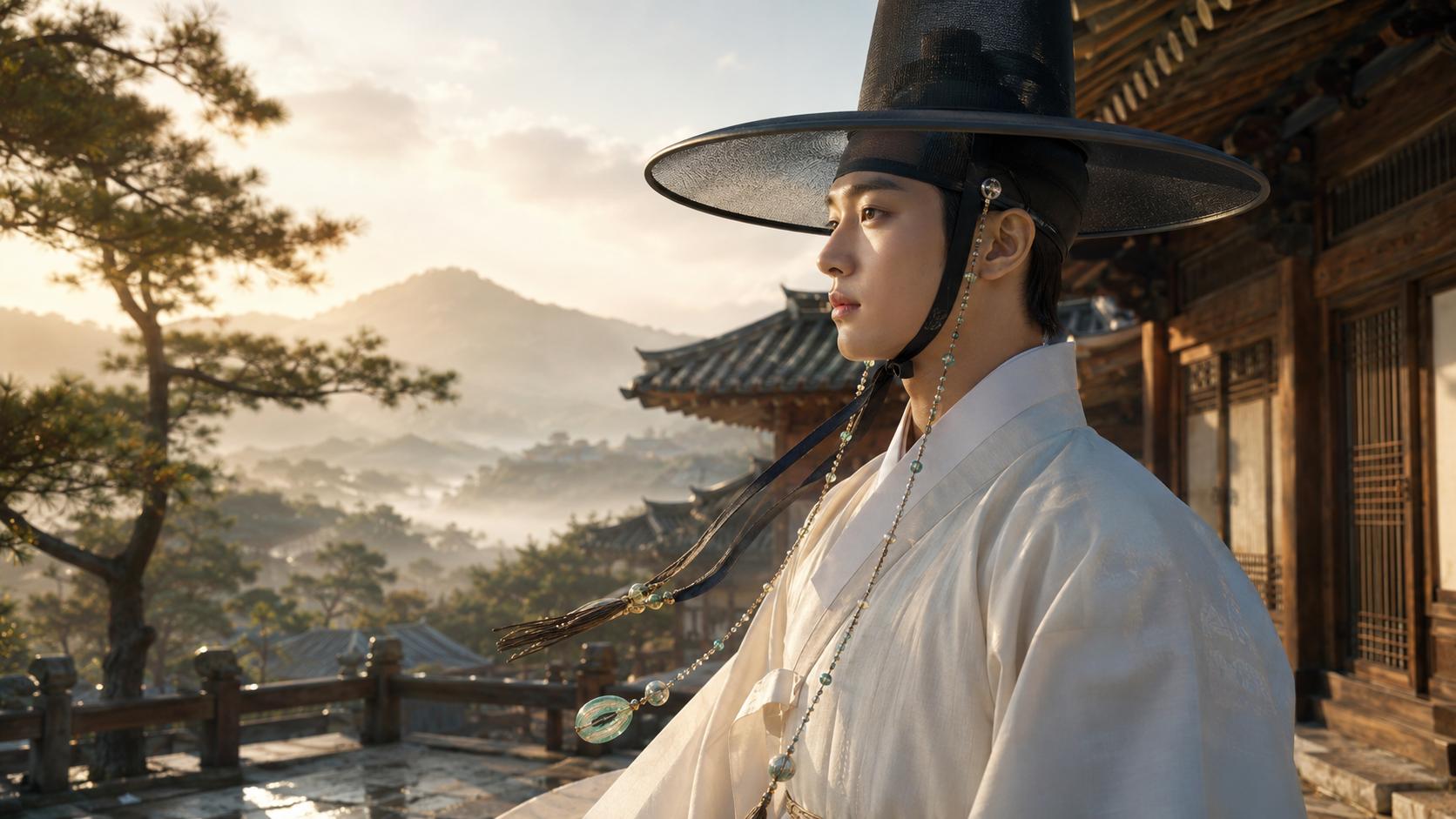
The gat had a subtle sheen, and when it caught the light, its fine surface texture became visible. It was not a static object, but rather a visual element whose atmosphere changed as it moved.
When the gat string was added, the entire visual scene changed completely.
A silk string would gently sway in the wind, while a jade ornament attached to its end would briefly catch the light and shimmer. In that split second, the viewer’s gaze would naturally drop—not toward the face, but downward.
The gat string was not merely a fastening tool. It was a deliberately designed element of subtle motion meant to guide attention.
Gat Strings as a Form of Information
A gat string was not simply a cord used to secure the hat. Depending on its material and decoration, it could subtly reveal the wearer’s social status, taste, and economic standing.
Even when wearing the same gat, the impression changed completely depending on the string.
* Silk cords: simple yet refined
* Jade ornaments: symbols of authority and dignity
* Metal decorations: expressions of wealth and presence
* Knot craftsmanship: a display of artisanal skill
Jade, in particular, was not merely decorative. In East Asian culture, it was valued for its hardness and pure color, symbolizing moral integrity, authority, and refined character.
More importantly, it was not just the material itself, but how it interacted with light. Jade reflected a cool glow under sunlight, while metal caught the eye in an instant. In this sense, gat strings functioned as a kind of “moving visual effect.”
A Culture of Detail Hidden in Men’s Fashion
Modern men’s fashion tends to favor simplicity in accessories. However, during the Joseon Dynasty, even the smallest string carried both aesthetic and symbolic meaning.
A gat string was not just decoration—it was information about the person wearing it.
Without saying a word, the length of the string, the knot style, and the presence or absence of decoration could all express one’s identity and social position.