


Dwaeji Gukbap(돼지국밥): Busan’s Real Soul Food
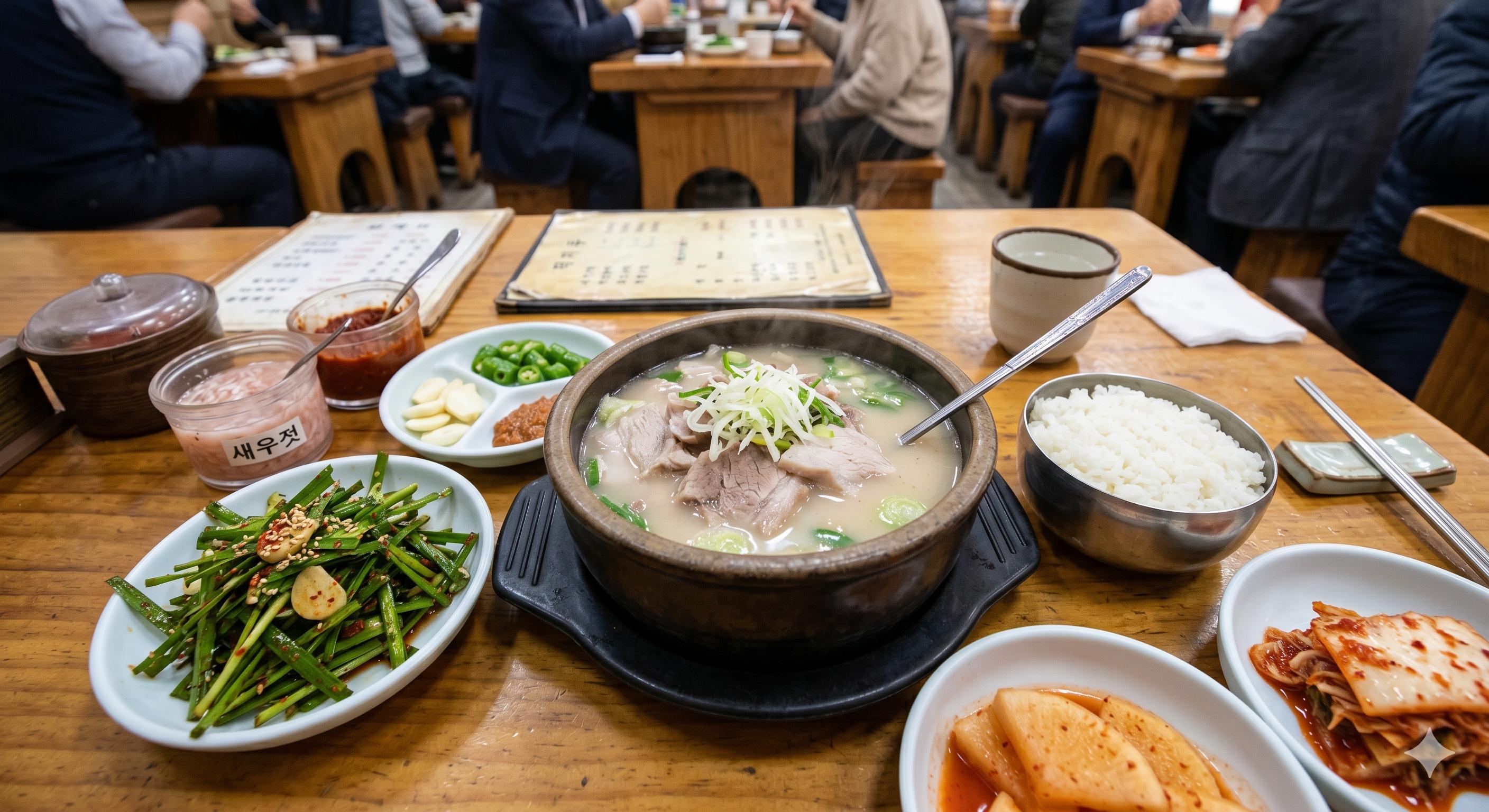
Dwaeji gukbap (돼지국밥) is pork bone soup with rice, and it belongs to Busan the way clam chowder belongs to Boston or ramen belongs to Sapporo.
In This Article
Busan has beaches, a film festival, and a port. But ask a local what defines the city, and they will say the soup.
Dwaeji gukbap (돼지국밥) is pork bone soup with rice, and it belongs to Busan the way clam chowder belongs to Boston or ramen belongs to Sapporo. Every city in Korea has its version of gukbap. Only Busan's has this kind of loyalty. Locals eat it for breakfast, after a night out, before a long shift, and whenever they need something that feels like home. The bowl itself is straightforward. Everything around it is not.
What makes it Busan's
The origins of dwaeji gukbap trace back to the Korean War, when Busan served as the wartime provisional capital and hundreds of thousands of refugees settled in the city. Feeding large numbers of people with limited ingredients produced a cuisine built on maximizing what was available. Pork bones, which were cheap and abundant, became the base for a broth that could feed many people from a single pot. The style that emerged from that period is what Busan still serves today.
The broth
The defining characteristic of Busan dwaeji gukbap is its broth. Unlike the clear, lighter broths found in other Korean soups, the broth here is milky white and opaque — the result of boiling pork bones at a high temperature for several hours until the collagen and fat fully emulsify into the liquid. The flavor is deep, slightly fatty, and distinctly porcine. It is not subtle. First-time visitors sometimes find it intense. Regulars find everything else mild by comparison.
Toryeom: the technique that makes it
One aspect of dwaeji gukbap that rarely gets explained to visitors is toryeom (토렴), the method used to serve it. Rather than simply ladling broth over cold rice, the cook ladles hot broth over the rice repeatedly, pouring it back into the pot between each pass, until the rice reaches the right temperature and texture. The rice absorbs the broth gradually without becoming waterlogged. The result is a bowl where rice and soup are fully integrated rather than simply combined. It is a small distinction that makes a significant difference in how the bowl eats.
The three condiments
Dwaeji gukbap arrives intentionally under-seasoned. The kitchen does this deliberately. The condiments on the table are not garnishes — they are part of how the dish is built, and the correct combination is a matter of personal preference that every regular has strong opinions about.
Saeujeot (새우젓) is salted fermented shrimp, the primary seasoning for dwaeji gukbap. A small spoonful stirred into the broth brings out depth and umami without making the soup visibly different. Most Busan locals use it as their baseline seasoning before anything else. The flavor is concentrated, so a little goes a long way.
Dadaegi (다대기) is a thick paste of ground chili, garlic, and fermented seafood. Adding it to the bowl shifts the entire character of the soup — the broth turns reddish, the heat builds, and the flavor becomes more aggressive. Some diners add a large spoonful. Others add just enough to notice. A few skip it entirely. There is no correct answer, only preference.
Jeonguji-muchim (정구지무침) is seasoned chive salad, and it is the side dish that defines a Busan dwaeji gukbap table. Jeonguji is the Busan dialect word for chives — in standard Korean they are called buchu, but in Busan, the local word is used without exception. The chives come seasoned with chili powder and, depending on the restaurant, mixed with fermented fish sauce or kept light to preserve the clean, sharp flavor of the chive itself. Most diners pile a generous amount directly on top of the rice before stirring everything together. The combination of fatty pork broth, savory chive, and heat from the seasoning is what makes dwaeji gukbap taste the way it does.
How to eat it
The standard sequence is this: taste the broth first, without adding anything. Then add saeujeot gradually until the seasoning feels right. Add dadaegi if heat is wanted. Pile jeonguji-muchim on top and stir it into the rice and broth together. From that point, the bowl is yours. There is no single correct way to eat it, but starting with the broth unseasoned allows you to understand what the kitchen has built before adjusting it.
The menu beyond the bowl
Most Busan dwaeji gukbap restaurants offer more than one configuration. The standard bowl comes with sliced pork. Ordering with sundae (순대, Korean blood sausage) or naejang (내장, offal) is common, and many restaurants allow combinations: meat and sundae, meat and offal, or all three together. Yukbaekban (육백반) — broth and rice served separately with the meat on the side — is another option for those who prefer to control the ratio themselves. These are not unusual requests. They are standard menu items that regulars order without thinking.
Why it tastes different here
Dwaeji gukbap exists outside of Busan. It can be found in Seoul, in other cities, in restaurants that advertise the Busan style. It rarely tastes the same. Part of this is the water, part is the sourcing of the pork, and part is simply the accumulated knowledge of restaurants that have been making the same broth for decades. The oldest dwaeji gukbap restaurants in Busan have been operating continuously since the 1950s and 1960s. The broth they serve has been refined over thousands of iterations. That kind of depth does not travel easily.