


Korean That Koreans Can't Understand
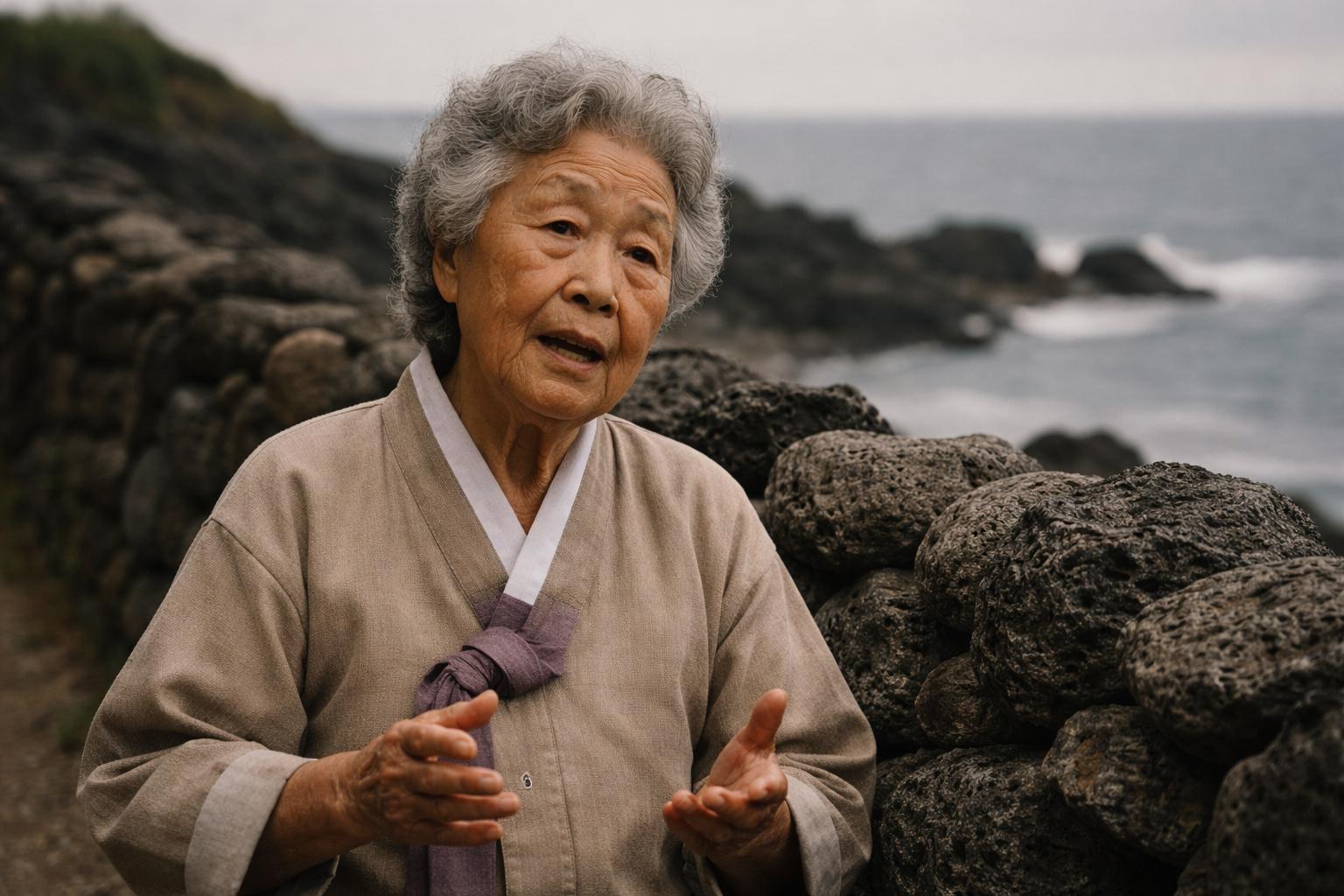
When Typhoon Maisak struck Jeju in 2020, JTBC News aired an interview with a local evacuee.
In This Article
From a Typhoon Interview to a Meme — Why Jeju's Dialect Sounds So Different
When Typhoon Maisak struck Jeju in 2020, JTBC News aired an interview with a local evacuee. An elderly woman named Kim Jeong-ja began speaking on camera. Subtitles appeared on screen, but viewers on the mainland had trouble even verifying whether the subtitles matched what she was actually saying. It was Korean — and yet almost none of it was comprehensible.
The Line That Became a Meme
Someone clipped the interview segment and uploaded it to YouTube under the title "Jeju dialect you cannot understand." The video caught the algorithm. In the comments, people began transcribing what they heard — mixing in English wherever their ears filled in the blanks. One comment read: "쾅 하는 소리에 아이구 배가 터져게 빛나여 거덕인지도 몰르구 여기에 나 would like hater top one For the chuck wonder like station 동네사람들." It meant nothing, but people responded: "That's exactly what it sounds like." The comment spread.
A remixed version of the interview set to a hip-hop beat — titled "Grandma's Killing Verse, Live" — started circulating. Impression videos followed. Parody versions featuring politicians appeared. Rappers Zico and Moon Sang-hoon reenacted the interview on YouTube. Kim Jeong-ja eventually appeared in a GS25 advertisement. A single clip from a typhoon disaster report had become a cultural moment.
Why Does It Sound So Different?
There are historical reasons why Jeju's language diverged so far from mainland Korean. For centuries, Jeju's geographic isolation as an island meant it developed linguistically on its own, largely cut off from the mainland. While Korean on the mainland continued to evolve over time, Jeju's language did not follow the same path. As a result, Jeju dialect retains significant traces of Middle Korean — forms of the language that disappeared from standard Korean long ago.
The most striking example is the vowel arae-a (ᆞ), a sound that no longer exists in modern Korean but is still used in Jeju speech. The vocabulary is different too. "Tree" is nang, "horse" is mol. Intonation patterns differ. Sentence structures differ. Linguists debate whether Jeju speech should be classified as a dialect of Korean or as a separate language altogether. UNESCO designated it a critically endangered language in 2010.
Even Jeju Locals Can't Always Follow It
What makes this more than just a mainland curiosity is that younger Jeju residents are increasingly unable to understand their own grandparents' speech. The spread of standardized Korean through public education, television, and the internet — combined with more frequent movement between Jeju and the mainland — has steadily diluted the dialect. Two people from Jeju meeting in Seoul for the first time will typically default to standard Korean with each other.
There is a well-known story about a Seoul-born coast guard officer newly posted to Jeju who received a phone call and couldn't understand a word of it. He had to ask a colleague from Gyeongsang Province — who had been stationed in Jeju for two years — to interpret. The call turned out to be a casual check-in from a local.
A Dying Language Being Consumed as Content
Paradoxically, as Jeju's dialect edges toward extinction, it has begun to take on a second life as content. The YouTube channel Mworaenghaman — built around Jeju dialect skits and explanatory videos — has accumulated 200,000 subscribers. The format works because people outside Jeju tune in precisely to ask: "What does that even mean?" On TikTok, videos of Jeju dialect clips rack up comments like "this sounds like rap" and "this sounds like English."
Kim Jeong-ja was drawn back into this wave too. In 2022, a Jeju-based YouTube channel brought her in to watch the various parody videos that had been made in her honor. It was reportedly the first time she learned she had become famous.
A Language Being Documented Before It Disappears
Organizations including the Jeju Language Preservation Society continue efforts to document and protect Jeju's dialect. A Jeju-language translation of The Little Prince — titled Durin Wangja — has been published. But the reality is stark. The people who speak Jeju dialect fluently in daily life are concentrated almost entirely among the elderly, and their numbers are shrinking quickly.
The typhoon interview meme did, in its own way, generate genuine interest in the language. What started as a joke — people puzzling over a clip they couldn't decode — is also evidence of something more significant: just how independently this language survived. The fact that Korean speakers find it incomprehensible is, in a way, proof of how far it traveled on its own.