


The Painting Always Behind the Korean King's Throne — What Is Irwolobongdo (일월오봉도)?
Foreign viewers watching Korean historical dramas on Netflix and global OTT platforms often leave the same question:

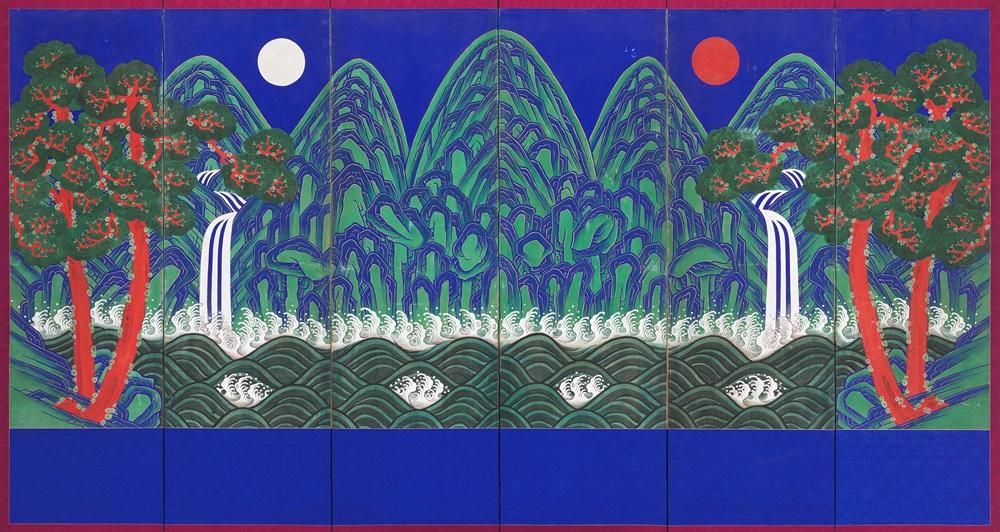
This work used “Irworobongdo Folding Screen (Changdeok 6416)”, which was opened to the public under the Korea Open Government License Type 1 by the Royal Palaces and Tombs Center of the Korea Heritage Service. The original material can be downloaded free of charge from the website of the National Palace Museum of Korea.
In This Article
The Painting Foreign Viewers Always Ask About
Foreign viewers watching Korean historical dramas on Netflix and global OTT platforms often leave the same question:
“What is that painting always placed behind the king’s throne?”
The image is unmistakable — the sun and moon floating together in the sky, five mountain peaks rising in the center, and waves crashing below. The folding screen is known as Irworobongdo (일월오봉도), literally meaning “The Sun, Moon, and Five Peaks.”
Today, it has become one of the most recognizable visual symbols of Korean kingship for global audiences.
Wherever the King Was — In Life and Death
During the Joseon Dynasty (1392–1897), kings placed Irworobongdo not only behind the royal throne inside palace halls, but anywhere the king temporarily stayed during ceremonies, processions, or official events.
Its role extended beyond the king’s lifetime.
The screen was also installed inside the binjeon — the temporary hall holding the king’s coffin during royal funerals — as well as the honjeon, where royal spirit tablets were enshrined, and jinjeon halls housing royal portraits.
Even after death, the screen visually preserved the authority and symbolic presence of the king.
According to artifact records from the National Palace Museum of Korea, surviving Irworobongdo folding screens can reach dimensions of 195.4 × 359.8 cm in six-panel format.
A Painting Completed Only by the King
The composition appears flat and strictly symmetrical.
The red sun symbolizes yang energy, while the white moon represents yin, together expressing cosmic balance. The five mountain peaks signify the center of the kingdom, while pine trees and waves symbolize permanence and continuity.
But the most important element is structural.
The image is only “completed” when the king sits on the throne in front of it. The king becomes the central axis of the composition itself — a visualization of the Confucian political philosophy that the ruler stands at the center of the universe.
Historians note that Joseon uniquely fixed this specific image permanently behind the king’s seat as an official symbol of royal authority.
Why It Was Made as a Folding Screen
Irworobongdo was primarily produced in folding-screen format for practical reasons.
Folding screens could be moved and installed easily. Inside wooden palace architecture, they also blocked wind and divided interior space.
Because the king frequently moved between ceremonies and palace buildings, folding screens allowed the symbolic backdrop of kingship to be instantly recreated anywhere.
Royal protocol books known as Uigwe (의궤) contain numerous records documenting the installation of Irworobongdo during state ceremonies.
Related references also appear in the 1904 royal construction record Gyeongungung Junggeondogam Uigwe.
How K-Dramas Turned It Into a Global Icon
The global expansion of K-dramas and OTT platforms dramatically increased international recognition of Irworobongdo.
Because the screen repeatedly appears behind kings in historical dramas, many foreign viewers now immediately associate it with Korean royal authority.
The image has even begun appearing in modern interior design reinterpretations.
Museum visitors have also reported seeing foreign tourists recognize the screen from Korean banknotes and historical dramas before seeking out the actual artwork at the National Palace Museum of Korea.
Interest increased further after viewers connected the imagery to the visual stage background used in the animated film KPop Demon Hunters.
Where to See the Real Screen
Original Irworobongdo folding screens can be viewed at the National Palace Museum of Korea inside the “Royal Court of Joseon” exhibition hall on the second floor.
Admission is free.
Opening Hours
- Monday–Friday, Sunday: 09:30–17:30 (Last admission 17:00)
- Saturday and the last Wednesday of each month: 09:30–21:00 (Last admission 20:30)
- Closed: January 1, Lunar New Year Day, Chuseok Day, and the last Monday of each month
English, Japanese, and Chinese guided tours for foreign visitors operate on weekdays between 1 PM and 3 PM.
Visitors gather in front of the information desk in the second-floor lobby.
The museum is accessible on foot from Gyeongbokgung Station (Line 3).