


HOTTEOK(호떡): The Korean Market Snack Nobody Leaves Without
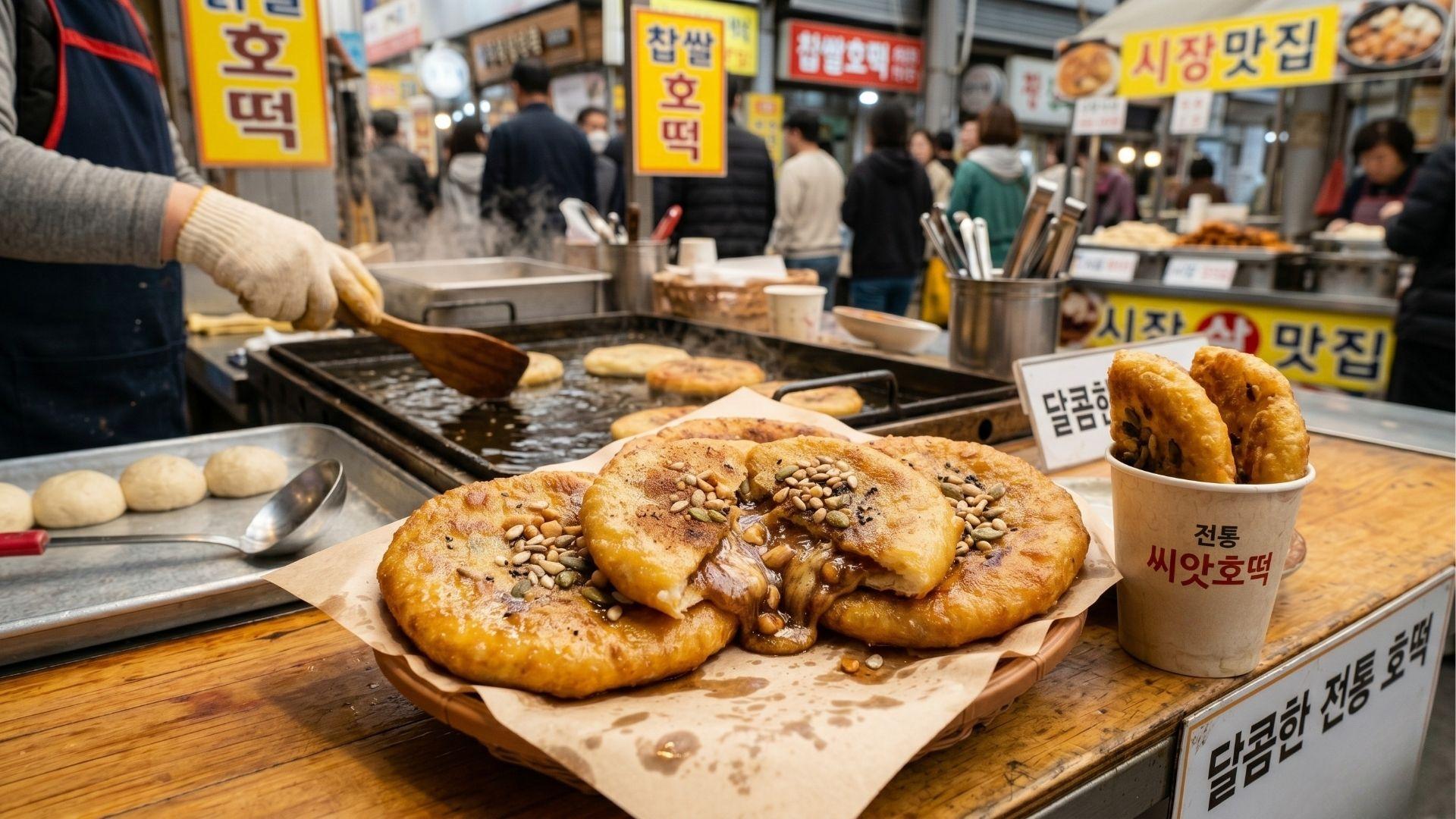
Walk through any Korean traditional market on a cold day and you will smell it before you see it. That warm, caramel sweetness rising from a street cart is HOTTEOK (호떡)…
In This Article
Walk through any Korean traditional market on a cold day and you will smell it before you see it. That warm, caramel sweetness rising from a street cart is HOTTEOK (호떡) — a fried pancake stuffed with melted brown sugar, and one of the most nostalgic street foods in Korea.
The Snack Every Korean Knows
Ask any Korean about their market memories and hotteok will come up. It is the food people reach for before they even start browsing the stalls. Not after lunch, not as an afterthought — hotteok comes first.
Hotteok is not a sit-down food. You eat it standing, holding it in a small paper cup or foil wrapper, switching it between hands because it is too hot to hold in one place for long. That slight inconvenience is part of the ritual. Nobody complains.
It takes about two minutes to make. And yet for most Koreans, no trip to a traditional market feels complete without one.
Where Hotteok Came From
Hotteok did not originate in Korea. In the 19th century, Chinese merchants migrating to the Korean Peninsula during the late Joseon Dynasty brought with them a savory wheat cake filled with beef and onions. Koreans encountered it, liked the concept, and changed everything about the filling.
The name itself reflects this history. HO (호, 胡) is a Chinese character that historically referred to people from the north and west — in this context, the Chinese traders who introduced the food. TTEOK (떡) refers to the soft, chewy texture of the dough. The name itself tells the story: a food that came from outside and became Korean.
The savory original became a sweet street snack. The beef filling was replaced with brown sugar, cinnamon, and nuts. That transformation — taking something foreign and adapting it entirely to local taste — is a pattern that repeats throughout Korean food history.
What Is Actually Inside
The classic hotteok filling is brown sugar, cinnamon, and crushed nuts — usually peanuts or walnuts — mixed together and sealed inside a ball of yeasted wheat dough. When pressed flat on a hot oiled griddle, the sugar melts completely and turns into a thin, molten syrup that pools at the center of the pancake.
The outside becomes golden and slightly crispy. The inside stays soft and chewy, with a liquid sugar center that flows the moment you bite through. The heat of the filling is intense enough to burn your tongue if you are not careful. Most people bite carefully anyway and do it again immediately.
The vendor uses a round metal press to flatten the dough ball on the griddle — that pressing motion is one of the most familiar visual signatures of a hotteok cart. Anyone who has watched it happen knows exactly what is coming next.
The Sound, the Steam, the Wait
The reason hotteok is so deeply tied to traditional markets is the full experience around it. The sizzle when the dough hits the oiled pan. The press coming down. The steam rising in cold air. A short line of people waiting with their hands already reaching for their wallets.
Hotteok is strongly associated with winter. The molten filling stays warm long after leaving the griddle, and holding the paper cup with both hands functions almost like a hand warmer. The cold makes the steam more dramatic. The contrast between the temperature outside and the heat of the pancake is part of the appeal in a way that does not translate to warmer weather.
Some of the most famous hotteok carts in Korea have lines that stretch down the street. Namdaemun Market in Seoul is known for its hotteok vendors, where waiting 20 to 30 minutes for a single pancake is considered completely normal.
Ssiat Hotteok: The Busan Version
Busan developed its own version called SSIAT HOTTEOK (씨앗호떡) — seed hotteok. The Busan style is deep-fried instead of pan-fried, then sliced open and filled with a generous heap of mixed seeds and nuts: sunflower seeds, pumpkin seeds, peanuts, walnuts, and pine nuts.
The result is crunchier, nuttier, and more substantial than the classic version. It became nationally famous after appearing on a popular Korean television program, and Busan's GUKJE MARKET (국제시장) became one of the most visited hotteok destinations in the country as a result.
Today both versions coexist at markets across Korea. Choosing between them is one of the small decisions that makes a market visit feel personal.
Why Koreans Still Line Up for It
Hotteok has been available at Korean markets for well over a century. It has not been reinvented or modernized into something unrecognizable. The basic recipe — dough, sugar, heat — has stayed almost exactly the same.
That consistency is part of why it works. Hotteok is one of those foods where the expectation and the experience always match. You know exactly what you are getting, and that reliability is its own form of comfort.
For Koreans who grew up eating it at markets with their parents or grandparents, hotteok carries accumulated memory in a way that newer foods simply cannot. Eating one at a market stall as an adult feels like standing in the same spot you stood in as a child. The cart may be different. The hands holding it are older. The taste is exactly the same.