


Haenyeo (해녀): The Breath of Jeju's Women Who Have Guarded the Sea for Centuries
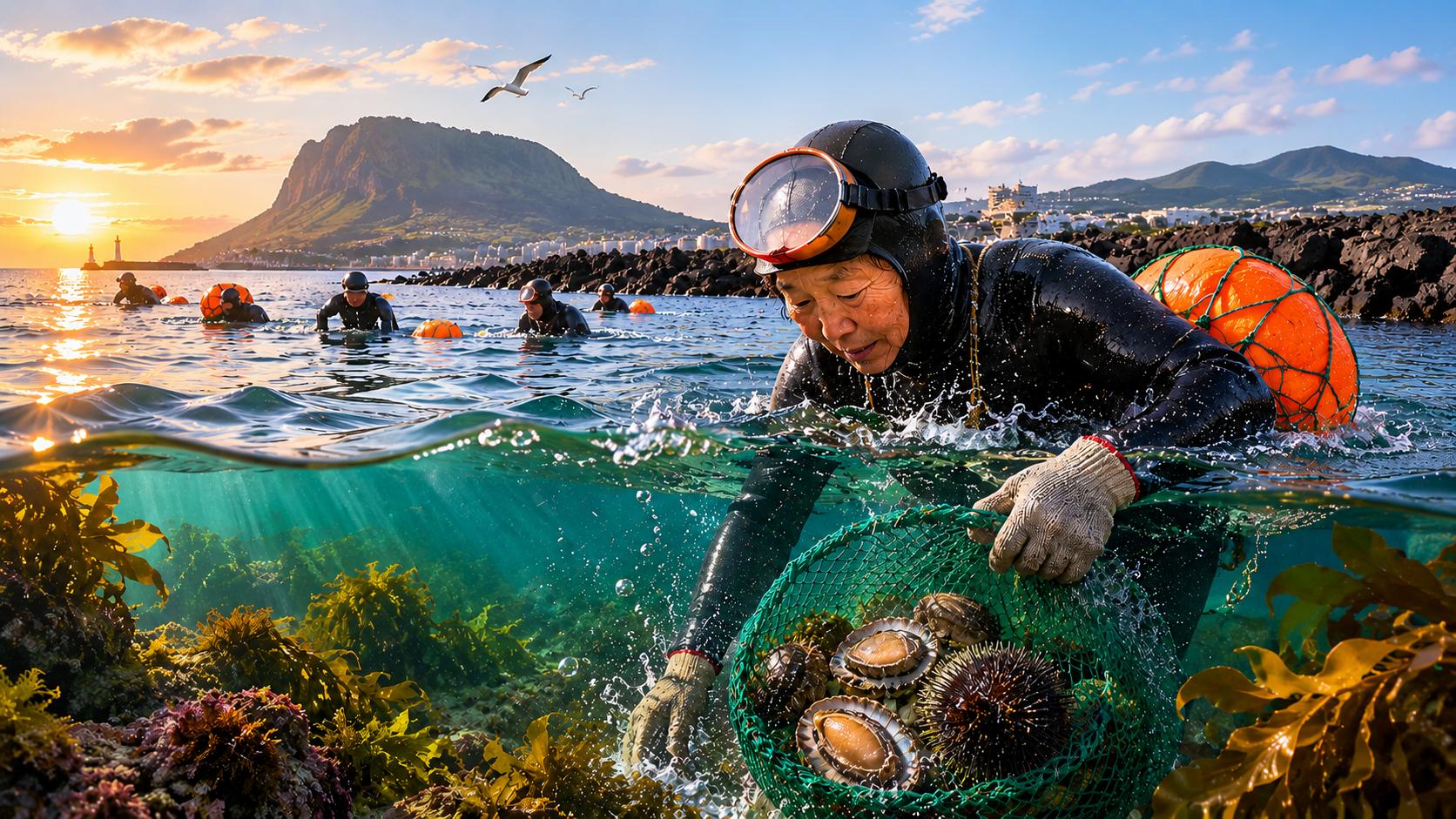
One of the most remarkable sights for foreign travelers visiting Jeju Island is seeing women diving into the ocean without any specialized equipment.
In This Article
The Art of Coexisting with the Sea
One of the most remarkable sights for foreign travelers visiting Jeju Island is seeing women diving into the ocean without any specialized equipment. They are the Haenyeo.
With only a rubber wetsuit and goggles, they navigate depths of up to 10 meters to harvest abalone, sea urchins, and shellfish. Even those in their 80s remain active. Each dive involves holding their breath for about a minute, and they spend up to 7 hours a day, 90 days a year, at sea.
The most crucial element is the "Sumbisori." This unique whistling sound, made by exhaling the breath held underwater all at once upon reaching the surface, is a signal that the Haenyeo is alive and a breathing method they developed to push their limits while adapting to nature.
They do not harvest seafood indiscriminately. They have created and followed self-imposed rules to take only what is needed, returning small abalones or young conch back to the sea. The most primitive model of "sustainable living"—a concept highly emphasized in modern society—has existed in the Jeju sea for centuries.
Female-Led Community and Economic Independence
Jeju's Haenyeo culture is particularly special because it is centered around women. Haenyeo are categorized into "Hagun," "Junggun," and "Sanggun" based on their diving ability, with the most experienced "Sanggun" Haenyeo leading the others.
They have managed their own organizations centered around fishing village associations, Haenyeo associations, and Haenyeo schools, passing down knowledge and skills to younger generations.
They gathered in communal spaces called "Bultteok" to check on each other's safety and decide on major village affairs. This female-led decision-making structure and economic self-reliance were rare forms in Korean society at the time.
The Jeju Special Self-Governing Province has designated this culture as an official symbol representing Jeju and the spirit of its people. Haenyeo culture is a living record showing that the history of Jeju women is, in fact, the history of Jeju itself.
Why Focus on Haenyeo Now?
Since its inscription on the UNESCO Representative List of the Intangible Cultural Heritage of Humanity in 2016, Haenyeo have received global attention. However, the numbers tell a different story.
As of 2024, the number of registered Haenyeo is 2,623, a 27.4% decrease over four years from 3,613 in 2020. Over 90% are elderly, with 60.8% aged 70 or older and 28.9% in their 60s, while there are only 6 people under the age of 30.
Nevertheless, the reason Haenyeo culture is receiving more attention today is that its values align precisely with the demands of the times. Their fishing method of coexisting without exploiting nature is close to the answer sought in the era of climate crisis. Their way of community self-governance has functioned longer than any other system.
The story of the Haenyeo resonates deeply because it is a living culture that is still breathing and working in the sea, rather than a history stuffed in a museum.
Lessons from the Jeju Sea
If you meet a Haenyeo while traveling in Jeju, I hope you go beyond just observing their labor and think about the values they have protected. How to handle one's breath, how to cooperate with a community, and how to deeply connect with nature—Haenyeo culture poses fundamental questions about "how to live."
If you are planning a trip to Jeju, consider visiting the Haenyeo Museum or walking through the fishing villages where their lives are ingrained. The short yet intense "Sumbisori" they exhale will leave a deep resonance in your journey.