


Korea's Fruit Mousse Obsession: The Cake That Looks Too Real to Eat
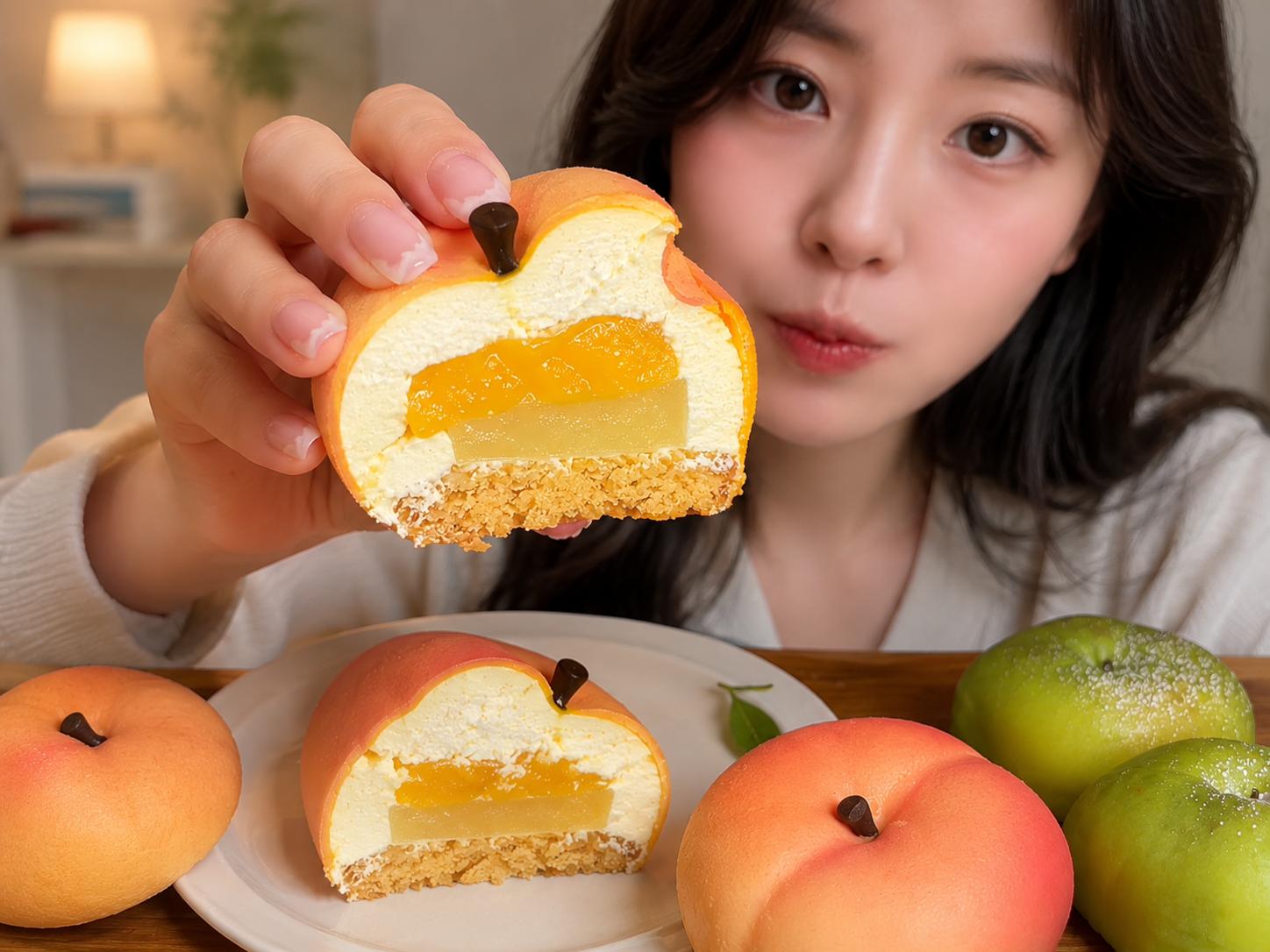
You set it on the table. It looks like a peach.
AI-generated image
In This Article
You set it on the table. It looks like a peach. A perfect, slightly blushed, entirely convincing peach. Then you press your thumb into it, the chocolate shell gives way with a sharp crack, and the whole illusion collapses into mousse. That is the entire experience. And apparently, that is enough to make people line up for hours.
A Dessert That Fools Your Eyes First
Fruit mousse cakes — desserts molded and painted to look indistinguishable from real fruit — have taken over food content across TikTok, Instagram Reels, and YouTube Shorts. The format is consistent: someone places what appears to be a mango, a strawberry, or a cherry on a plate, then cracks through the outer shell to reveal layers of mousse, jam, and cake inside. The reveal moment drives the view count. In Seoul, certain bakeries are now operating waitlists and daily sell-out limits. The product is not cheap. The line does not shorten.
The Chef Behind the Obsession
The origin of this trend traces back to one person. CEDRIC GROLET (세드릭 그롤레) is a French pastry chef and executive pastry chef at Le Meurice in Paris, known internationally for his TROMPE L'OEIL (트롱프뢰유) creations — a French term meaning "deceives the eye." Grolet has spent years sculpting desserts that look exactly like their source fruit: a lemon that tastes entirely of lemon, a hazelnut with flowing praline inside, a fig whose exterior mirrors the texture and color of the real thing. He was named best pastry chef in the world multiple times by Les Grandes Tables du Monde. In May 2024, a single TikTok video of Grolet assembling his fruit pastries accumulated over 117 million views. The internet had found its next food obsession.
What's Actually Inside
The construction of a fruit mousse cake is more involved than it looks. The outer shell is made from white chocolate and cocoa butter, molded into the shape of a specific fruit using a silicone mold, then airbrushed or spray-coated to replicate the color and surface texture of the real thing — right down to the soft gradient of a ripe peach or the deep red of a cherry. Inside sits a layer of airy mousse, typically built around the flavor of the fruit being imitated, along with a fruit jam or compote core and a thin sponge cake base. The whole thing is kept frozen until just before serving, which is part of why the crack sounds the way it does.
Why TikTok Made This Explode
Grolet's fruit desserts existed long before TikTok, but the platform gave them something a Parisian pastry counter could not: infinite reach and a format built for the reveal. The crack of the shell, the cross-section showing layers of mousse and fruit, the moment the dessert stops being a fruit and becomes a cake — these are short, satisfying, repeatable clips that the algorithm rewards. Bakers in Los Angeles, Berlin, Singapore, and Seoul began producing their own versions, tagging them with Grolet's name whether or not they had trained under him. The trend spread faster than any traditional media coverage could have managed.
How Korea Made It Its Own
In Korea, the fruit mousse trend arrived and immediately connected with an existing culture around ASMR (에이에스엠알) food content and the growing appetite for desserts that function as experiences rather than just food. The crunch of the chocolate shell — described in Korean as WAGWAJAK (와그작), an onomatopoeia for that specific crisp-breaking sound — became the hook. Tteok-kal, the national bakery chain, launched its own version under the name the AGWAJAK SERIES (아그작 시리즈) at its flagship store in central Seoul, packaged in fruit-shaped boxes and priced around 50,000 won for a set. The product sold out daily. Open-run videos — clips of people arriving before opening time to secure a unit — spread across TikTok and Instagram within days of launch.
The Crack Is the Point
What the fruit mousse cake captures is something the food industry has been circling for a while: the idea that a dessert is no longer just something you eat, but something you perform. You crack it, film it, share it. The food itself is the content. A Tteok-kal spokesperson described the trend directly, noting that the ASMR quality and the gap between the exterior and interior were driving organic sharing among younger consumers. That gap — the object that looks like one thing and reveals itself as another — is the entire appeal. It is not a particularly complex idea. But in a format where three seconds of screen time determines whether something gets seen, simplicity is not a weakness.