


The Maritime Polity: What Was "탐라국 (Tamna-guk)" Like?
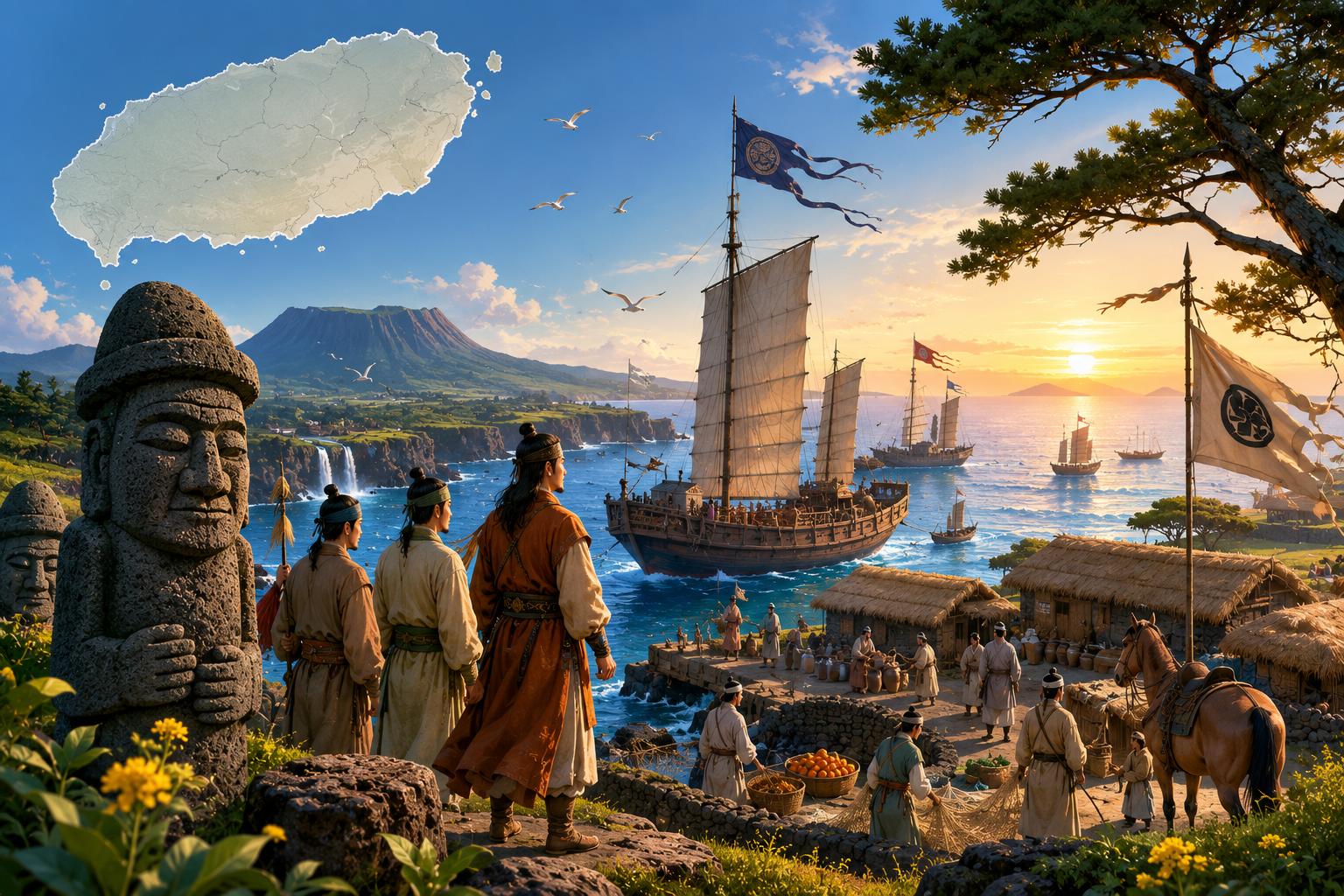
Jeju Island is one of Korea's most beloved travel destinations—but fewer than a thousand years ago, it was an independent maritime kingdom with its own language, culture, and diplomacy. This is the story of Tamna, the ancient sea-state that once ruled the waters of East Asia.
In This Article
A Kingdom Born from the Earth
The founding story of Tamna begins not with a hero descending from the heavens—as is common in mainland Korean mythology—but with three divine men rising up from the ground itself. According to the Samseong Mythology (三姓神話), three founding figures named Go Eul-na, Yang Eul-na, and Bu Eul-na emerged from three holes in the earth known as Samseonghyeol (三姓穴), located in what is now central Jeju City.
These three men eventually took as their wives three princesses who arrived by sea from a place called Byeongnang-guk (碧浪國), bringing with them grain seeds, calves, and foals. From this union, agriculture and animal husbandry on the island are said to have begun. The myth underscores a key aspect of Tamna's identity: a people with origins distinct from the mainland, and a society whose history was intertwined with the sea from its very founding.
A Maritime Hub of East Asia
Surrounded entirely by sea, Tamna leveraged its geography to develop active diplomatic and trade relationships across East Asia. From the 5th century onward, it maintained close ties with Baekje, and following the 7th century, it engaged with Silla as the political landscape of the Korean Peninsula shifted—all while preserving its own governing structure.
Tamna's international reach extended well beyond the peninsula. Historical records including China's Old Book of Tang (舊唐書) and New Book of Tang (新唐書), as well as Japan's Nihon Shoki (日本書紀), contain clear documentation of Tamna conducting its own diplomatic missions and trade by sea. Jeju's prized exports—horses, tangerines, and abalone—were highly valued as tribute goods among royal courts and aristocratic circles across East Asia, and helped establish the kingdom's presence on the regional stage.
The Gradual Absorption into the Mainland
Tamna's long history of autonomy came to an end through a gradual process spanning the Goryeo and Joseon periods.
- In the early 10th century, during the reign of Goryeo's founder Taejo, Tamna's crown prince Go Ja-gyeon voluntarily submitted to Goryeo rule, though the kingdom retained a degree of self-governance as a vassal state.
- In 1105, under King Sukjong of Goryeo, the Tamna kingdom system was formally dissolved and replaced by a county-level administrative unit called Tamna-gun (耽羅郡).
- In 1416, under King Taejong of Joseon, Jeju was absorbed into Jeolla Province and a centrally appointed governor (Moksa) was dispatched, completing the island's full integration into the mainland administrative system.
Even after the formal end of the kingdom in 1105, Goryeo allowed Tamna's ruling class to retain their hereditary surnames—Go (高), Yang (梁), and Bu (夫)—and permitted a measure of local autonomy during a transitional period, reflecting a policy of gradual rather than abrupt integration.
What Tamna Left Behind
The legacy of Tamna is still present in Jeju today. The Jeju language—so distinct from standard Korean that UNESCO has designated it as a critically endangered language—carries traces of a cultural lineage separate from the mainland. The island's deeply rooted shamanistic traditions, said to be home to 18,000 deities, and its characteristic stone-and-wind culture are all understood to be expressions of a cultural identity that stretches back to the Tamna era.
When you visit Jeju, the island's unique character takes on new meaning when seen through the lens of its ancient past: this was once a maritime state that stood on its own, navigating the vast seas of East Asia with confidence and independence.