


The Great Korean Food Debate: Dip or Pour Your Tangsuyuk?
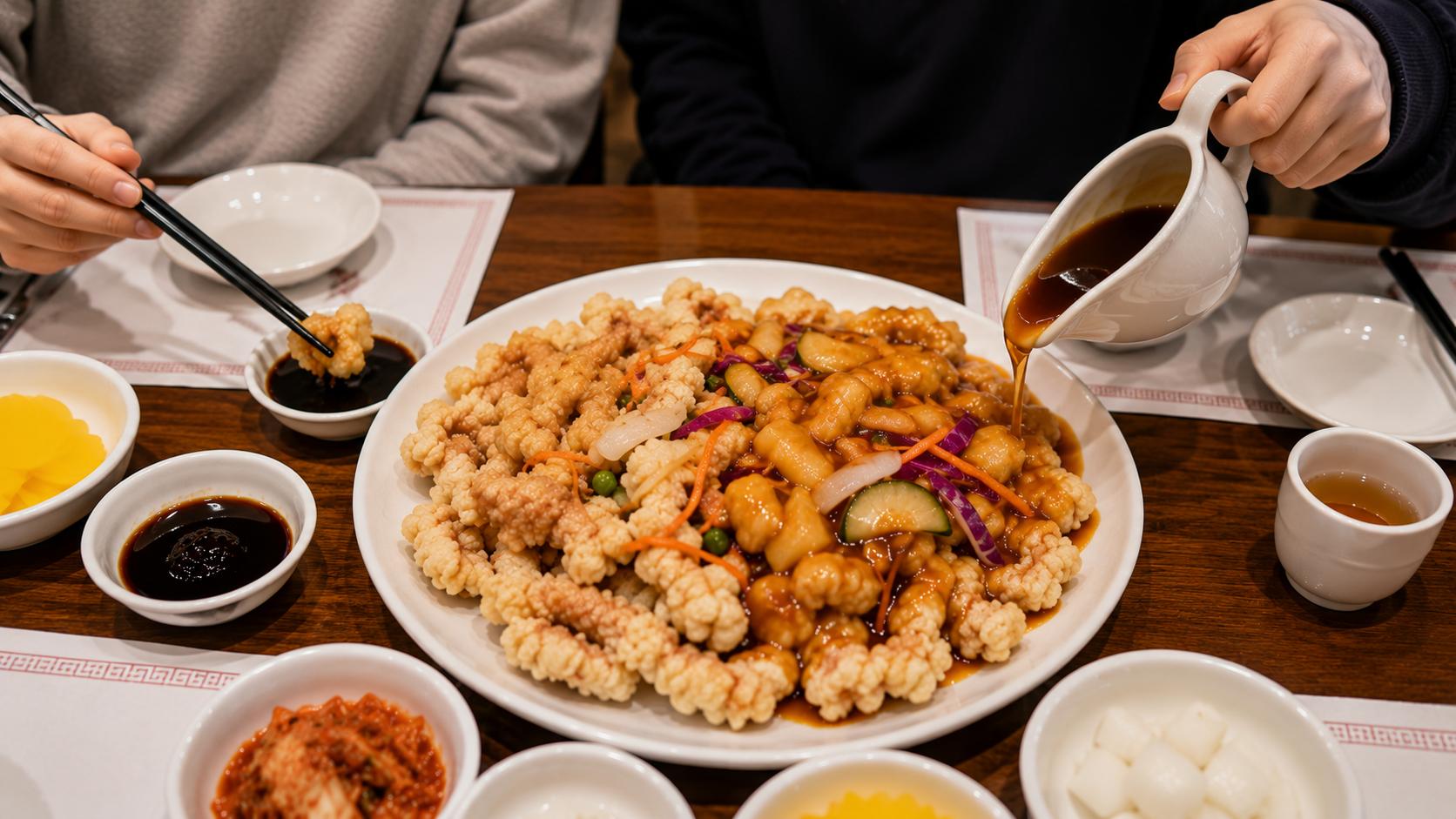
In an era captivated by the global explosion of K-pop and K-food, international onlookers are often baffled by a hyper-specific, fiercely contested debate dominating Korean variety shows and mukbangs: Should sweet and sour pork (Tangsuyuk) be "dipped" or "poured"? Welcome to the battleground of "Jik-meok" (찍먹) versus "Bu-meok" (부먹)—where a simple culinary preference has been elevated into a definitive cultural psychological test. To an outsider, arguing over how to sauce fried pork might seem like a trivial quirk. Yet, this precise obsession represents a fascinating facet of modern K-culture. It is a harmlessly hyper-fixated ecosystem where an everyday meal transforms into a viral social meme, a multi-generational bonding ritual, and an ultimate test of interpersonal chemistry.
In This Article
The Great Culinary Schism: Texture vs. Infusion
Walk into any Korean-Chinese restaurant in Seoul, and the moment a golden platter of Tangsuyuk hits the table, a palpable tension fills the air. Before anyone reaches for chopsticks, an invisible standoff occurs between two fundamental ideologies. The "Jik-meok" (dippers) camp fiercely guards the sauce bowl, determined to preserve the crystalline crispiness of the fried pork by dipping each piece individually. Opposing them are the "Bu-meok" (pourers), who recklessly drench the entire platter in a glossy, translucent glaze, arguing that the true essence of the dish lies in the soft, sauce-infused harmony of the batter.
This ongoing civil war transcends mere gastronomy. In South Korea, your stance on Tangsuyuk acts as an immediate cultural identifier—a lighthearted philosophy that dictates how you navigate communal dining and serves as the ultimate ice-breaker when meeting someone new.
The Gamification of Diet by Media and Fandom
The ascension of this debate from dining tables to a nationwide "universe war" is largely driven by South Korea’s media engine. In the entertainment industry, asking K-pop idols or actors whether they are "dippers or pourers" has become a mandatory balance-game question. Fans over-analyze these fleeting answers with laser focus, celebrating a shared preference with their "bias" as a sign of cosmic compatibility, or playfully mourning an idol's chaotic choice to pour.
Mukbang creators have heavily gamified this phenomenon for digital consumption. Videos featuring aggressive, dramatic pourings or ultra-crispy ASMR dipping sounds routinely harvest millions of global views. By transforming a routine lunch choice into a high-stakes internet performance, Korean media has successfully engineered a hyper-relatable social meme out of pure domestic banter.
The Rise of Third-Party Factions
As the years have rolled on, this rigid binary conflict has inevitably mutated, birthing specialized sub-factions that reflect the evolving ingenuity of Netizens. Weary of the endless diplomatic gridlock, creative eaters introduced "Dam-meok" (submergers)—those who leave a select few pieces drowning in the sauce for a hybrid texture. Then came the purist rebels of "Gan-meok," who bypass the sweet sauce entirely in favor of a sharp soy-sauce-and-chili-powder mix.
Most notably, the pragmatists established "Cheo-meok"—a chaotic, humorous stance that roughly translates to "shut up and eat whatever is in front of you before it gets cold." This obsessive need to classify and micro-analyze casual habits has set a cultural blueprint for modern Korean trends, paving the way for succeeding viral debates like the "Mint Choco War" or the infamous "Sesame Leaf Contention."
The Social Calculus of Harmless Conflict
To an international audience, treating a plate of fried pork like a political referendum might seem delightfully absurd. However, this ritual reveals the unique social genius of K-culture. In a fast-paced, high-pressure society, these hyper-specific debates offer a vital psychological pressure valve. By bypasses heavy, polarizing topics like politics or religion, Koreans utilize the entirely harmless medium of "how we eat food" to tease, connect, and establish safe boundaries of intimacy with one another.
The next time you tune into an idol's live stream or sit down at a table with Korean friends, try dropping the ultimate question: "Are you a dipper or a pourer?" With that single phrase, you will instantly unlock the playful core of Korean subculture, stepping right into a vibrant, delicious whirlwind that continues to swallow the internet.