


Nongak: The Living Sound of Korea’s UNESCO Heritage
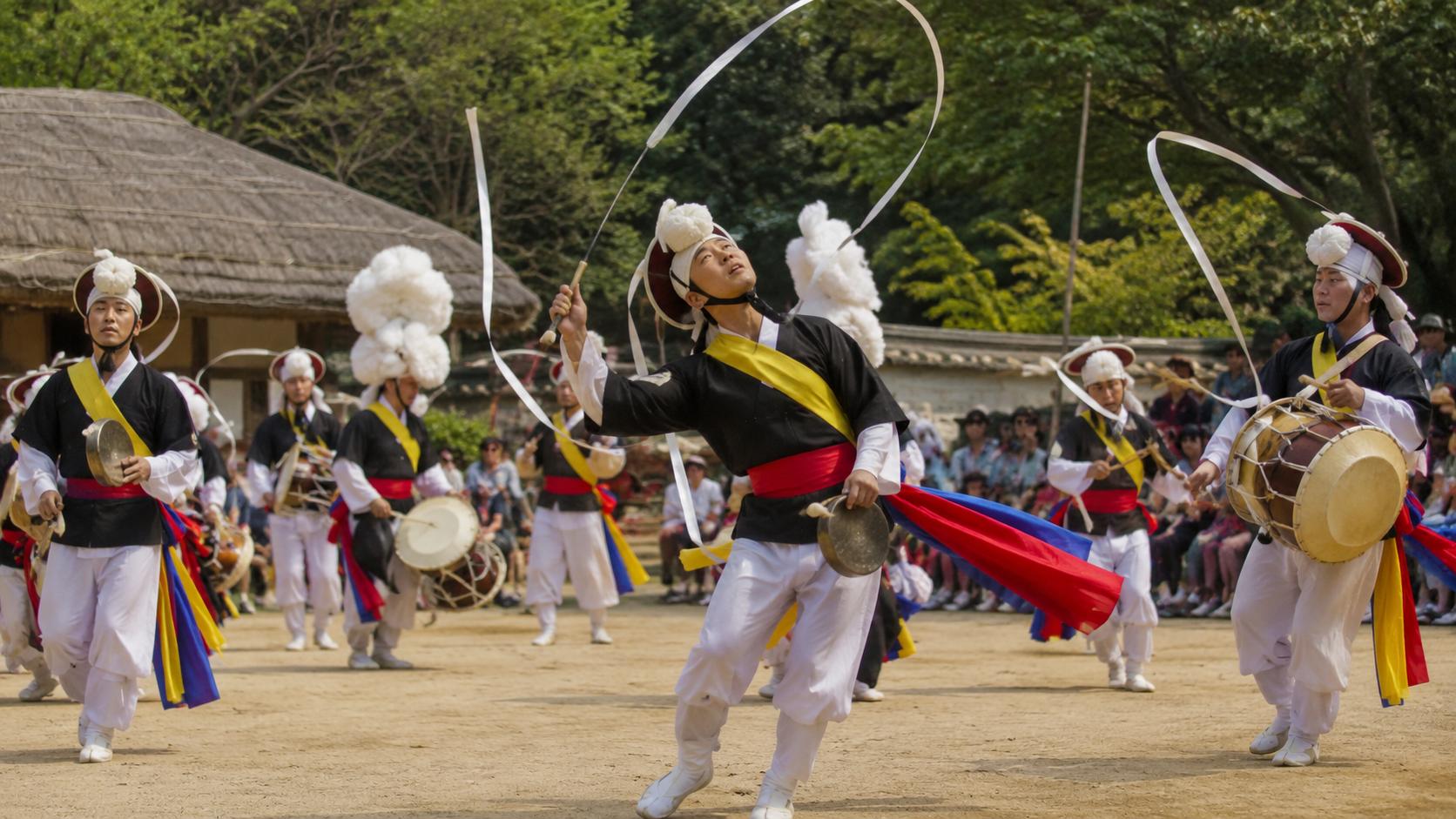
Beyond a simple display of folk music, Korean Nongak (Traditional Community Band Music, Dance, and Rituals) is a thunderous celebration of communal life and cosmic harmony. Inscribed on the UNESCO Representative List of the Intangible Cultural Heritage of Humanity, Nongak seamlessly blends sophisticated percussion rhythms, acrobatic choreography, and theatrical rituals. Executed by rural societies to secure bountiful harvests and ward off malevolent spirits, this multi-disciplinary art form transforms the village square into a living canvas of collective energy. This feature explores the structural physics of Nongak’s instruments, its complex spatial formations, and the enduring communal spirit preserved within its joyous cadence.
In This Feature
The Communal Pulse of the Soil
Nongak originated within the ancient agrarian cycles of the Korean peninsula, serving as both a spiritual plea for agricultural abundance and a vital catalyst for community solidarity. Historically performed during seasonal labor gatherings (Dure), village rituals (Daedong-gut), and holidays, Nongak dissolved rigid social hierarchies. Under the fluttering command of the farm banner (Nongbaji), villagers transformed from weary laborers into ecstatic performers. It was an essential mechanism for collective survival; the shared, hypnotic rhythms synchronized physical labor in the rice paddies, alleviated the exhaustion of the harvest, and forged an unbreakable psychological bond among community members.
The Quadraphonic Universe: Nature’s Quartet
The auditory core of Nongak relies on four fundamental percussion instruments, collectively known as Samul, each embodying a specific atmospheric phenomenon and cosmic element. The Kkwaenggwari (small gong), made of high-tin bronze and played by the lead musician (Sang쇠), produces a piercing, metallic chatter that mirrors lightning, directing the entire band’s tempo. The deeper, resonant Jing (large gong) sustains long, undulating vibrations that represent the sweeping wind. The hourglass-shaped Janggu produces rain-like patters with its contrasting animal hides, while the sturdy barrel-drum Buk provides the rolling thunders of the earth. Together, these instruments recreate the natural ecosystem, turning acoustic vibration into a prayer for elemental balance.
Spatial Geometry: Formations and Acrobatic Dance
To witness Nongak is to witness a massive, moving geometric maze. The performers do not remain stationary; they march, wind, and unwind in complex military-inspired tactical formations called Jinbup. Performers execute dazzling physical feats while maintaining intricate rhythmic cycles. Musicians wearing the Sangmo—a helmet topped with a long, flowing ribbon attached to a rotating wooden spindle—manipulate the ribbon into giant, spinning halos through precise neck movements, mapping out sophisticated multi-dimensional vectors in the air. Interspersed with acrobatic dancers (Sogo-chum) and masked actors (Japsek), the performance becomes an immersive street theater that turns empty open spaces into arenas of artistic joy.
A Living UNESCO Heritage for Tomorrow
In an era dominated by rapid urbanization and digital isolation, Nongak serves as a critical antidote, preserving the participatory roots of human performance art. Recognizing its global cultural value, UNESCO officially inscribed Nongak onto its Intangible Cultural Heritage list in 2014. Today, major regional variations—such as the high-speed, military precision of Honam Nongak and the robust, soaring leaps of Yeongnam Nongak—are fiercely protected by preserved transmission centers. By evolving from localized agrarian rituals into a celebrated global performing art, Nongak ensures that the democratic spirit of the village square, where every spectator is a potential dancer, continues to echo across borders.