


Why Koreans Get a Year Older for Eating Soup
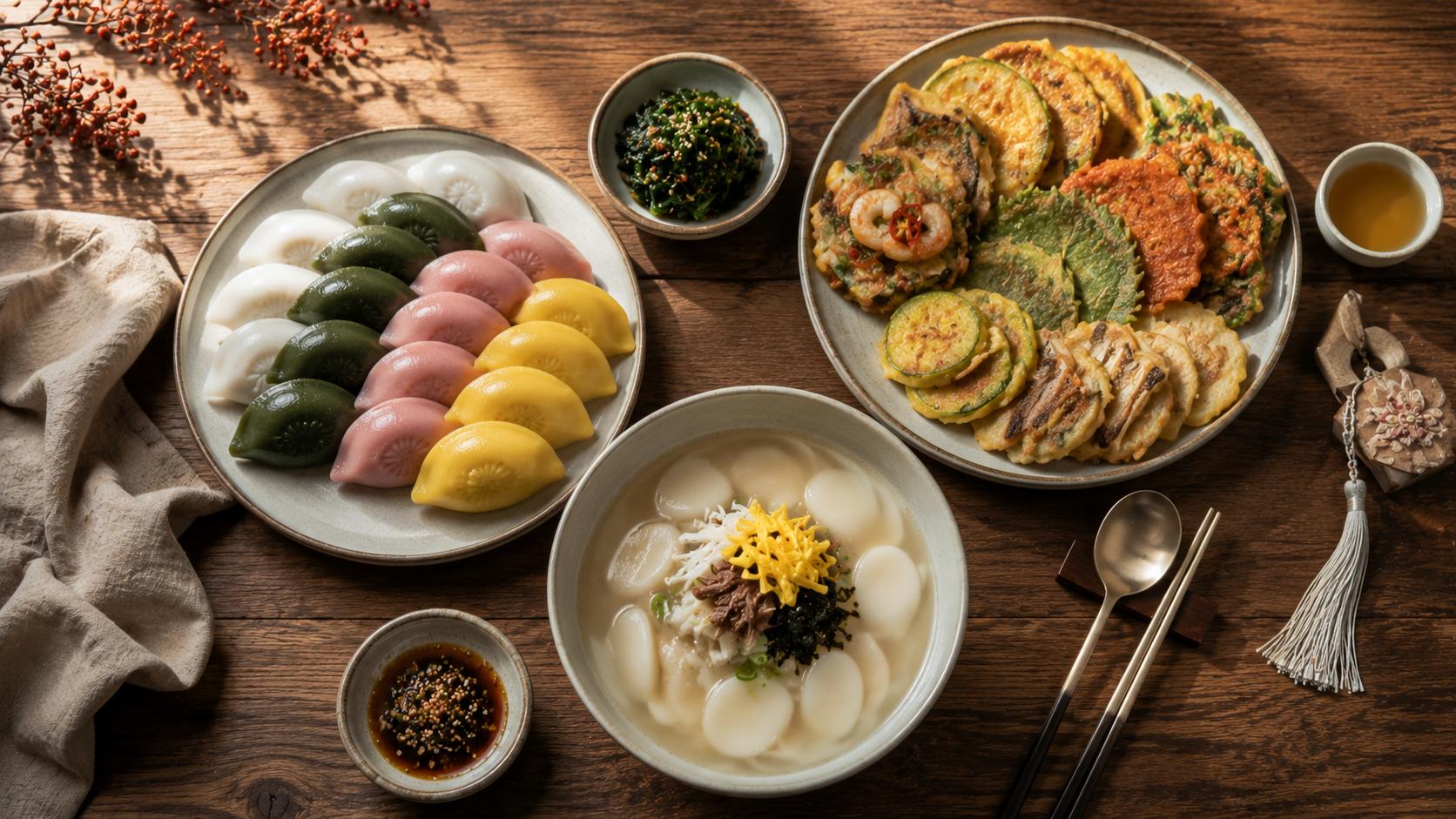
Tteokguk and songpyeon symbolize Korea's two biggest holidays, while jeon — fried pancakes made by the whole family — fills out the rest of the table.
In This Article
Korean Holiday Food — Tteokguk, Songpyeon, and Jeon
Korea's two biggest holidays are Seollal, the Lunar New Year, and Chuseok, the harvest festival. Food plays a central role in both. Tteokguk and songpyeon are dishes that symbolize the holidays themselves, while jeon is another fixture that fills out the table and the scene around it.
Tteokguk — One Bowl, One More Year
On the morning of Seollal, nearly every household in Korea eats tteokguk — thin slices of white rice cake simmered in a clear broth. The rice cake is white because it represents a clean slate and a fresh start. There's a long-standing belief in Korea that finishing a bowl of tteokguk on New Year's Day adds one year to your age, which is why Koreans sometimes ask someone's age indirectly by saying, "How many bowls of tteokguk have you eaten?" Tteokguk is also placed on the memorial table during ancestral rites, carrying meaning as a ritual that marks the start of a new year.
Songpyeon — The Half-Moon Rice Cake Eaten Only at Chuseok
Songpyeon is the signature food of Chuseok. Rice flour dough is filled with sesame seeds, beans, or red beans, shaped into a half-moon, and steamed over a bed of pine needles. It's made using that year's freshly harvested grain, expressing gratitude to ancestors for the harvest. There's also a story behind the shape: as the dough is filled and folded, it transforms from a shape resembling a full moon into a half-moon, which some interpret as the rice cake symbolizing both phases of the moon at once. Songpyeon is believed to have become widespread during the Goryeo dynasty, and it's a distinctly Korean rice cake — equivalent dishes are hard to find in China or Japan. The pine needles serve a double purpose: they add fragrance and keep the rice cakes from sticking together.
Jeon — The Fried Food That Fills Out the Holiday Table
Jeon is made by thinly slicing fish, meat, or vegetables and pan-frying them in a light batter. It's a fixture on the memorial table during both Seollal and Chuseok, and making jeon together as a family is one of the most recognizable scenes of the holiday season in Korea. That said, jeon takes considerable time and effort to prepare, and the smell of frying oil tends to linger in the kitchen for hours — which has led to growing momentum toward simplifying holiday memorial tables in recent years. The Sungkyunkwan Confucian institute even released standardized guidelines stating that fried dishes don't need to be included on the memorial table at all. Dealing with the jeon that's left over after the holiday has become its own minor tradition, with new recipes for repurposing leftover jeon and namul circulating widely right after every holiday season.