


She Dives 20 Meters Deep — With Nothing But Her Breath
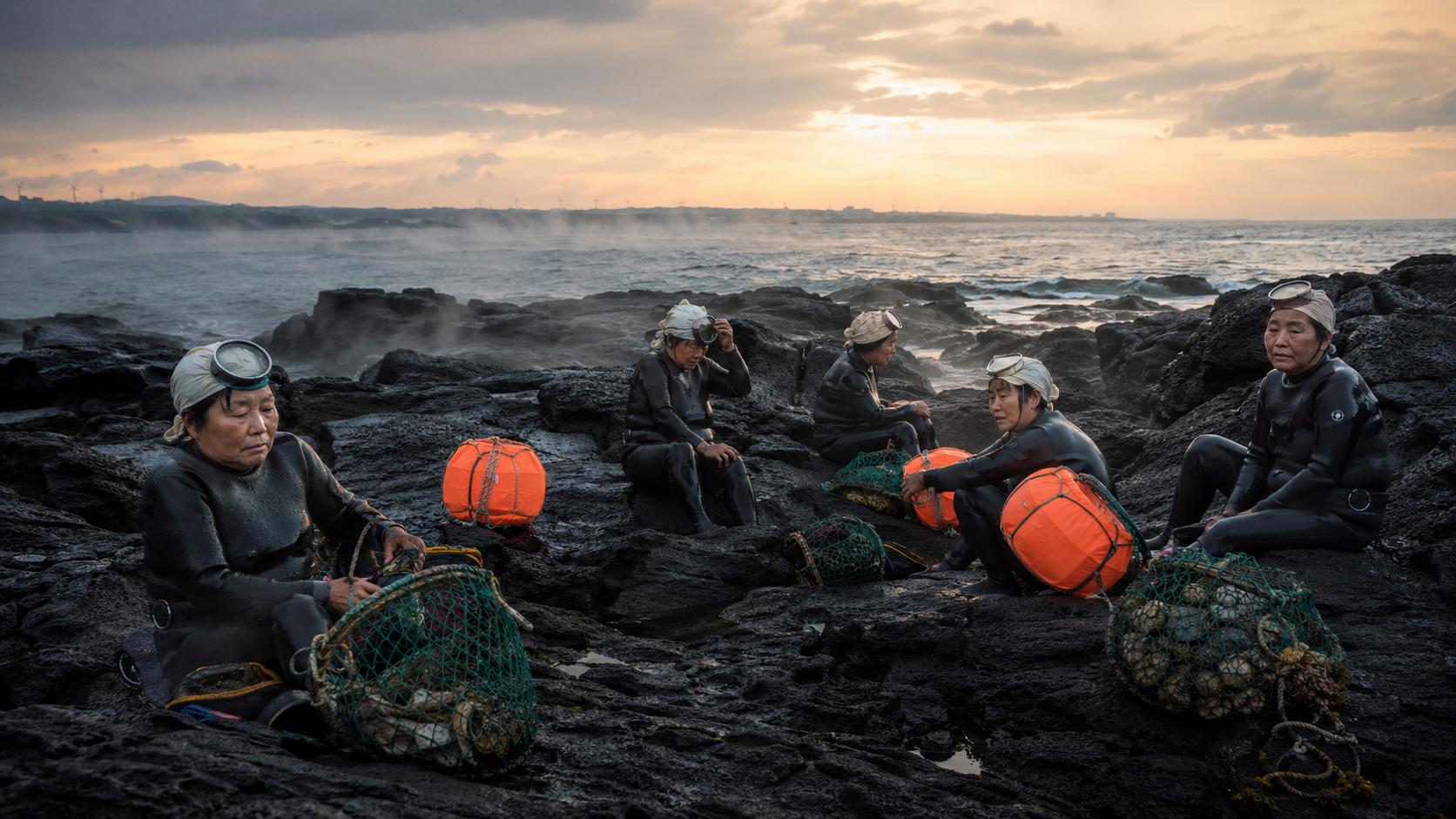
A haenyeo is a female diver from Jeju Island who descends into the sea armed with nothing but her own lungs.
In This Article
No Oxygen Tank, Just the Body
A haenyeo is a female diver from Jeju Island who descends into the sea armed with nothing but her own lungs. They dive to an average depth of 10 meters — sometimes as deep as 20 — harvesting abalone, conch, sea urchin, and sea cucumber. A single dive means holding their breath for one to two minutes on average. They repeat this hundreds of times a day.
It is less a special skill than something earned through years of training, experience, and a deep sensitivity to the sea. Haenyeo learn to read the direction of currents, the temperature of the water, and the rhythm of the waves — not with instruments, but with their bodies.
Why Women?
Historically, women in Jeju went to sea far more than men. Several theories attempt to explain this, but the most compelling centers on body fat and the ability to retain heat: women can endure the same water temperatures for longer. There is also the theory that during the Joseon Dynasty, men faced heavy tax burdens, leaving the relatively tax-exempt work of the sea to women.
This gave rise to a distinctive social structure on the island. Women took on the primary economic role while men managed the household and raised the children. The haenyeo were not simply workers — they were the pillars holding Jeju society together.
A Fading Breath
In the 1960s, Jeju was home to more than 30,000 haenyeo. Today, that number has fallen to around 3,000 — most of them women in their sixties or older. Younger generations are not choosing the hard and dangerous work of the sea. Haenyeo schools have been established and the government has introduced support programs, but the fear that centuries of tradition could vanish within a single generation is becoming very real.
Still, Young Women Are Heading to the Sea
Yet there is hope. In recent years, women in their twenties and thirties have begun stepping into the haenyeo life. Weary of city living, they are making their way to Jeju and knocking on the doors of haenyeo schools. Some are driven by a sense of duty to carry on the tradition; others are simply drawn to a way of life lived alongside nature.
Young haenyeo share their daily lives on social media, and haenyeo documentaries are drawing attention at international film festivals. Today, you can find a grandmother haenyeo and a granddaughter-aged haenyeo surfacing in the same waters, releasing the same breath.