


Jeju Doldam(제주돌담): 800 Years of Volcanic Wisdom
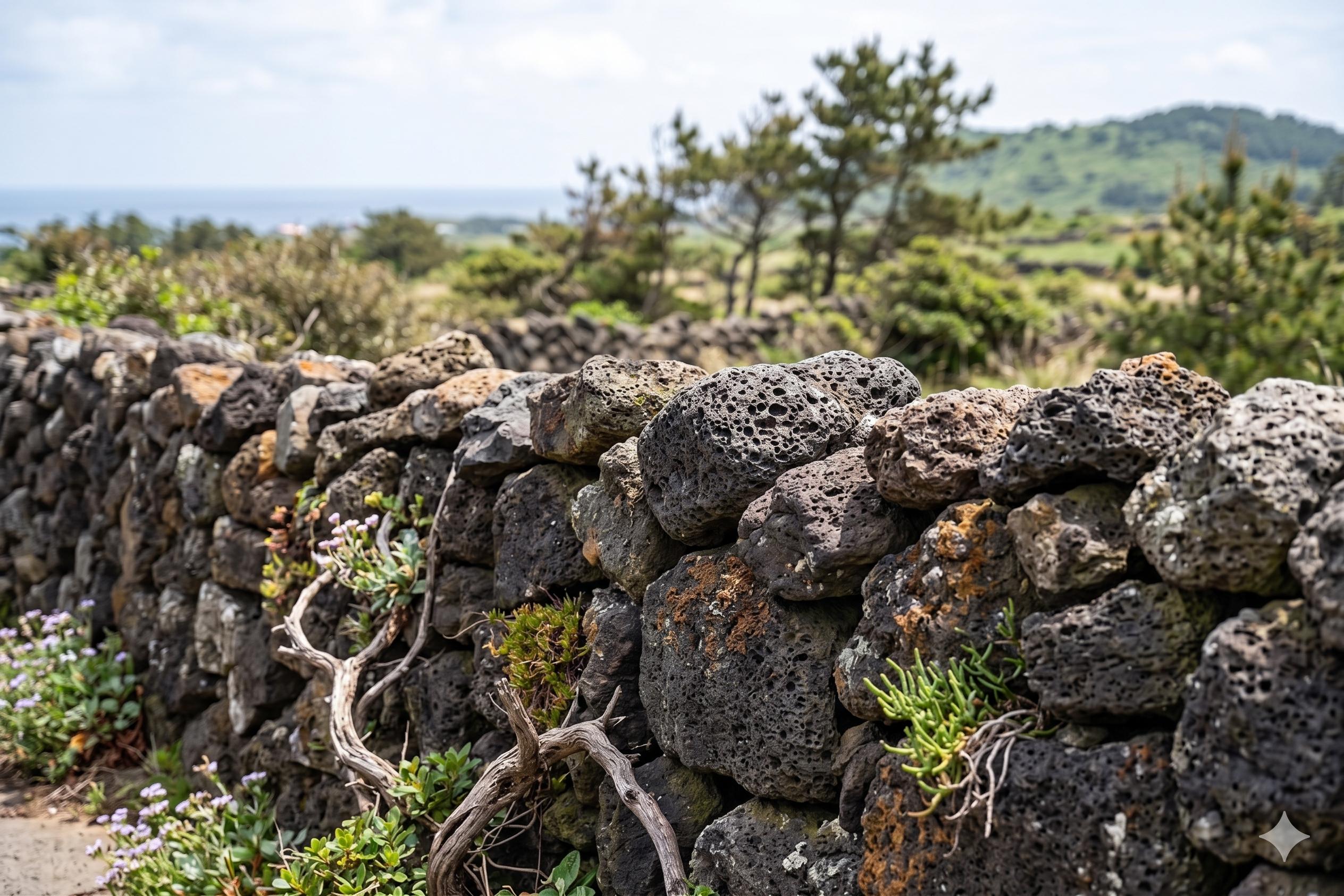
Jeju Island is covered in black stone walls. They divide the fields, line the roads, and surround traditional homes.
In This Article
Why Is Jeju Covered in Stone Walls?
Jeju Island is covered in black stone walls. They divide the fields, line the roads, and surround traditional homes. The material is almost always the same: basalt, the volcanic rock that forms the island itself.
Stretching across more than 20,000 kilometers throughout Jeju, these walls are collectively known as heungnyongmalli — “ten thousand leagues of black dragon” — because of the way they wind continuously across the landscape.
The Island Kept Producing Stone
Jeju was formed through volcanic activity. Beneath the soil lies hardened lava, and every time farmers plowed the land, fragments of basalt rose to the surface. When ox-drawn plows were later replaced by motorized tillers, even larger rocks emerged from the ground.
Instead of removing the stones elsewhere, farmers stacked them directly on the spot. In practice, this meant that clearing the field and building the wall became part of the same process.
Walls Engineered for Wind
Jeju’s batdam stone walls were not built as solid barriers. Small gaps were intentionally left between the stones, allowing wind to pass through rather than crash against the wall directly. This principle is known as pawung hyogwa — the wind-breaking effect.
A completely sealed wall collapses under Jeju’s strong winds. A wall with gaps survives. The same structure also prevented grazing horses and cattle from entering crop fields while helping stop topsoil from being washed away.
A 13th-Century Solution That Stayed
The stone wall system was formally established in 1234 during the Goryeo Dynasty. Kim Gu (金坵, 1211–1278), who had been appointed magistrate of Jeju, ordered residents to construct stone boundaries after land disputes between neighboring farms became difficult to control.
Historical records indicate that stone walls already existed before Kim Gu’s arrival. However, his directive transformed what had been a scattered local practice into a structured, island-wide system.
From National to Global Recognition
In January 2013, Jeju’s batdam were designated Korea’s National Important Agricultural Heritage No. 2. The following year, in April 2014, they were officially inscribed on the FAO’s Globally Important Agricultural Heritage Systems (GIAHS).
Jeju is now pursuing UNESCO Intangible Cultural Heritage status — not as an entirely new nomination, but as an extension of the “Art of Dry Stone Walling,” which was already inscribed in 2018 by eight countries including France and Italy.
The official application process began in 2025, with a target inscription period of 2028–2029.