


Jultagi (줄타기): The Korean Tightrope Art Where Comedy Meets Acrobatics
In 2005, a Korean film centered on itinerant performers and court entertainment, The King and the Clown ( 왕의 남자 ), became one of the most commercially
AI-generated image
In This Article
In 2005, a Korean film centered on itinerant performers and court entertainment, The King and the Clown (왕의 남자), became one of the most commercially successful Korean films of its time, drawing over twelve million admissions domestically. While not solely focused on tightrope walking, the film prominently features traditional performance arts such as jultagi, which play an important symbolic role throughout the story.
More Than a Tightrope Performance
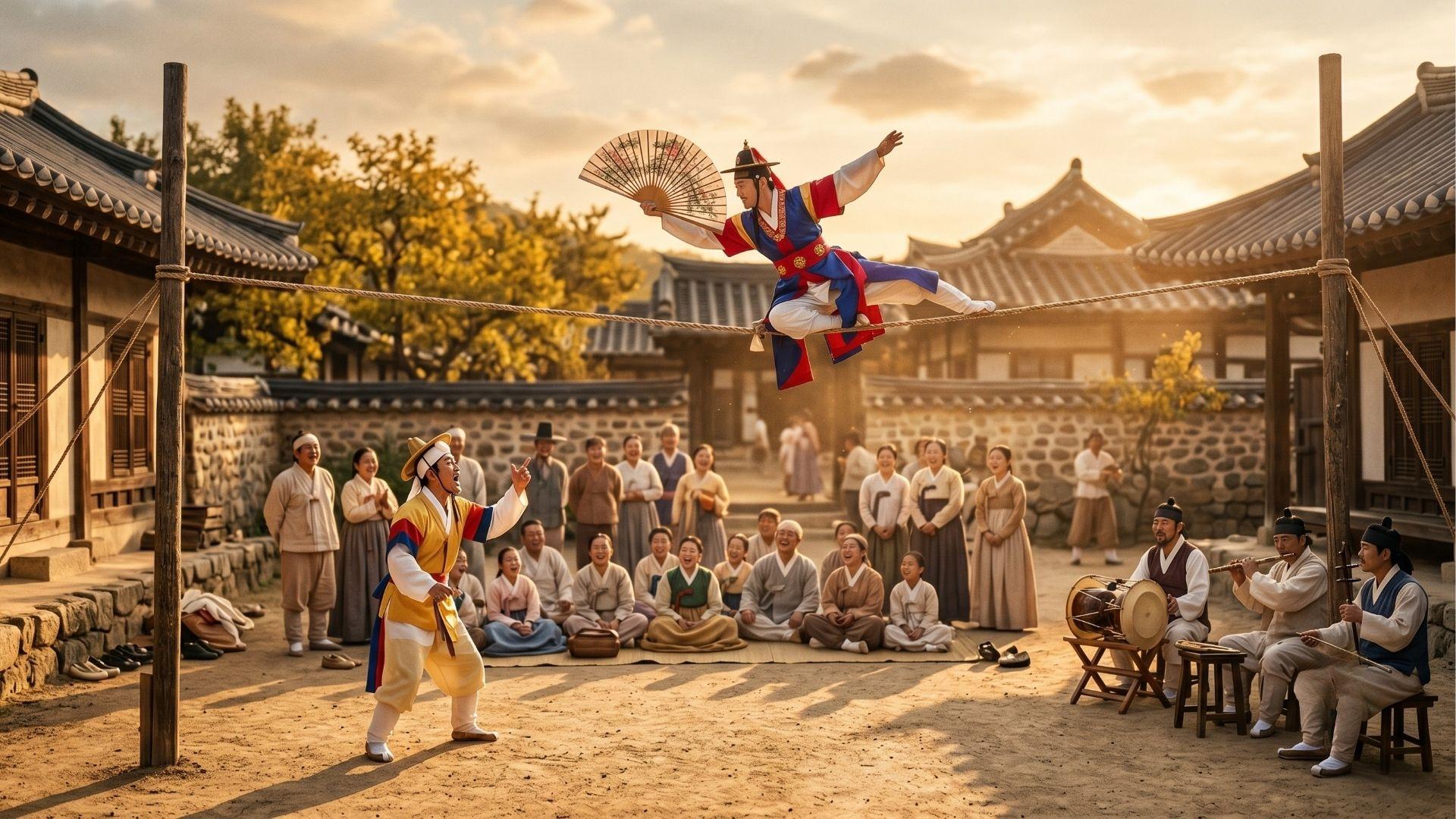
Jultagi (줄타기) is a traditional Korean performing art in which a performer walks and performs acrobatic movements on a rope stretched between two poles, accompanied by live music and spoken dialogue with a ground-level clown.
Unlike many tightrope traditions that focus primarily on physical skill, jultagi combines acrobatics with structured dialogue and humor. A performer on the rope interacts continuously with a clown below, while musicians respond to the rhythm of movement. The result is a hybrid form that blends physical performance with storytelling and comedic exchange.
While improvisation is part of the performance, jultagi also follows established sequences of techniques and stage structure developed over centuries.
How Jultagi Is Structured
A traditional jultagi performance involves three main roles. The JUL-GWANGDAE (줄광대) performs on the rope, executing acrobatics while engaging in dialogue. The EORIT-GWANGDAE (어릿광대) remains on the ground, responding with comedic exchanges. The SAMHYEON-YUKGAK musicians provide live musical accompaniment using traditional instruments such as the janggu (drum), piri (flute), and haegeum (fiddle).
Performances traditionally begin with a ritual known as JUL-GOSA (줄고사), performed to pray for safety and a successful show. The structure then progresses gradually: early movements establish rhythm, middle sections emphasize humor and audience interaction, and later segments focus on more complex acrobatic techniques.
Historically, jultagi was performed during seasonal festivals such as Dano and Chuseok, and staged in open public spaces, making it accessible to all social groups.
The Cultural Impact of The King and the Clown
The film The King and the Clown (왕의 남자), directed by Lee Joon-ik, is set during the Joseon Dynasty and follows a group of traveling performers who become involved in the political tensions of the royal court.
Within the film, jultagi appears as both a performance art and a narrative symbol. The rope becomes a space where characters express emotion, tension, and social commentary. In the final sequence, the tightrope functions as a stage for the film’s emotional climax, highlighting the performers’ precarious position between entertainment and political danger.
The film reached over twelve million admissions in South Korea and played a significant role in introducing traditional Korean performance culture to international audiences. However, jultagi itself remains only one element within the broader historical and cultural context depicted in the story.
Jultagi as a Living Heritage
Jultagi was designated as a Korean National Intangible Cultural Heritage in 1976 and later inscribed on the UNESCO Representative List of the Intangible Cultural Heritage of Humanity in 2011.
Today, it continues to be preserved and performed by trained practitioners and cultural preservation groups across Korea. Performances are regularly held at cultural festivals, heritage sites, and dedicated performance venues.
Rather than being a static historical artifact, jultagi remains a living tradition. While its core structure has been preserved for centuries, the spoken dialogue and humor evolve with each generation of performers, reflecting contemporary audiences while maintaining its traditional foundation.