


Giwa(기와): The Roof Tile That Has Topped Korean Palaces for a Thousand Years
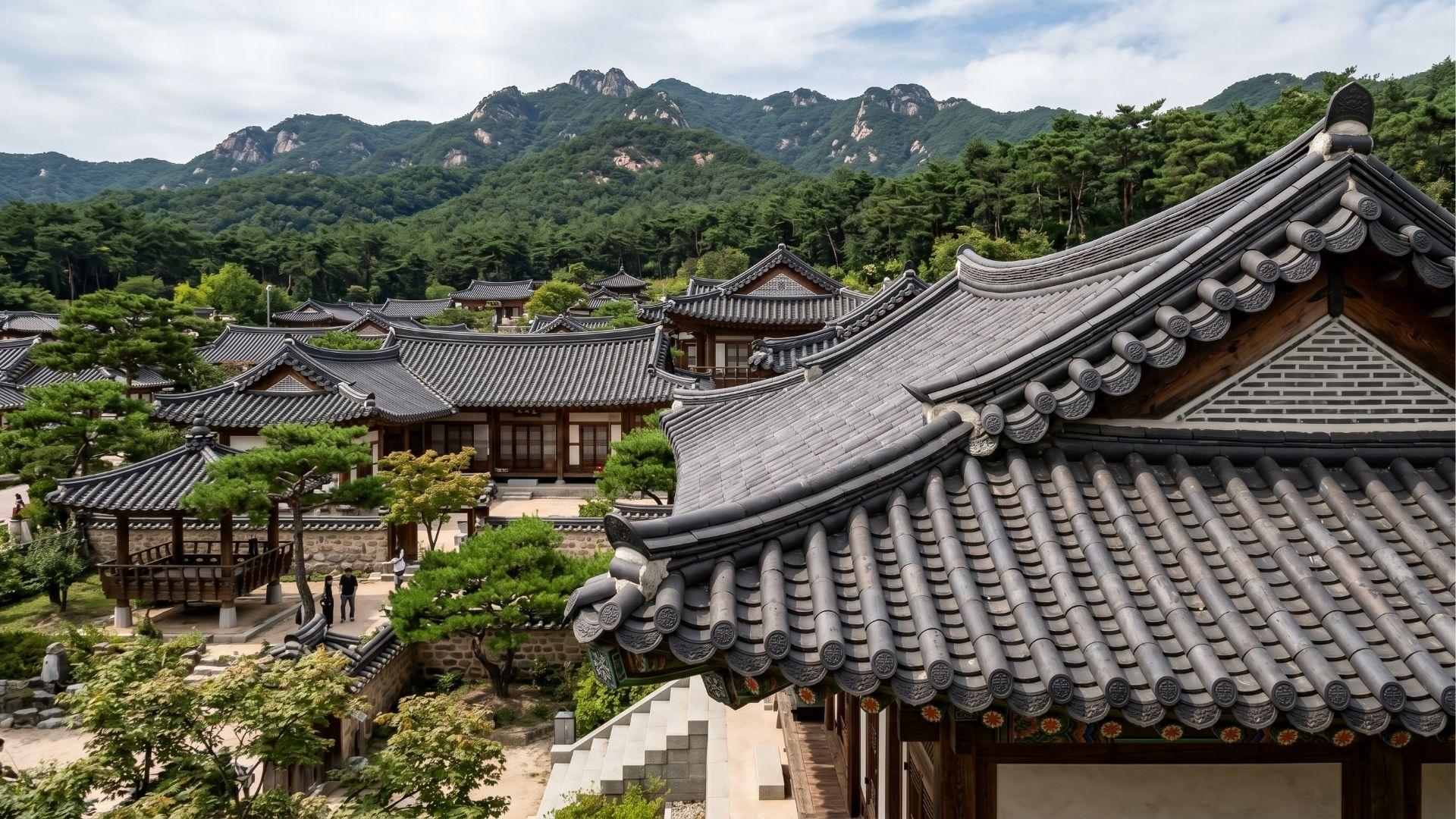
Every photograph of Gyeongbokgung Palace features the same unmistakable silhouette: a sweeping roofline of dark grey curved tiles, layered in rows, rising at the corners.
In This Article
Every photograph of Gyeongbokgung Palace features the same unmistakable silhouette: a sweeping roofline of dark grey curved tiles, layered in rows, rising at the corners. Most visitors photograph it. Very few know what they are looking at. The tiles are called GIWA (기와), and they have been shaping the skyline of Korean architecture for over a thousand years.
The Roof You See Everywhere But Never Think About
Walk through any historic district in Korea — Bukchon Hanok Village in Seoul, the old city of Jeonju, the palace complexes of the Joseon Dynasty — and the rooflines are consistent. Dark grey tiles, curved and overlapping, with upturned edges at the corners. This is not a coincidence of aesthetics. It is the result of a single material, refined over centuries, that became the defining visual element of Korean traditional architecture.
Giwa appears on palaces, temples, government buildings, and private homes of the yangban class. Its presence on a building communicated status, permanence, and adherence to a particular architectural tradition. A building with a giwa roof was not just sheltered — it was placed within a cultural and social order.
What Giwa Actually Is
Giwa is a type of fired clay roof tile used in traditional Korean architecture. It comes in two primary forms: the AMGI (암기와), a concave tile that channels rainwater downward, and the SUTGI (수키와), a convex tile that covers the joints between the concave tiles. These two forms interlock across the roof surface, creating a system that is both watertight and structurally stable.
The characteristic dark grey color comes from a reduction firing process in which oxygen is limited during the final stage of kiln firing. This produces a dense, hard tile with a surface that resists water absorption. The color is not a glaze — it is the natural result of the firing method.
Decorative end tiles, called MAEUPGI (막새기와), are placed at the edges of the roof and often feature stamped designs — lotus flowers, geometric patterns, or mythological creatures. These are among the most studied artifacts in Korean archaeological research, as their patterns help date construction periods and identify regional production centers.
Why the Curve Is Not Decorative
The most visually distinctive feature of a giwa roof is its upturned corners, a characteristic shared across East Asian traditional architecture but executed differently in each culture. In Korean architecture, the degree of curvature tends to be more moderate than in Chinese examples and more pronounced than in Japanese ones — a distinction that specialists note but that is difficult to perceive without direct comparison.
The curve serves structural and practical functions. The upturned corner, called CHEOMA (처마), extends the eave further from the building wall, directing rainwater away from the foundation. In a climate with concentrated seasonal rainfall, this is not an aesthetic choice. It is an engineering response to weather conditions that have remained consistent for millennia.
The overall weight of a giwa roof is considerable. Traditional timber frame structures in Korea were engineered specifically to carry this load, with bracket systems that distribute weight from the roof to the columns rather than the walls. The architecture and the roofing material developed together as a system.
The Symbols Baked Into the Tile
Giwa was never purely functional. The decorative end tiles placed at the edges of a roof — called MAEUPGI (막새기와) — carried stamped designs that served purposes beyond aesthetics. Lotus flowers represented purification and the warding off of evil spirits, drawing on Buddhist symbolic tradition. Geometric sun patterns were understood to strengthen positive energy and repel misfortune. Most striking were the GUIMYEON (귀면) designs — demon face motifs pressed into the tile surface, their exaggerated features intended to frighten away malevolent forces before they could enter the building below.
On palace rooftops, a different class of protective figure appears: the JAPSSANG (잡상), small ceramic sculptures placed in a row along the ridge of the roof. Their origins are debated, with some accounts linking them to characters from the Chinese novel Journey to the West. Their function, however, was consistent — to guard the building against fire, evil spirits, and misfortune. The number of japssang on a roof varied according to the status of the building, with the most important structures carrying the longest rows. They can still be seen on the rooftops of Gyeongbokgung Palace today.
At the two ends of a roof ridge, larger ornamental elements called CHIMI (치미) were sometimes placed. These represented mythological aquatic creatures, and their presence on a wooden building was understood as a counterbalance to fire — water symbolism positioned at the highest point of a structure that fire would reach first. The logic was not decorative. It was protective, placed with the same intention as the haechi statues at the palace gate: to give a building the best possible chance of surviving what threatened it.
How It Is Made
Traditional giwa production begins with clay preparation. The clay is worked repeatedly to remove air pockets and achieve consistent density. It is then shaped around a cylindrical mold — a wooden form wrapped in fabric that allows the clay to be removed cleanly after shaping. The shaped tile is left to dry slowly before firing.
Firing takes place in a tunnel kiln at temperatures between 900 and 1,000 degrees Celsius. The reduction firing that produces the characteristic grey color requires precise control of airflow during the final stage. Tiles that crack, warp, or discolor during firing are discarded. The rejection rate in traditional production is significant, which is part of why giwa roofs were historically expensive to build and maintain.
The skill required at each stage — clay selection, shaping consistency, kiln management, and the judgment to identify usable tiles — has been passed down through direct instruction across generations of craftspeople.
Giwa as Intangible Cultural Heritage
The Cultural Heritage Administration of Korea recognizes traditional giwa production as intangible cultural heritage. This designation reflects the judgment that the knowledge required to produce giwa by traditional methods cannot be fully captured in written documentation — it exists in the hands, eyes, and accumulated experience of trained craftspeople.
The number of practitioners working in traditional giwa production has declined significantly over the past several decades. Industrial ceramic roof tiles, which are cheaper and more uniform, have replaced giwa in most new construction. Traditional giwa is now produced primarily for the restoration of designated cultural heritage sites, where regulations require materials consistent with the original construction.
Maintaining the intangible heritage designation ensures that training programs continue, that master craftspeople are documented, and that the knowledge base does not disappear entirely as demand for traditional production shrinks.
Giwa in Modern Korea
Outside of heritage restoration, giwa appears in contemporary Korean architecture in two ways. The first is direct continuation — new hanok buildings, whether private residences or commercial spaces, often use giwa roofs as part of an intentional connection to traditional aesthetics. Neighborhoods like Bukchon and Jeonju Hanok Village have seen significant investment in this kind of construction.
The second is reinterpretation. Contemporary Korean architects have incorporated giwa-inspired forms into modern buildings — curved rooflines, grey ceramic cladding, layered tile patterns — without reproducing the traditional structure directly. This approach treats giwa less as a material and more as a visual language that carries recognizable cultural meaning.
For most people visiting Korea, giwa is simply the roof. It is the texture of every palace photograph, the silhouette of every hanok alley. Understanding what it is — how it is made, why it curves, what it meant to the people who built it — changes what those rooflines look like.