


Why Hanok Is Designed Around Airflow: The Science of Korea's Breathing House
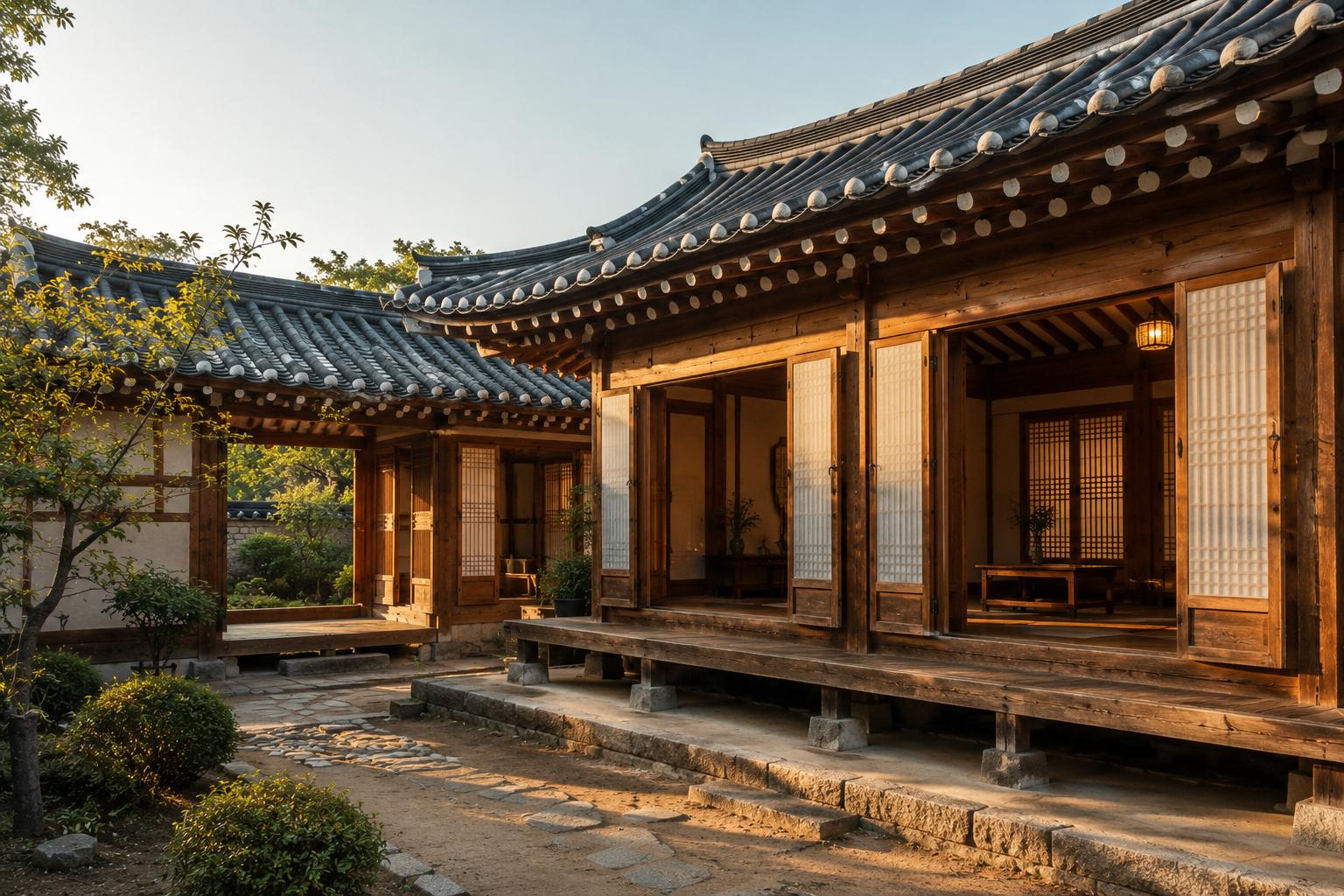
Hanok is the traditional Korean dwelling, designed to regulate the indoor environment through the natural flow of air, light, and heat — without mechanical systems.
In This Article
Hanok is the traditional Korean dwelling, designed to regulate the indoor environment through the natural flow of air, light, and heat — without mechanical systems.
In an era before heating and cooling technology existed, the structures had to withstand both the hot, humid summers and the cold, dry winters of the Korean peninsula. To meet this challenge, ventilation, lighting, and heat retention were integrated directly into the architecture itself.
How Hanok Ventilates Without Machines
The hanji paper used in Hanok windows has a fine porous structure that allows outside air to enter while releasing indoor moisture to the exterior.
When the daecheong — the open wooden-floored hall positioned between the front and rear of the house — has its doors opened, a cross-ventilation structure is formed.
Air from the front courtyard passes through the daecheong and exits toward the rear yard, creating a pressure difference inside the building. This pressure differential drives continuous air circulation throughout the interior.
How Eaves and the Raised Foundation Respond to Seasonal Change
The deep eaves of a Hanok are understood to be designed so that they block the high-angle sunlight of summer, while allowing the low-angle sunlight of winter to reach deep into the interior.
The raised stone foundation — known as the gidan — lifts the building above ground level. This blocks ground moisture from entering the structure during summer.
Air is also allowed to pass beneath the foundation, which helps lower the temperature of the wooden floor above by allowing ventilation underneath.
The Architectural Role of the Daecheong
The daecheong is an open-plan space positioned between the ondol-heated rooms and the outer courtyard.
Its elevated floor structure, open at the bottom, shields the interior from ground heat. As warm air from the courtyard passes through the daecheong, a natural cooling effect is produced.
Beyond its cooling function, this space also serves as a transitional buffer zone connecting the interior and exterior of the home.
How Ondol and the Wooden Floor Coexist
Hanok integrates two opposing climate-response systems within a single structure.
Ondol — also known as gudeul — is a radiant floor heating system that circulates heat generated from a firebox through channels beneath the floor, storing warmth in the stone slabs above.
The daecheong, by contrast, is an open structure that circulates air and provides a cooling function during warmer months.
These two systems are used selectively depending on the season, functioning together as a structural solution to the extreme climate conditions found on the Korean peninsula.
While contemporary architecture has largely moved toward sealed enclosures and mechanical systems to manage energy, Hanok took a different path — drawing natural forces into the building's structure itself. From the perspective of climate-adaptive architecture, the design principles of Hanok are referenced as a case study in discussions around sustainable building.