


A Practical Korea Travel Guide for First-Time Visitors
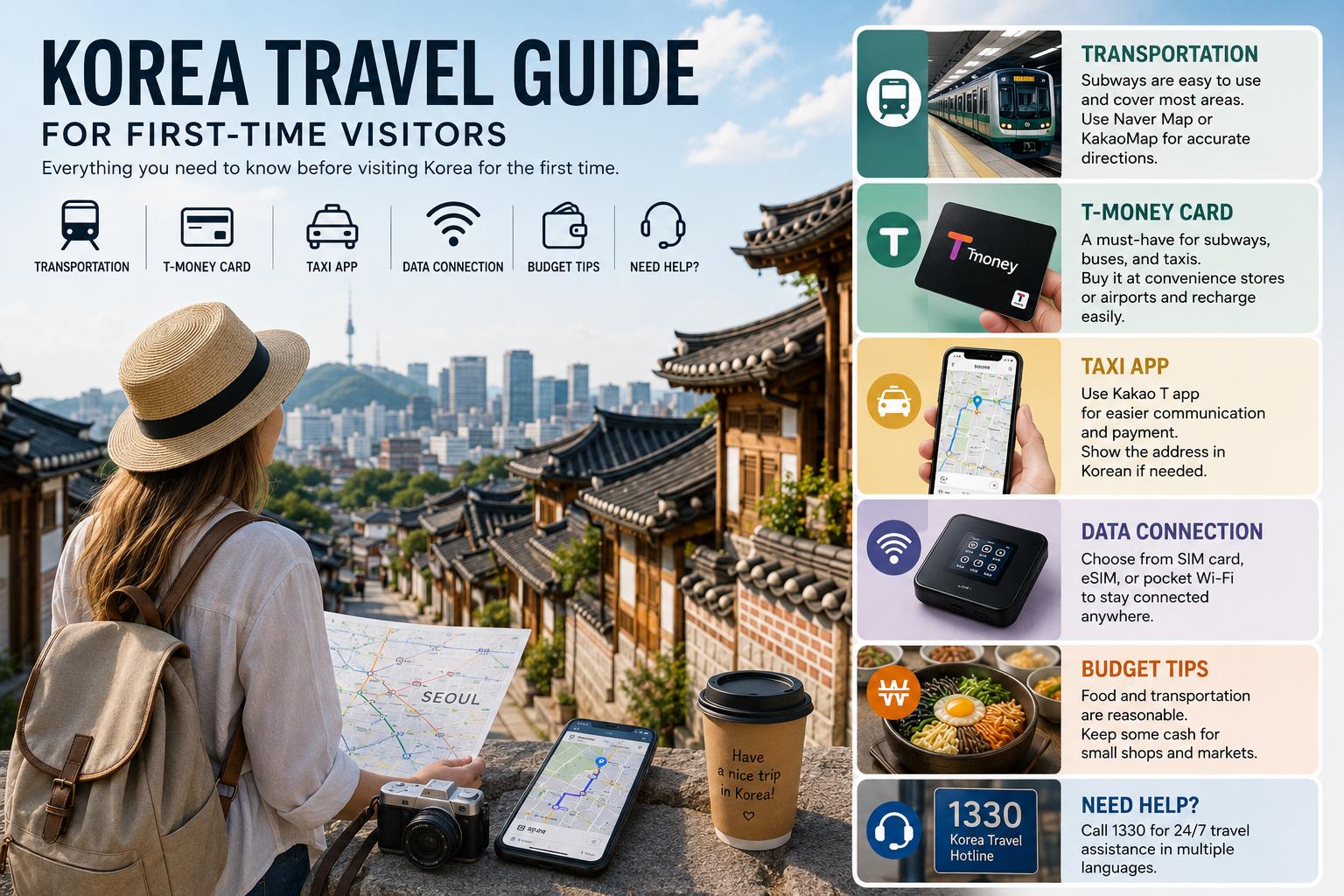
Korea is frequently mentioned as one of the most travel-friendly countries in Asia. Public transportation is well-connected, cities are relatively safe…
In This Article
Korea is frequently mentioned as one of the most travel-friendly countries in Asia. Public transportation is well-connected, cities are relatively safe, and card and mobile payments are widely used. In large cities like Seoul, travel is possible late into the night, and everyday infrastructure such as convenience stores and cafés is well established.
That said, first-time visitors from abroad can still encounter unexpected friction. Questions like which transit card to buy, which app to use instead of Google Maps, and how to communicate with a taxi driver when there is a language barrier are small in isolation — but without answers, travel fatigue builds quickly.
This guide covers only the practical information that makes a meaningful difference. These are the core things that make traveling in Korea considerably easier.
Getting Around: Start with the Subway
For first-time visitors, the subway is the most reliable way to get around. The Seoul Metro in particular connects most parts of the city center and extends to surrounding areas including Incheon, Suwon, and Gapyeong. Station signage is typically available in Korean, English, Chinese, and Japanese, and transfer systems are reasonably well organized.
Buses are cheaper and cover more detailed routes, but for first-time visitors, stop names and boarding procedures can feel confusing. A practical approach is to rely on the subway for the first few days and gradually mix in buses once you are more comfortable.
For intercity travel, the KTX is the most convenient option. The journey from Seoul to Busan takes approximately two and a half hours. Tickets can be booked through the official Korail website or app. SRT is a separate high-speed rail service bookable through the SR app.
The KR Pass, a rail pass available to foreign visitors, allows unlimited travel on designated trains for a set period. It can be a cost-effective option if you plan to visit multiple cities within a short timeframe.
Maps: Naver Map and KakaoMap Work Better
One of the things that most often surprises foreign travelers in Korea is the map situation. Google Maps can have limited accuracy for walking directions and public transit routes in Korea, so locals primarily use Naver Map and KakaoMap instead.
Both apps support English interfaces and tend to offer more accurate subway transfer times, bus arrival information, and walking navigation. They also contain more locally sourced restaurant and café data, which makes them considerably more useful in practice.
If you are preparing for a trip to Korea, it is worth installing one of these apps before you leave.
Transit Card: Get One on Day One
One of the first things worth preparing when visiting Korea is a T-Money card — a rechargeable transit card accepted on most public transportation nationwide, including subways, buses, and some taxis.
It is available at convenience stores such as GS25, CU, 7-Eleven, and emart24, as well as at airport information desks. The card itself typically costs around 2,500 won and can be topped up with cash at convenience store counters or subway station recharge machines. Most machines offer an English menu.
The most practical benefit of T-Money is the transfer discount. When switching between the subway and a bus within a set time window, the additional fare is reduced or waived. Without a transit card, the full base fare applies to every separate journey.
Single-use transit cards are also available, but they require a deposit refund process that can be cumbersome for short-stay visitors. For anyone staying more than a day, T-Money is the more practical choice.
Some mobile wallet services also support transit card functionality, but this can be restricted depending on the device settings or whether the card was issued overseas. For first-time visitors, a physical card is the most reliable option.
Taxis: Show Your Destination in Korean
Korean taxis are relatively affordable and safe. Most operate on a metered fare system and tipping is not customary. Payment by cash, card, or T-Money is accepted, and a late-night surcharge applies after midnight.
The most common challenge for foreign visitors is the language barrier. Not all drivers speak English, so showing the destination address in Korean is the most practical approach. A quick search on a map app will display the Korean address of any location.
A more convenient option is to use the KakaoT app, which is the most widely used taxi-hailing app in Korea and works similarly to Uber. Entering a destination displays an estimated fare, and in-app payment is available. The app also supports an English interface.
Note that some overseas-issued cards may not process correctly through the app. On the first day, it is advisable to have a physical card or a small amount of cash as a backup.
Data: It Affects Your Trip More Than You Think
Free Wi-Fi is relatively easy to find in large cities like Seoul, but if your itinerary involves frequent movement or travel to regional areas, having personal mobile data makes things considerably easier. Navigation, translation, taxi-hailing, and messaging all rely heavily on a data connection.
There are three main options to consider.
Local SIM card — Carrier booths from KT, SK Telecom, and LG U+ can be found at Incheon Airport arrivals. Options range from data-only plans to plans that include a Korean phone number. A passport is required for purchase.
eSIM — If your smartphone supports eSIM, you can purchase and activate a plan online before departure. The main advantage is that there is no need to wait in line at the airport. A range of short-stay plans are available.
Pocket Wi-Fi — A portable Wi-Fi device that can connect multiple devices simultaneously. Useful when traveling with friends or family. The drawbacks are that it needs to be charged daily and carried as a separate item.
A Few Things That Often Surprise First-Time Visitors
Bring a portable charger. Mobile dependency in Korea is high. Maps, mobile payments, translation apps, and taxi-hailing are all handled on a smartphone. Battery drains faster than expected during a full day of travel, especially with a lot of walking or photography. Many travelers note that battery life turned out to matter more than Wi-Fi access.
Public trash cans are less common than expected. Even in large cities like Seoul, public bins can be difficult to find on the street. When carrying street food or coffee, you may not find a place to dispose of it immediately. Recycling bins in front of convenience stores or trash cans inside subway stations tend to be the most accessible options.
Public restrooms, on the other hand, are plentiful. Free restrooms are generally easy to find at subway stations, large buildings, shopping malls, and cafés.
Keep a small amount of cash on hand. Korea has very high card payment adoption, but some stalls at traditional markets and older, smaller restaurants may only accept cash. Having around 20,000 to 30,000 won available tends to be enough as a precaution.
Food tends to offer good value. Convenience store staples like kimbap, triangle rice balls, and sandwiches are inexpensive. A meal of bibimbap, soondubu jjigae, or doenjang jjigae at an ordinary restaurant is generally affordable. Traditional markets such as Gwangjang Market, Namdaemun Market, and Mangwon Market are good places to eat well at a lower cost. On the other hand, accommodation in central Seoul, branded cafés, and some fruit can be more expensive than expected — particularly during peak seasons.
If Something Goes Wrong: Call 1330
One of the most useful official support channels during a trip to Korea is the 1330 Korea Tourism Organization travel information line.
It operates 24 hours a day and offers consultation in Korean, English, Japanese, and Chinese. Services include directions to hospitals, general tourism information, lost item inquiries, and interpretation support.
Calls are generally free from within Korea, and it is a service that many foreign travelers actually use. However, it tends to be underrecognized — many visitors are simply unaware that it exists.
A little preparation goes a long way in Korea. The public transportation, convenience stores, public safety, and digital infrastructure are all strong. Once you get through the first few days of adjustment, traveling in Korea tends to feel considerably more efficient and manageable than expected.