


From Scroll to Screen: Inside the Global Phenomenon of K-Webtoon Based Dramas
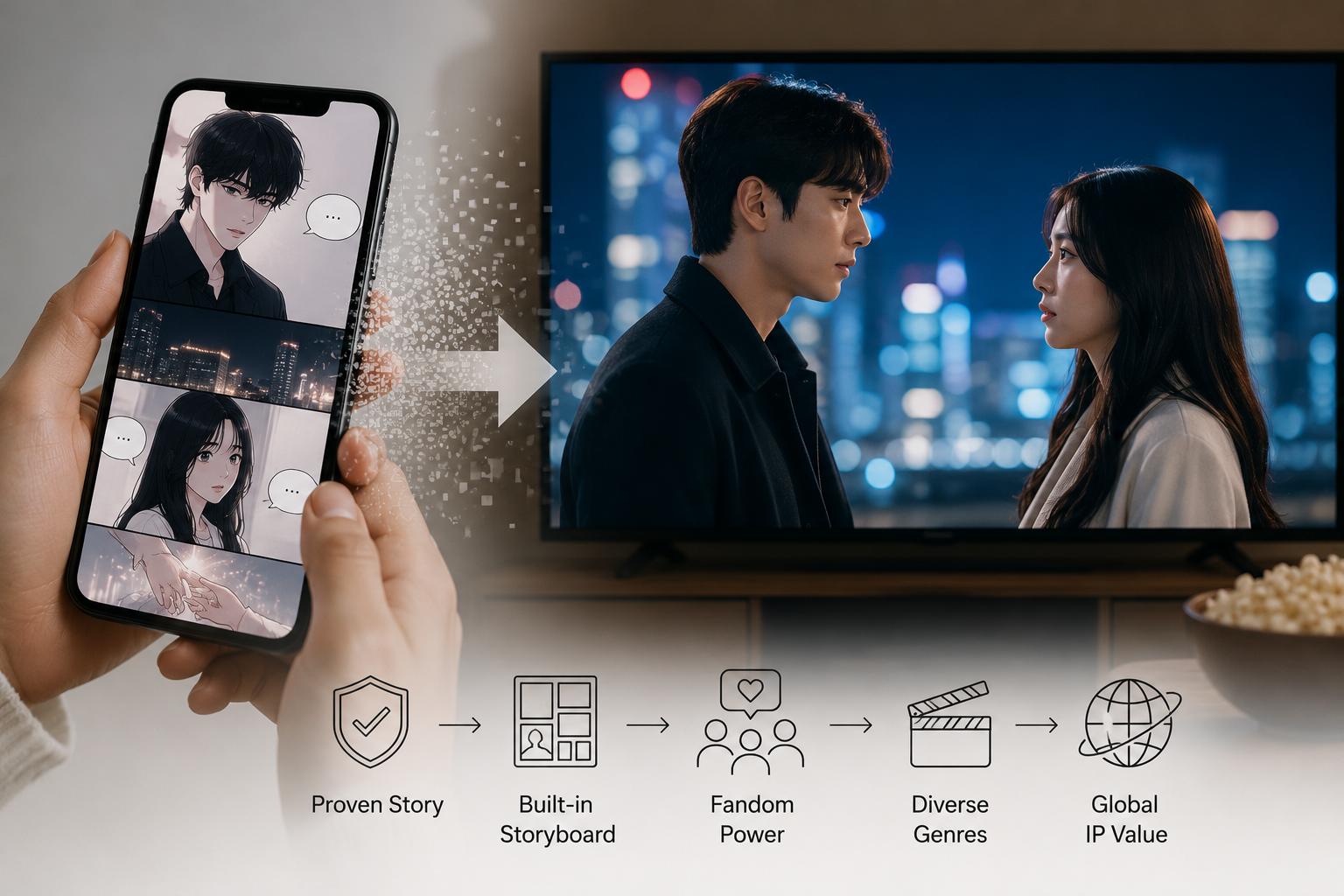
A webtoon that millions read on their phones is now keeping global audiences up at night as a hit drama series. The rise of K-webtoon adaptations is reshaping the content industry—driven by pre-validated stories, built-in fandoms, and the expanding reach of global OTT platforms.
In This Article
A Guaranteed Hit? The Power of a Pre-Validated Story
For a production company, pouring tens of billions of won into a new drama is a colossal gamble. The biggest reason webtoon adaptations have become so attractive is precisely that they can significantly reduce this risk. By drawing on plot twists, compelling characters, and tightly woven conflict structures that have already been tested by tens of millions of readers over several years, productions can dramatically cut their initial exposure.
The fact that a story begins with a manuscript whose commercial viability has already been proven—through paid subscriptions and reader comments—has fundamentally altered the dynamics of the drama production ecosystem.
Cost-Efficient Directing: The Storyboard Is Already Done
A webtoon functions as a fully realized visual storyboard for a drama. Unlike prose fiction, which exists only in words, a webtoon already visualizes panel composition, framing, character expressions, and even the timing of dialogue. Directors and actors can intuitively reference the original artwork to interpret characters and determine camera angles.
This dramatically shortens the pre-production period and provides decisive guidance for translating the source material's distinctive visual sensibility—its mise-en-scène—into live-action footage.
'Sync Rate' and the Art of Organic Viral Marketing
The moment news breaks that a webtoon is being adapted, online communities erupt with "dream casting" debates and heated discussions about "sync rate"—how closely a cast member resembles the original character. The source material's devoted fandom becomes simultaneously the drama's harshest critic and its most passionate promoter.
When a cast actor is perceived as perfectly matching the original character, the resulting fandom catharsis explodes across social media as organic viral marketing—generating overwhelming buzz well before the first episode airs.
Breaking Genre Limits: From Zombies to Time Slips
Korean dramas were once widely seen as confined to a fairly predictable set of genres: conglomerates, birth secrets, and romance. But as webtoons—with their virtually unlimited imaginative scope—began supplying source material, those genre boundaries collapsed entirely.
Thrillers, science fiction, fantasy with entirely original world-building, zombie apocalypses—bold subject matter that would have been difficult to attempt on broadcast television—found new life when paired with the production budgets of global OTT platforms such as Netflix and Disney+, emerging as high-quality genre dramas.
One Source, Infinite Screens
The K-webtoon adaptation boom illustrates just how far-reaching the ripple effects of a single powerful intellectual property can be in the content industry. A drama's success, in turn, drives a global resurgence in sales of the original webtoon, and the expansion continues without pause into merchandise, games, and animation.
The small panel a reader once scrolled through on a smartphone screen has become the beating heart of K-content—powerful enough to steal sleep from audiences around the world.