


Science under the Full Moon: A Complete Guide to "Jeongwal Daeboreum (정월대보름)"
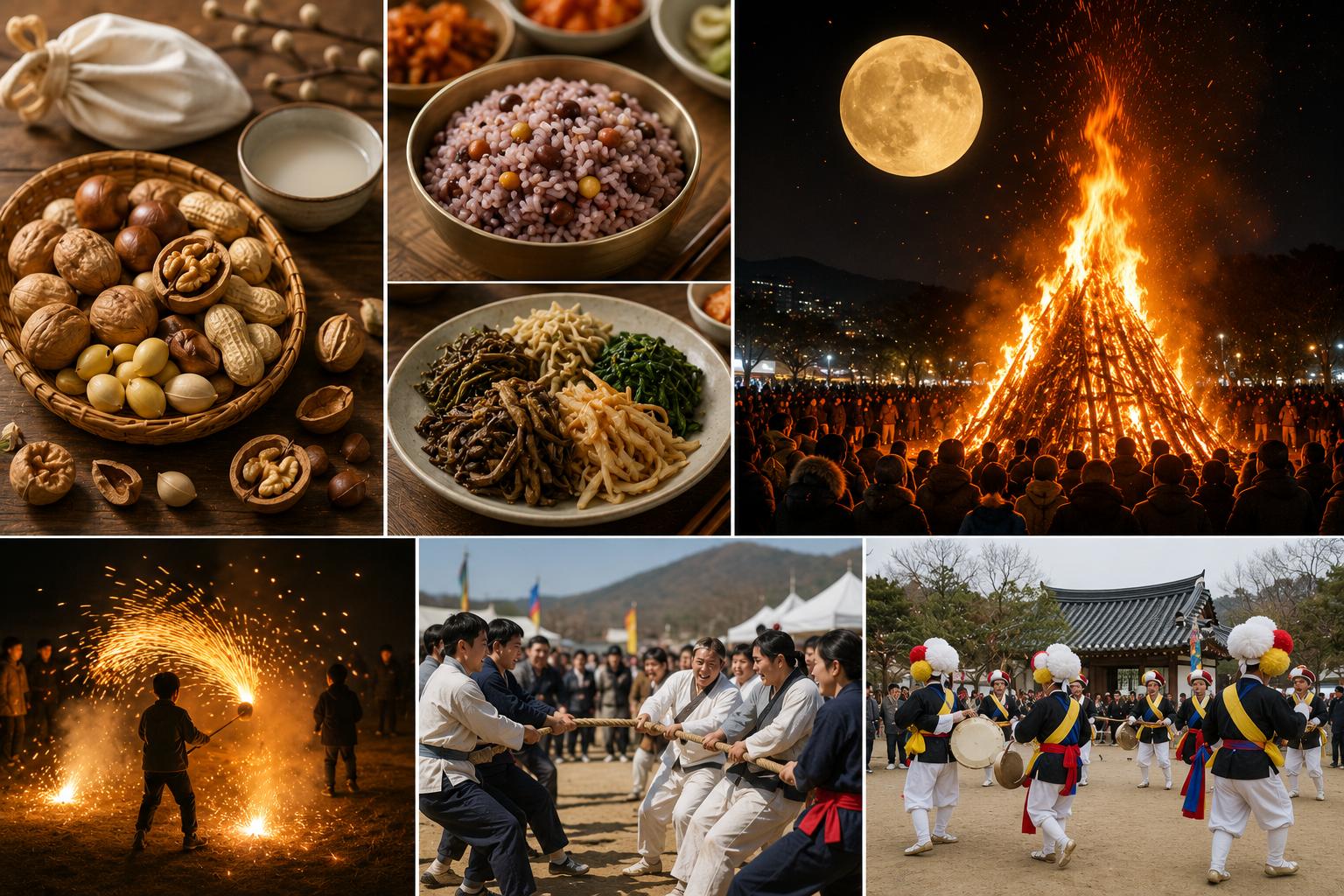
The fifteenth day of the first lunar month marks Jeongwol Daeboreum — Korea's Great Full Moon Festival. Far beyond a seasonal holiday, it is a concentrated archive of communal wisdom: nutritional traditions refined over centuries, fire rituals that doubled as agricultural technology, and village-wide games that wove entire communities into one. This is your complete guide to understanding it all.
In This Article
Morning Food Rituals & Their Nutritional Logic
Daeboreum morning begins with a distinct food culture rooted in health and intention. Beneath each custom lies a practical wisdom — an attempt to replenish nutrients that were scarce during the cold winter months.
부럼깨기 (Bureom-kkaegi) (Nut-Cracking): Early in the morning, people crack hard nuts — raw chestnuts, walnuts, ginkgo nuts, peanuts — equal in number to their age. The ritual is accompanied by the shout, "Bureom kkaemulcha!" ("Let's crack the bureom!"), and it is believed that biting through in a single crunch will keep skin ailments away and strengthen teeth throughout the year. From a modern nutritional standpoint, the unsaturated fatty acids abundant in nuts are indeed beneficial for protecting skin that tends to dry out in winter.
오곡밥(Ogokbap) and 진채식(Jinchae-sik) (Five-Grain Rice and Dried Vegetables): A bowl of ogokbap — rice cooked with millet, sorghum, red beans, and black beans — is the centerpiece of the Daeboreum table. It is served alongside nine types of dried vegetables (jinchae), including dried pumpkin slices, eggplant, radish greens, and bracken, all preserved from the previous autumn. Eating these is said to protect against the summer heat. In a season when fresh produce was unavailable, this combination served as a near-complete nutritional prescription of vitamins and minerals through dried vegetables.
귀밝이술 (Gwibalkisul) (Ear-Brightening Wine): Before breakfast, a small cup of cold, unwarmed rice wine is consumed. It is believed that drinking it will sharpen one's hearing and ensure that only good news reaches the ears throughout the coming year.
Fire, Moon, and Nighttime Ceremonies
As the sun sets and the great full moon rises, the most visually spectacular part of Daeboreum begins — a festival of fire and light.
달맞이(Dalmaji) and 달집태우기(Daljip-taeuggi) (Moon Greeting and Moon-House Burning): On the night of Daeboreum, people climb hills and mountains to wait for the first full moon to appear. When it rises, a large ceremonial structure called a daljip — built from bamboo and straw — is set ablaze. As the flames roar upward, the village's misfortunes are understood to be carried away with the smoke, and prayers for a bountiful harvest are offered to the glowing sky.
쥐불놀이(Jwibulnori) (Fire-Swinging Play): On the eve of or on the night of Daeboreum, fires are set along the edges of rice paddies and fields. The practice is well known for the image of a tin can punctured with holes, filled with burning charcoal, and swung in wide circles. While it reads as a festive game, it functioned as sophisticated agricultural technology: burning the field edges eliminated the eggs and hibernating nests of pests and rats, while the ash left behind acted as a natural fertilizer for the soil.
Community Games: Becoming One Village
Daeboreum extended beyond individual blessings — it was a large-scale communal festival in which every member of the village participated together.
- 줄다리기(Juldarigi) (Tug-of-War): Teams are divided into a "female rope" side and a "male rope" side. It was traditionally believed that a win by the female-rope team would bring a good harvest. Beyond superstition, the practice reinforced cooperation and solidarity among community members.
- 지신밟기(Jishin-balbgi) (Earth-God Treading): A troupe of traditional musicians (pungmulpae) traveled from house to house throughout the village, playing music to appease Jishin, the god of the earth, and to pray for blessings upon each household. The custom embodied the spirit of mutual flourishing within a community.
- 더위 팔기(Deowi Palgi) (Selling the Summer Heat): A playful morning prank: you call a friend's name, and if they answer, you declare, "Buy my summer heat!" — symbolically transferring the burden of the coming summer's heat onto them. It was a lighthearted psychological defense against the hot months ahead.
How to Celebrate Daeboreum Today
If you'd like to experience Daeboreum in full, consider starting the morning by cracking a walnut — just the one — before breakfast. At lunch, seek out ogokbap and a plate of seasoned dried vegetables at a traditional Korean restaurant. In the evening, look for a local Daeboreum festival: watching a daljip go up in flames while quietly making a wish is, by most accounts, the most memorable part of the holiday.