


Culinary Heritage of Jeju: Why "제주 흑돼지 (Jeju Heokdwaeji)" is Famous
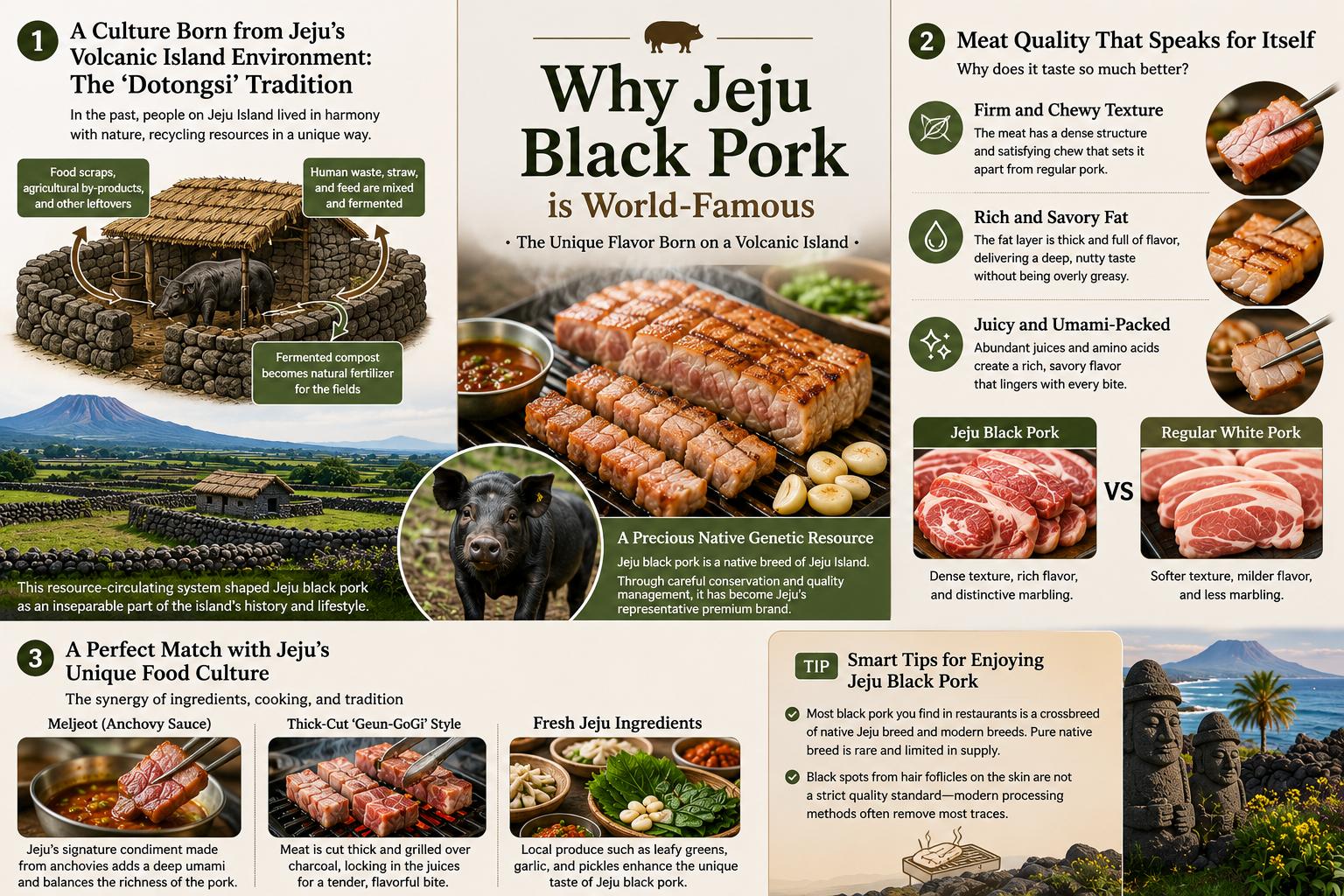
Jeju Island's black pig is more than a regional delicacy—it is a product of the island's volcanic landscape, a distinctive farming culture, and a food tradition that has been refined over centuries. Understanding why Jeju black pork commands such a devoted following means understanding the island itself.
In This Article
The 'Dot-tong-si': A Volcanic Island's Farming Culture
The story of Jeju black pork begins with the island's unusual built environment. Because Jeju's volcanic basalt soil drains rainfall so rapidly, the land was historically difficult to farm. To make the most of scarce resources, Jeju people developed the dot-tong-si—a structure that combined a toilet and a pig pen. Kitchen scraps, food waste, and agricultural by-products were fed to the pigs, while the resulting fermented manure became a valuable natural fertiliser for the island's infertile fields.
This tight loop of human and animal coexistence shaped a pig that was deeply woven into the rhythms of island life. The black pig was never simply livestock; it was an integral part of the Jeju household economy. (Note: black pigs sold commercially today are raised in modern, hygienic facilities and are not connected to traditional dot-tong-si practices.)
What Makes the Meat Different
The most direct explanation for Jeju black pork's reputation is sensory: the meat tastes and feels different from standard commercial pork. Several characteristics are commonly noted:
- Firm, springy texture: The muscle tissue is denser than that of standard white pigs, giving each bite a satisfying chew.
- Rich, nutty fat: The fat layer tends to be thicker and has a flavour that many describe as nutty rather than greasy when cooked over an open flame.
- Deep, savoury taste: The meat contains a good balance of amino acids and natural juices, producing a full, lingering flavour as you chew.
Research and selective breeding have continued to build on these natural qualities. One notable result is Nanchuk Matdon (난축맛돈), a premium crossbreed developed by the National Institute of Animal Science's Subtropical Livestock Research Institute in Jeju. Introduced from 2005 using genomic selection technology, Nanchuk Matdon crosses the Jeju native black pig with the Landrace breed to combine superior marbling with faster growth rates. According to researchers at the institute, years of continuous improvement have brought its weight consistency close to that of standard commercial pigs—while retaining the red, well-marbled meat quality the breed is known for. Chefs have noted that cuts typically considered unsuitable for grilling, such as the rear leg, can be cooked on the grill with this breed, which is an unusual distinction.
A Complete Food Culture
What makes Jeju black pork a compelling culinary experience is not only the meat itself but the traditions that surround it. Two elements in particular stand out:
- Mel-jeot (멜젓): A fermented anchovy sauce made from mel (the Jeju dialect word for anchovy), this condiment is heated on the grill alongside the pork and used as a dipping sauce. The brininess cuts through the richness of the fat and adds an additional layer of depth.
- Geun-gogi (근고기) culture: Rather than slicing the meat thin, Jeju restaurants traditionally grill thick, unsliced chunks of pork belly or neck over charcoal or coal briquettes. This method seals the juices inside the meat and is considered a defining characteristic of the Jeju grilling tradition.
Efforts to preserve the genetic lineage of the native Jeju black pig are ongoing, led by relevant livestock research institutions, recognising its value as a domestic genetic resource.
A Smart Eater's Guide
Visitors to Jeju should be aware of a practical distinction: pure native Jeju black pigs (Jeju jaelae heukdwaeji) are produced in very small numbers and are rarely found in regular restaurants. Most establishments serve a high-quality crossbreed—a hybrid between the native pig and improved commercial breeds—which is also marketed as Jeju black pork. The crossbreed delivers the flavour qualities the region is known for and is the standard dining experience.
One commonly held visual cue—black hair follicle marks on the skin—is sometimes used as an informal indicator of authenticity. However, depending on how the pig is processed, these marks may or may not be visible, so they should not be treated as a definitive sign.