


Pillars of the Island: The Roots of Jeju's Women-Centered Culture
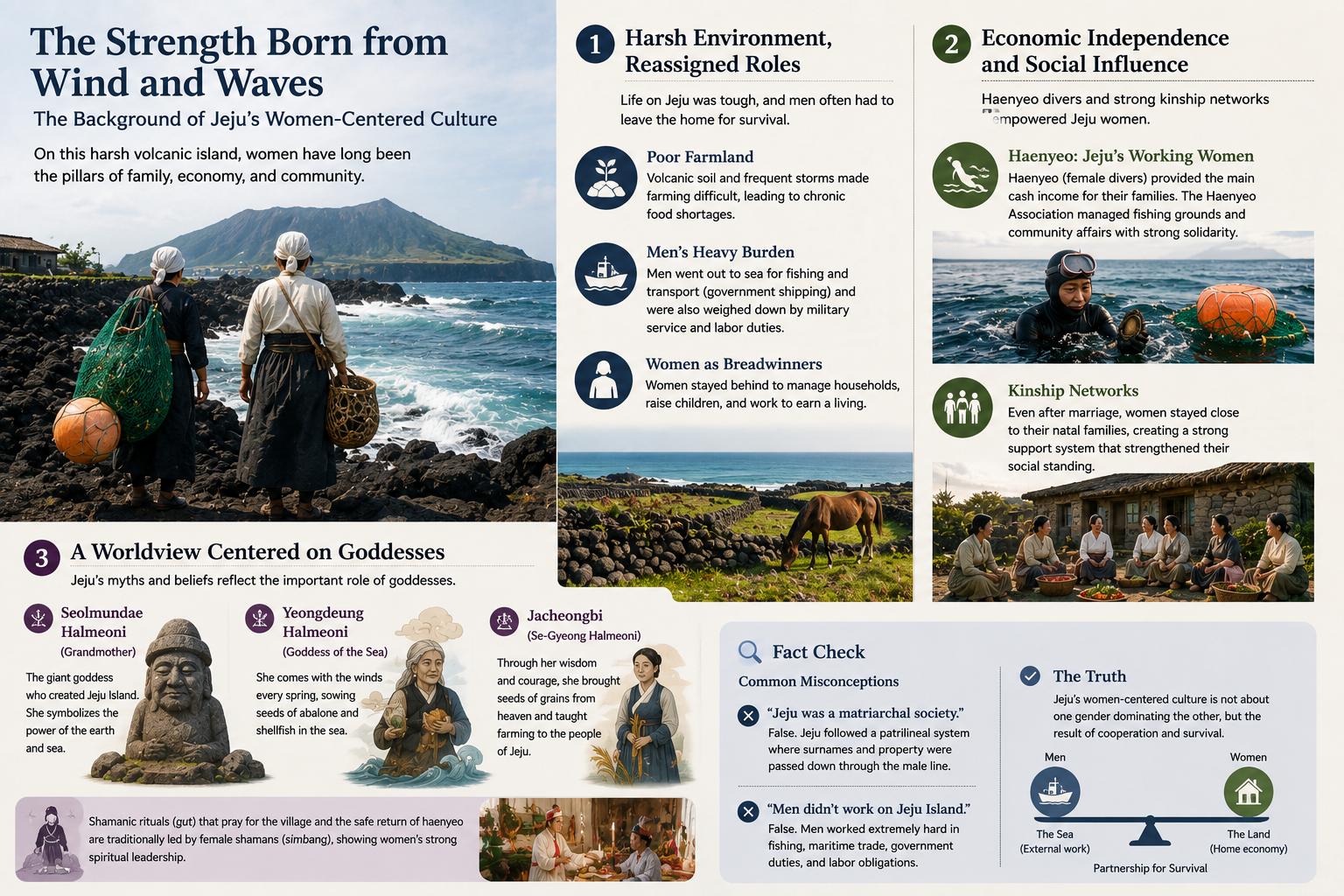
Jeju Island, off the southern coast of Korea, is often described as having a distinctly "women-centered culture." Behind this observation lies not a simple reversal of gender roles, but a remarkable story of survival, labor, and community forged by a harsh volcanic landscape and an unforgiving sea.
In This Article
A Harsh Environment and the Reshaping of Roles
The roots of Jeju's women-centered culture lie above all in its unforgiving geography. As a volcanic island blanketed in basalt rock, Jeju's soil allowed rainwater to drain straight through, making wet-field rice farming nearly impossible. Dry-field crops, too, were regularly devastated by typhoons and droughts.
With farming unable to sustain a livelihood, Jeju's men were compelled to take to the sea—fishing, transporting goods to the mainland through dangerous waves, and bearing the weight of military corvée, forced labor, and the administration of exile settlements. The dangers and intensity of this work left men unable to consistently provide for their households.
Faced with this reality, the women left behind had little choice but to become the primary breadwinners of their families. Out of necessity, they stepped into economic roles that would eventually define Jeju's cultural identity.
Economic Independence and the Haenyeo Network
The most decisive force behind Jeju women's economic centrality was mulil—free-diving, or breath-hold diving for seafood. Known as haenyeo (해녀, sea women), these divers plunged into cold waters without any breathing apparatus, harvesting abalone, conch, and other marine produce. Their earnings constituted the household's primary cash income and funded their children's education, effectively making them the family's de facto heads.
The haenyeo-hoe (해녀회), a self-governing association of village diving women, went far beyond managing fishing grounds and harvest rules. It functioned as a powerful female-centered social network with broad influence over community affairs. In 2016, this haenyeo culture was inscribed on the UNESCO Representative List of the Intangible Cultural Heritage of Humanity.
Another key factor was the relationship Jeju women maintained with their birth families after marriage. While Confucian norms on the mainland often expected married women to sever close ties with their natal kin, Jeju women typically continued to live near their families of origin and relied on those networks for social and practical support. This proximity preserved women's social standing and voice within the community in ways that differed markedly from mainland Korean society.
Goddesses, Shamans, and a Female-Centered Worldview
Jeju's women-centered orientation is also reflected in its mythology and religious life. The island's most important creation and cosmological myths feature powerful female deities.
- Seolmundae Halmang — A colossal creator goddess said to have formed Jeju Island itself. She is depicted not as a heavenly figure but as a powerful earthly and oceanic mother.
- Yeongdeung Halmang — A sea goddess who arrives on the wind each lunar February, scattering seeds of abalone and conch across the ocean before departing.
- Jacheongbi (Segyeong Halmang) — A goddess of the earth who, through her own wisdom and courage, overcame great trials and brought the seeds of the five grains down from the heavens to teach Jeju people how to farm.
The role of simbang—the shamanic ritual specialists who pray for village safety and the safe return of diving women—has historically been filled predominantly by women. This extended female influence into the island's spiritual domain as well.
Fact Check: Not a Matriarchy
A common misconception frames Jeju as a fully matriarchal society, or alternatively as a place where men were simply idle. Neither characterization is historically accurate. Jeju, like the rest of Korea, operated within a patrilineal system in which surnames and property were passed through the male line.
What Jeju's women-centered culture actually represents is not a binary power shift in favor of women, but rather a division of labor forged by necessity. Men faced the deadly frontier of the sea and state obligations; women anchored the domestic economy and the land. It is more accurately understood as a story of mutual dependence and resilience—two groups bearing different, equally demanding burdens to survive together on a difficult island.