


Soul Food of the Island: The History and Culture Behind Jeju "몸국 (Momguk)"
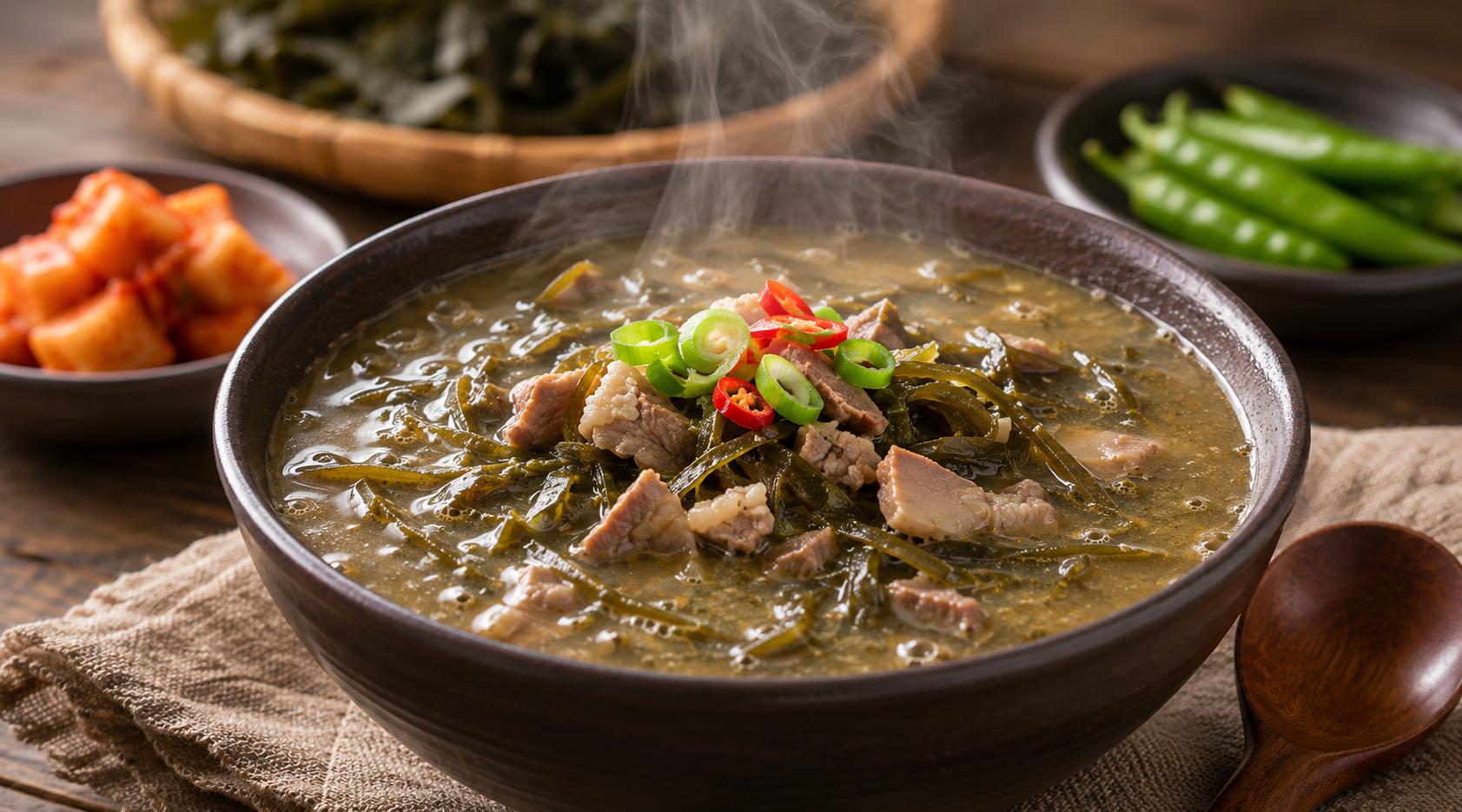
On the volcanic island of Jeju, where rocky soil and fierce winds once made rice farming nearly impossible, a humble bowl of soup tells the story of an entire community. Momguk—a thick, earthy broth of pork and sea mustard—is Jeju's soul food, born from ingenuity, scarcity, and the island's remarkable spirit of sharing.
In This Article
What Is Momguk?
If you browse a menu at a local restaurant on Jeju Island, you may come across a dish with an unfamiliar name: momguk. Unlike the clear broths common in mainland Korean cuisine, momguk is a thick, greenish-brown soup that immediately fills the mouth with the deep, rich flavor of pork broth and a subtle scent of the sea.
More than just a regional specialty, momguk carries within it the history, climate, and communal spirit of Jeju. It is Jeju's soul food in the truest sense.
The Ingredients Behind the Name
The word mom in momguk is the Jeju dialect word for mojaban—a type of seaweed known in English as gulf weed or sea mustard. This seaweed grows on the clean rocky shores of Jeju's coastal waters and is prized for its dietary fiber, minerals, and its distinctive texture that bursts lightly in the mouth.
A second essential ingredient is buckwheat flour. Because Jeju's volcanic basalt soil and strong winds severely limited rice cultivation compared to the mainland, buckwheat became a widely grown alternative crop on the island. In the final stage of cooking momguk, buckwheat flour is stirred into the broth. This not only thickens the soup to its characteristic consistency but also deepens and enriches its overall flavor.
The Nutritional Wisdom of Island Life
Momguk is a testament to what might be called the aesthetics of thrift—a dish shaped by the historical reality of Jeju as an isolated island where ingredients were precious.
In the past, a pig was slaughtered only on significant occasions such as weddings or funeral rites. When that rare event occurred, the lean meat was sliced and served to guests, while the remaining bones, head, offal, and the broth from boiling the meat were all gathered into a large pot and simmered for hours. Nothing was wasted.
The rich pork broth, combined with dried mojaban harvested from the winter sea, produced a deeply satisfying meal even without large amounts of meat. The seaweed was thought to balance the fattiness of the pork, while the buckwheat flour added carbohydrates—together creating a dish that was nutritionally well-rounded in a time and place where such balance was hard to come by.
A Feast Food and the Spirit of Sunurum
Today, momguk can be ordered at many restaurants across Jeju, often enjoyed as a hangover remedy or a hearty morning meal. But historically, it was a ceremonial dish associated with major village gatherings.
Jeju's weddings and funeral ceremonies often lasted several days, during which a large iron cauldron would be set up in the courtyard and momguk would be kept simmering continuously to feed the stream of guests. While the pork meat itself was distributed in measured portions—a practice known as bantaegi—the momguk was replenished with more seaweed and broth so that everyone in the village could eat their fill. It was, in that sense, the dish of abundance and equality.
This practice was deeply intertwined with sunurum, Jeju's tradition of communal cooperation in which neighbors would come together to help one another with major events. The sharing of momguk was one of its most tangible expressions.
How to Enjoy Momguk
For first-time visitors, momguk can feel unfamiliar—its thick consistency and the weight of the pork broth may take a moment to get used to. A helpful tip: try adding a small amount of minced cheongyang chili pepper or chili powder, which is usually placed on the table. The heat cuts through the richness of the broth and transforms the experience. It becomes easy to understand why momguk is considered one of Jeju's defining hangover soups.