


Eunjangdo (은장도): A Traditional Korean Silver Craft Accessory
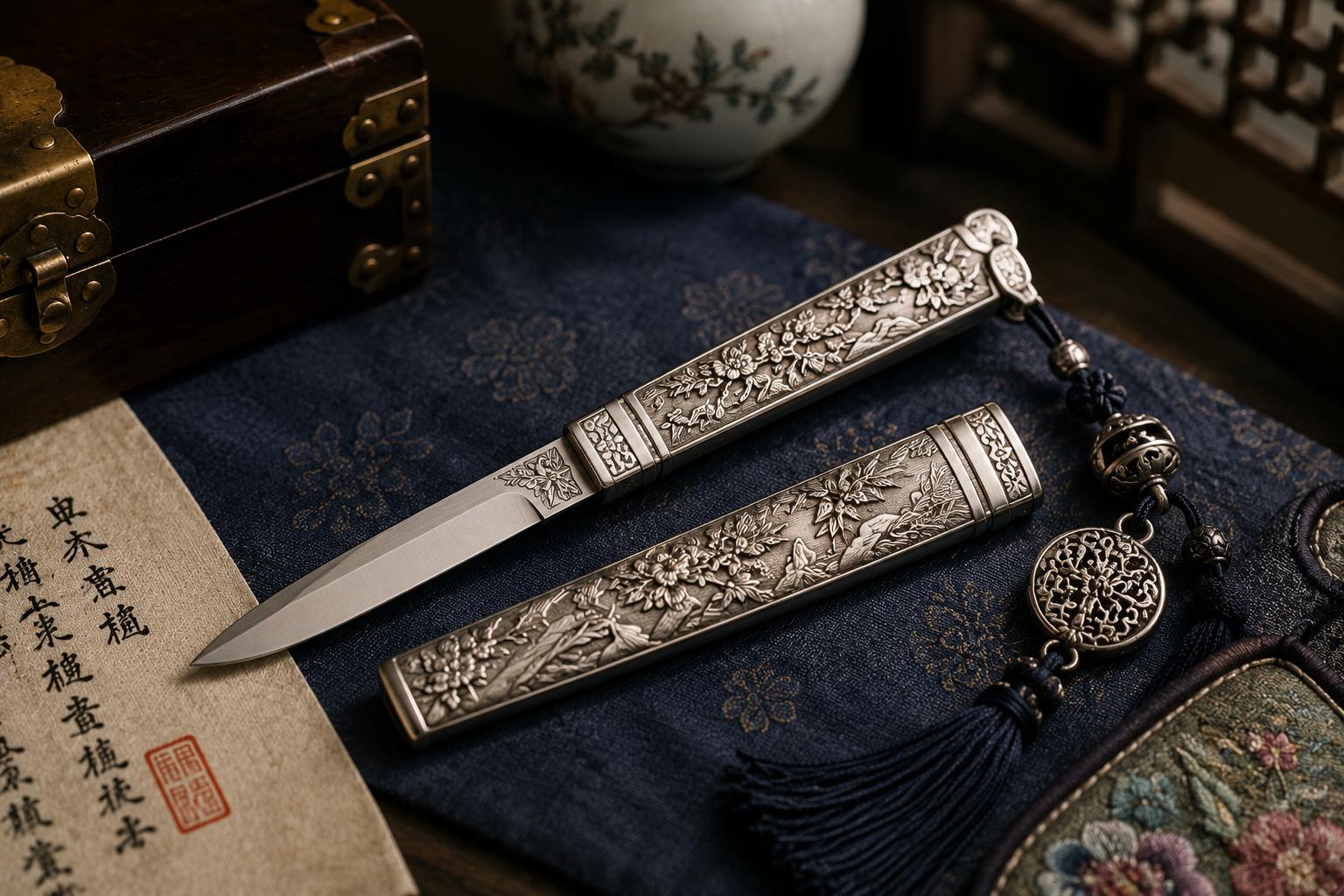
The 'Eunjangdo' (silver ornamental knife) was a daily companion for the nobility and women of the Joseon Dynasty. Beyond its reputation, we explore its value as a refined piece of traditional Korean metal craft that balanced artistic beauty with daily utility.
In This Article
What is the Eunjangdo?
The Eunjangdo (silver ornamental knife) is a portable knife made of silver, holding significance that surpassed that of a simple tool for people of the Joseon Dynasty. It was a craftwork that condensed the finest metalworking techniques of the time and served as an important ornament indicating one's status and dignity.
A Portable Craft for Daily Life
The 'Jangdo' was a widely used portable tool in the Joseon Dynasty, with the Eunjangdo emphasizing decorative and artistic aspects. In an era when knives and scissors were scarce, the Eunjangdo was utilized for simple daily tasks such as cutting thread or paper. The scabbard and hilt of the Eunjangdo were engraved with sophisticated silver filigree techniques, along with patterns favored by scholars of the time, such as flowers and landscapes.
A Symbol of Status and Refinement
The Eunjangdo went beyond being a mere living tool, functioning as an ornament that revealed the wearer’s social standing and personal taste. Pieces made with precious materials like gold, silver, jade, and coral were particularly prized by the royal family and noble scholar-official households for their rarity and artistic value. They were even considered valuable enough for kings to bestow upon their subjects as rewards.
Traditional Craftsmanship of Joseon
While often known only as a tool for self-defense or specific situations, the Eunjangdo was originally a customary tool carried on one's person in daily life. Although it was sometimes interpreted in the late Joseon period as a symbol of female chastity, its essence lies in being an artwork showcasing Korea's high-level metal craft techniques.
Many surviving Eunjangdo are currently housed in museums and are evaluated as representative relics demonstrating traditional Korean metal craft. Some have been designated as cultural heritage, serving as precious records of lifestyle that show how our ancestors harmonized practicality with aesthetic beauty.