


What Was Once a War Refuge Became Korea’s Most Beautiful Seaside Village
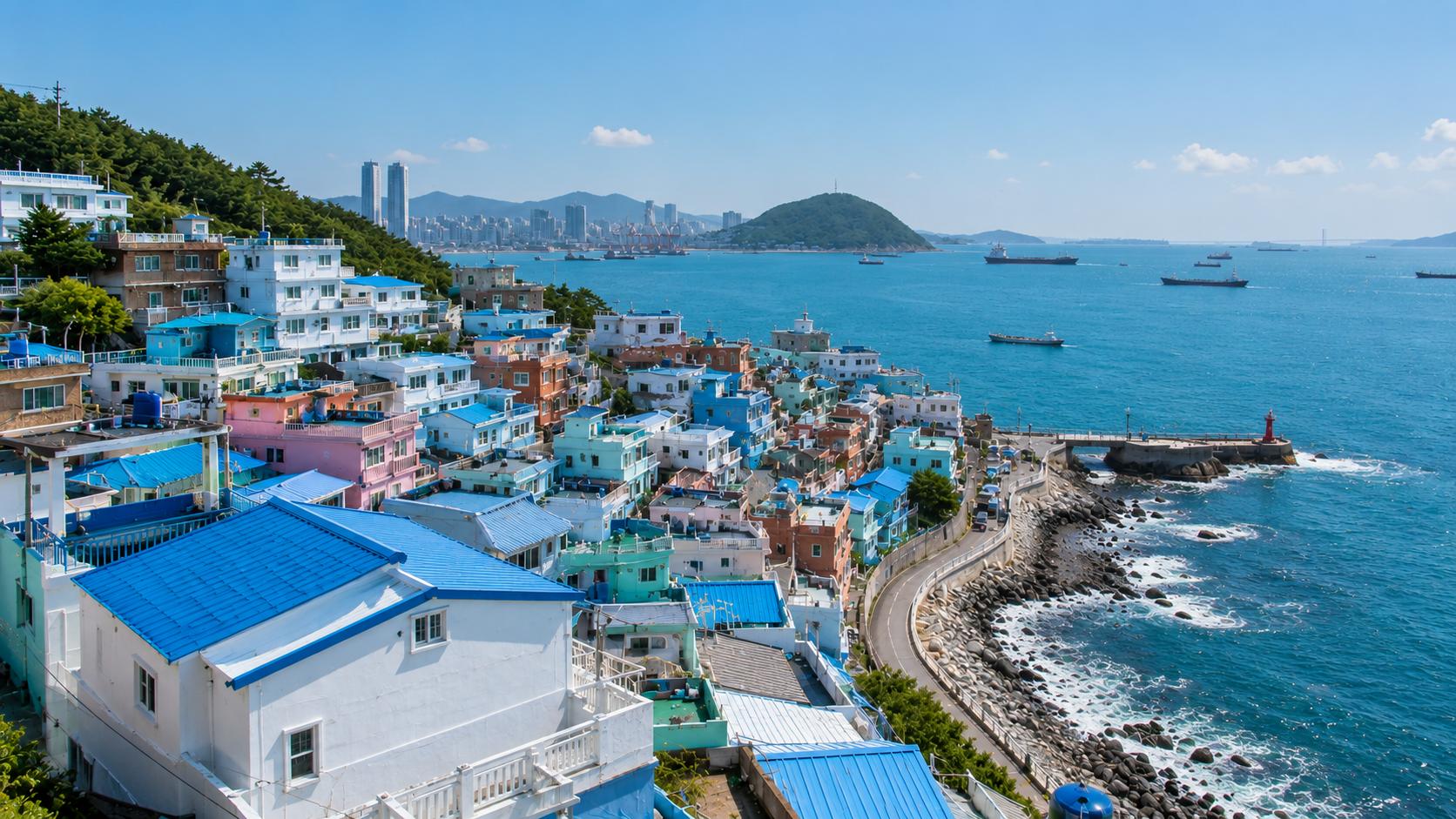
Perched precariously on the coastal cliffs of Yeongdo Island in Busan, a cluster of pastel-toned houses looks out over the vast, shimmering Korea Strait. This is Huinnyeoul Culture Village. Often romanticized by digital travelers as the "Santorini of Korea," this coastal enclave holds a identity that is far deeper and more uniquely Korean than any Mediterranean comparison. Once a desperate refuge for displaced families during the Korean War, these narrow cliffside alleys have transformed into a vibrant cultural sanctuary. Here, the relentless speed of modern Korea softens into the rhythm of breaking waves, offering a visual and emotional escape found nowhere else in Busan.
In This Destination
Beyond the "Santorini" Label: A Story of Survival
At first glance, the white-washed walls and blue accents lining the cliffs of Huinnyeoul easily evoke images of the Aegean Sea. Yet, to call it simply "Korea’s Santorini" misses the soul of the village. The name "Huinnyeoul" comes from the white water streams that used to cascade down Mount Bongrae like twisting silver threads. Its history, however, belongs to the mid-20th century, when refugees carved out tightly packed shelters on this steep, rocky edge. What began as a place of survival has been preserved not through luxury reconstruction, but through a collective artistic rebirth, making its beauty deeply grounded in human resilience.
The Geometry of Cliffside Alleys
Walking through Huinnyeoul is an exercise in slow, mindful exploration. The village is defined by a single, narrow spine of a coastal path where cars cannot enter. Houses are built so closely together that neighbors share walls, and every turn reveals a sudden, breathtaking frame of the ocean between mismatched rooftops. Small, weathered wooden benches sit outside doorways, and potted plants line the stone steps that plunge straight down toward the sea wall below. The architecture is organic, chaotic, and entirely intimate—a stark, poetic contrast to the sterile, high-rise marine cities gleaming across the bay.
Where the Sea Meets Art and Cinema
In recent years, the quiet village has captured the imagination of artists, indie cafe owners, and filmmakers alike, serving as the atmospheric backdrop for iconic Korean films like The Attorney (변호인). Former empty houses have been gently converted into tiny independent bookstores, ocean-facing craft studios, and minimalist cafes where tables look directly out onto the water. Local residents and visiting creators co-exist along these paths. Visitors instinctively find themselves lowering their cameras to listen to the soft murmur of wind chimes blending with the deep roar of ships anchored in the distant harbor.
A Sunset at the Edge of the World
The ultimate magic of Huinnyeoul unfolds late in the afternoon. As the sun begins to dip below the horizon, the coastal cliffs lose their pastel brightness and take on a deep, cinematic glow. The shadows of the tightly clustered houses stretch across the stone paths, and the ocean transforms into a sheet of liquid bronze. Down below, the Huinnyeoul Coastal Tunnel offers a dramatic, silhouettes-only view of the horizon. For travelers seeking a destination in Busan that combines raw coastal geometry, deep historical memory, and an unmatched sense of stillness, this cliffside village provides a space to simply watch the tide change.