


Mujigae-Tteok: The Korean Rainbow Rice Cake That's More Than a Pretty Dessert
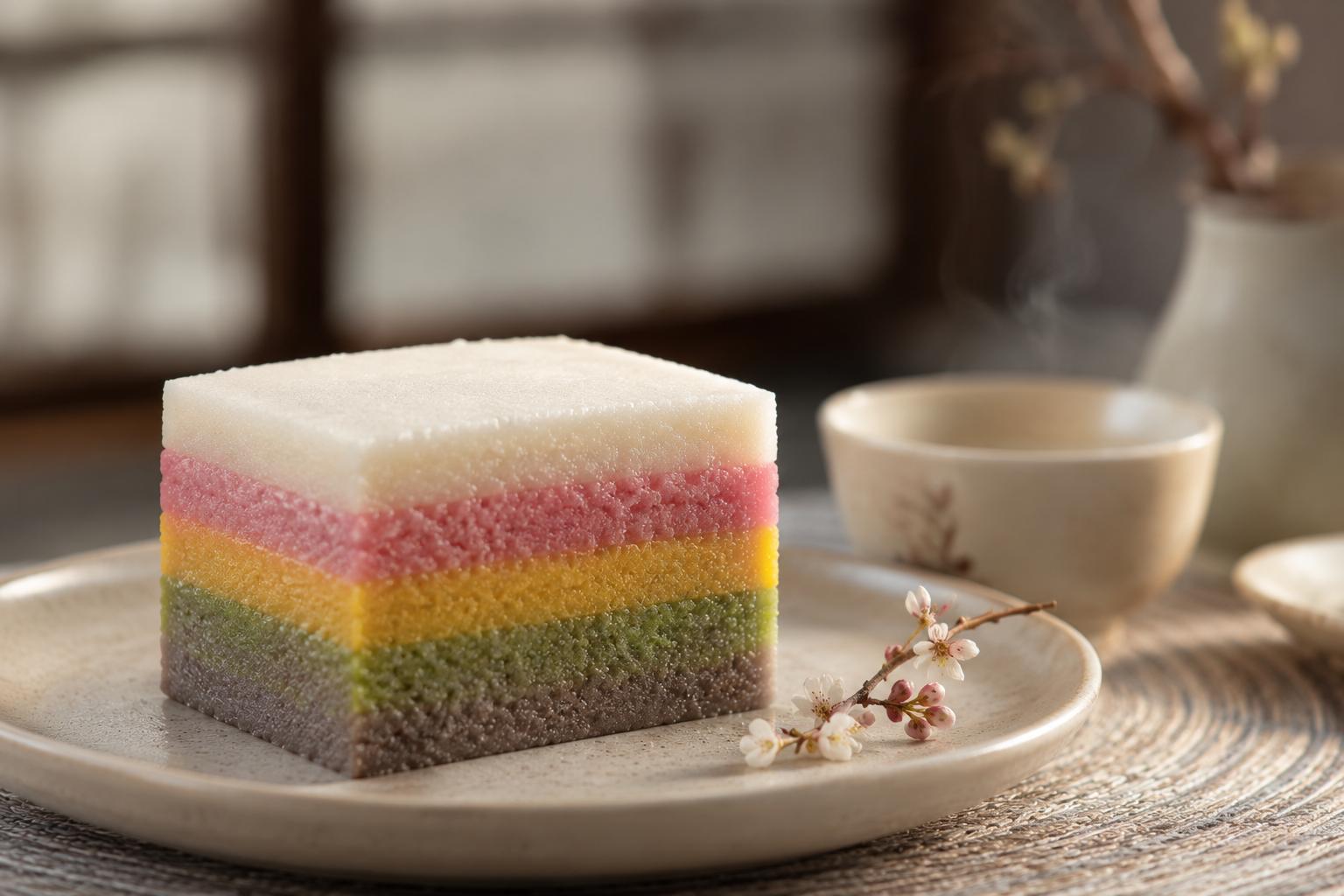
Mujigae-tteok — Korea's layered rainbow rice cake — isn't just a colorful dessert. It's a centuries-old expression of celebration, natural beauty, and the deep cultural weight Koreans place on tteok.
In This Article
Mujigae-Tteok — Korea's Rainbow Rice Cake, Explained
If you've attended a Korean first birthday, a wedding, or a hwangap — the milestone 61st birthday that marks the completion of five full 12-year lunar cycles — there's a good chance you've seen mujigae-tteok. Stacked in vivid horizontal layers of white, pink, yellow, green, and grayish brown, it looks almost too deliberate to be edible. That deliberateness is the point. Every layer is intentional, and its presence at a celebration carries meaning that goes well beyond flavor.
What It Is and Where the Name Comes From
Mujigae-tteok (무지개떡) translates literally to "rainbow rice cake" — mujigae means rainbow, and tteok is the broad Korean word for rice cake. The popular Korean recipe developer Maangchi has noted that the name itself reflects how her ancestors drew inspiration from natural beauty and wove it into everyday life. It's also known by two alternate names: saektteok (색떡) and saekpyeon (색편), both of which mean "colored rice cakes," though these terms emphasize the visual quality rather than the rainbow shape.
As a food, mujigae-tteok belongs to the seolgi-tteok family — steamed, non-glutinous rice cakes with a softer, more crumbly texture than the chewy, pounded varieties most non-Koreans associate with tteok. What sets it apart from its plainer sibling, baek-seolgi (a white steamed rice cake), is the addition of natural colorings layered into the flour before steaming.
When It's Made — and Why It Matters
Mujigae-tteok is a ceremonial food — you wouldn't typically find it at a casual meal or a street food stall. Its primary occasions are doljanchi (the first birthday celebration), weddings, and hwangapjanchi (the 61st birthday feast). The 61st birthday holds particular significance in Korean culture: it marks the moment when a person has completed five full cycles of the 12-year East Asian zodiac calendar, which traditional Korean reckoning treats as a symbolic rebirth.
The broader significance of tteok in Korean culture is hard to overstate. Tteok making was officially designated a national intangible cultural heritage by Korea's Cultural Heritage Administration, which noted that records of rice cake preparation appear in historical documents stretching back to the Three Kingdoms Period (57 B.C.–A.D. 668). Tteok is considered a symbol of jeong — a Korean concept that loosely translates to a feeling of deep affection and communal bond — and the tradition of making and sharing rice cakes for celebrations and new beginnings continues to this day. When someone opens a business or moves into a new home, for instance, distributing tteok to neighbors remains a common gesture of goodwill.
Mujigae-tteok, with its layered colors and labor-intensive preparation, sits near the top of this symbolic hierarchy. Making it by hand takes roughly one to two hours and involves working each layer of colored rice flour separately by hand before sifting and steaming. As Maangchi puts it, if you're making this cake for someone very special, the time and effort aren't really the point.
What Goes Into It
The base of mujigae-tteok is sweetened, non-glutinous short-grain rice flour — the same wet-milled mepssalgaru used in many other steamed tteok varieties. The flour is first soaked, ground, mixed with honey or a sugar solution, rubbed between the palms until the moisture is evenly distributed, and then sifted before being divided into portions for each color layer.
Traditionally, the colors come from entirely natural sources. Gardenia extract provides yellow; mugwort powder (ssukgaru) gives green; cactus fruit or a small amount of natural dye gives pink; and rock tripe — a type of edible lichen — produces the distinctive grayish-brown layer. White is simply the unseasoned base flour. According to Saveur, the five layers are most commonly stacked in this order from bottom to top: brown, green, yellow, pink, and white, though the arrangement can vary. Each layer is typically about two centimeters thick and is laid onto a cloth-lined siru (traditional earthenware steamer) before the whole cake is steamed together.
Modern home recipes often substitute more accessible colorings — matcha for green, butterfly pea powder for purple, red yeast powder or strawberry powder for pink — while keeping the layering and steaming method the same. The result is visually similar, though the flavor profile shifts slightly with each substitution.
Modern Variations
Contemporary tteok culture in Korea has embraced mujigae-tteok's visual appeal in new contexts. In Seoul and other cities, tteok cafés have emerged as a growing niche — spaces where traditional rice cakes are served alongside coffee and tea, often targeting younger Koreans and tourists who might not have grown up making tteok at home. Some of these cafés offer mujigae-tteok as a specialty item, sometimes reformatted into smaller individual portions or with modern flavor additions like matcha, yuzu, or even black sesame cream between layers.
Outside Korea, Korean-American communities have also adapted the cake for diaspora contexts. Recipe developer Christine Han has shared a version using strawberry and matcha powders, designed to be approachable for cooks who don't have access to traditional Korean specialty ingredients. The growing global interest in Korean food — driven by hallyu, the Korean cultural wave that includes K-pop and K-dramas — has brought mujigae-tteok to audiences who might otherwise never have encountered it. For many outside Korea, it arrives first as an image: something bright and geometric and unexpectedly beautiful, a cake that looks more like it belongs in an art installation than on a celebration table. That impression, it turns out, is not far from the original intention.