


Cheonmachong: The Royal Tomb You Can Walk Into
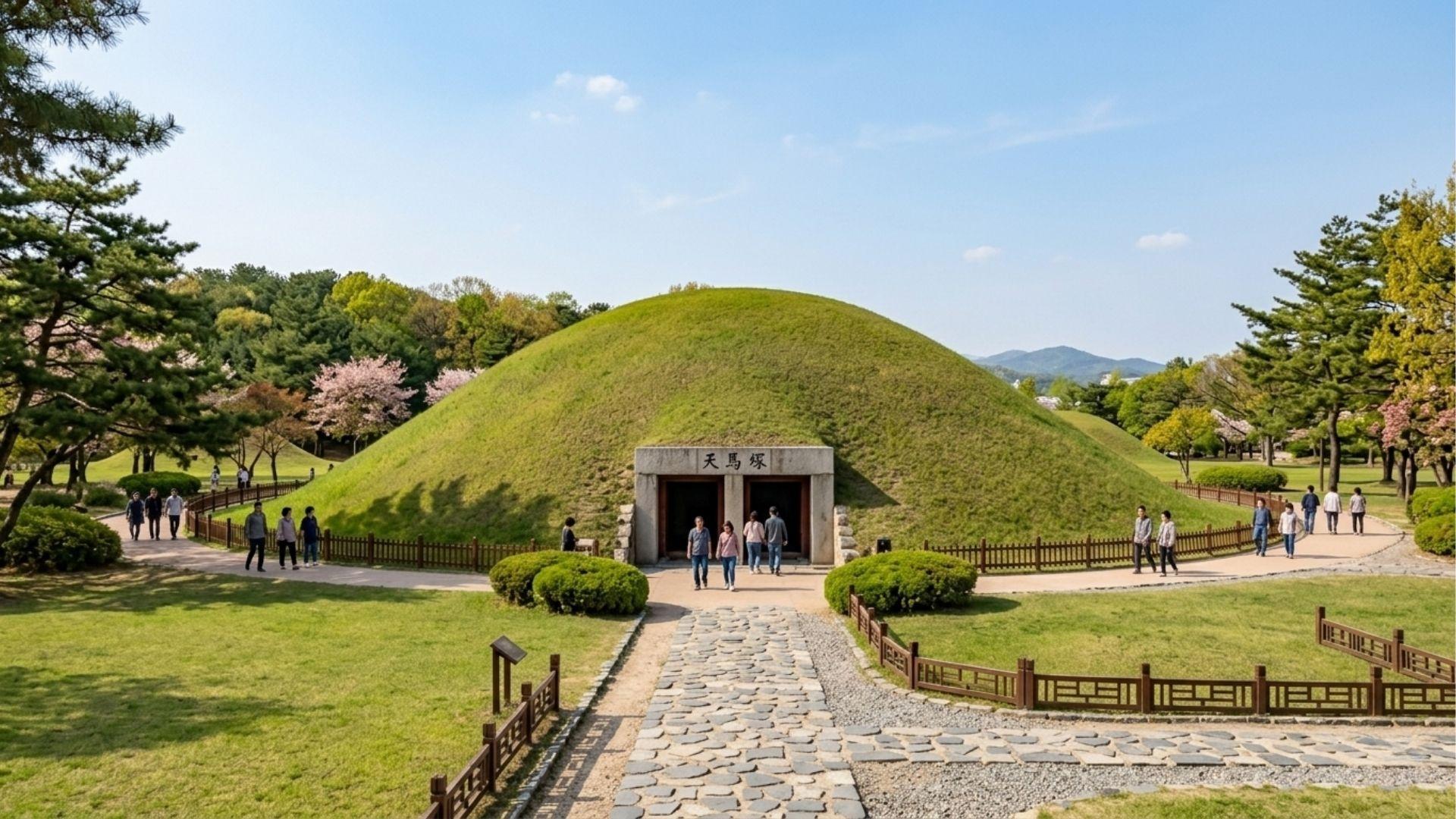
Somewhere in the middle of Gyeongju, a city that functions as an open-air museum of the ancient Silla Kingdom, you can walk down into a royal tomb that is over 1,500 years old. Cheonmachong — Tomb of the Heavenly Horse — is one of the few burial mounds in the world where visitors are permitted to step inside and stand within the original burial chamber. Part of the Daereungwon Tumuli Park complex, it sits within the Gyeongju Historic Areas, designated a UNESCO World Heritage Site in 2000. For anyone traveling through Korea, it offers something genuinely rare: direct, physical proximity to the deep past.
In This Feature
A Tomb You Can Actually Enter
Most ancient burial sites in the world are viewed from a distance — cordoned off behind barriers, visible only through glass, or accessible solely to researchers. Cheonmachong is different. Since its excavation in 1973, the tomb has been open to the public as a walk-in exhibit, allowing visitors to descend into the interior and stand directly inside the burial space of a Silla monarch from the 5th or 6th century.
This is not a reconstruction or a replica. The mound itself — roughly 47 metres in diameter and 12.7 metres tall — is the original earthen tumulus, and the chamber inside has been preserved and displayed in place. Walking in, you are entering the same structure that was sealed over a king for more than a millennium before its modern discovery.
What's Inside: The Burial Chamber
The interior of Cheonmachong is dim, cool, and unexpectedly intimate for a space of such historical weight. The burial chamber is displayed with replicas of the original artifacts found during excavation — including a gold crown, gold belt ornaments, and horse-riding equipment — arranged to reflect how they were positioned when the tomb was first unsealed.
The tomb takes its name from the Cheonmado, or Heavenly Horse painting — a birch bark saddle flap decorated with a white horse in flight, discovered among the grave goods. It was the first ancient painting ever found on the Korean peninsula, and remains one of the most iconic artifacts of the Silla era. The original is now held at the Gyeongju National Museum; what you see inside the tomb is a faithful reproduction displayed in context.
Daereungwon and the UNESCO Designation
Cheonmachong is one of 23 burial mounds within Daereungwon Tumuli Park, a walled enclosure in the center of Gyeongju that preserves the largest concentration of Silla royal tombs in Korea. The scale of the site is striking — enormous grass-covered mounds rise directly from the ground between walking paths, with the modern city visible just beyond the perimeter wall.
The park forms part of the Daereungwon Tumuli Zone, one of five designated zones that together make up the Gyeongju Historic Areas — a UNESCO World Heritage Site since 2000. The designation recognizes Gyeongju as one of the most significant repositories of East Asian cultural heritage, preserving over a thousand years of Silla history across palaces, temples, pagodas, and royal burial grounds spread across the city and its surrounding landscape.
Visiting Cheonmachong
Daereungwon Tumuli Park is located in central Gyeongju, within walking distance of the city's main downtown area. Entry to the park includes access to Cheonmachong's interior. The site is well-maintained and easy to navigate, with pathways looping between the mounds and clear signage in Korean and English throughout.
A visit pairs naturally with the Gyeongju National Museum, a short distance away, where the original Cheonmado painting and the majority of artifacts excavated from the tomb are on permanent display. Together, the two sites offer a complete picture of what Silla royal burial culture looked like — the physical space of the tomb, and the objects that filled it.