


The Royal Tomb of King Muryeong: East Asia's Only Confirmed Ancient Royal Burial
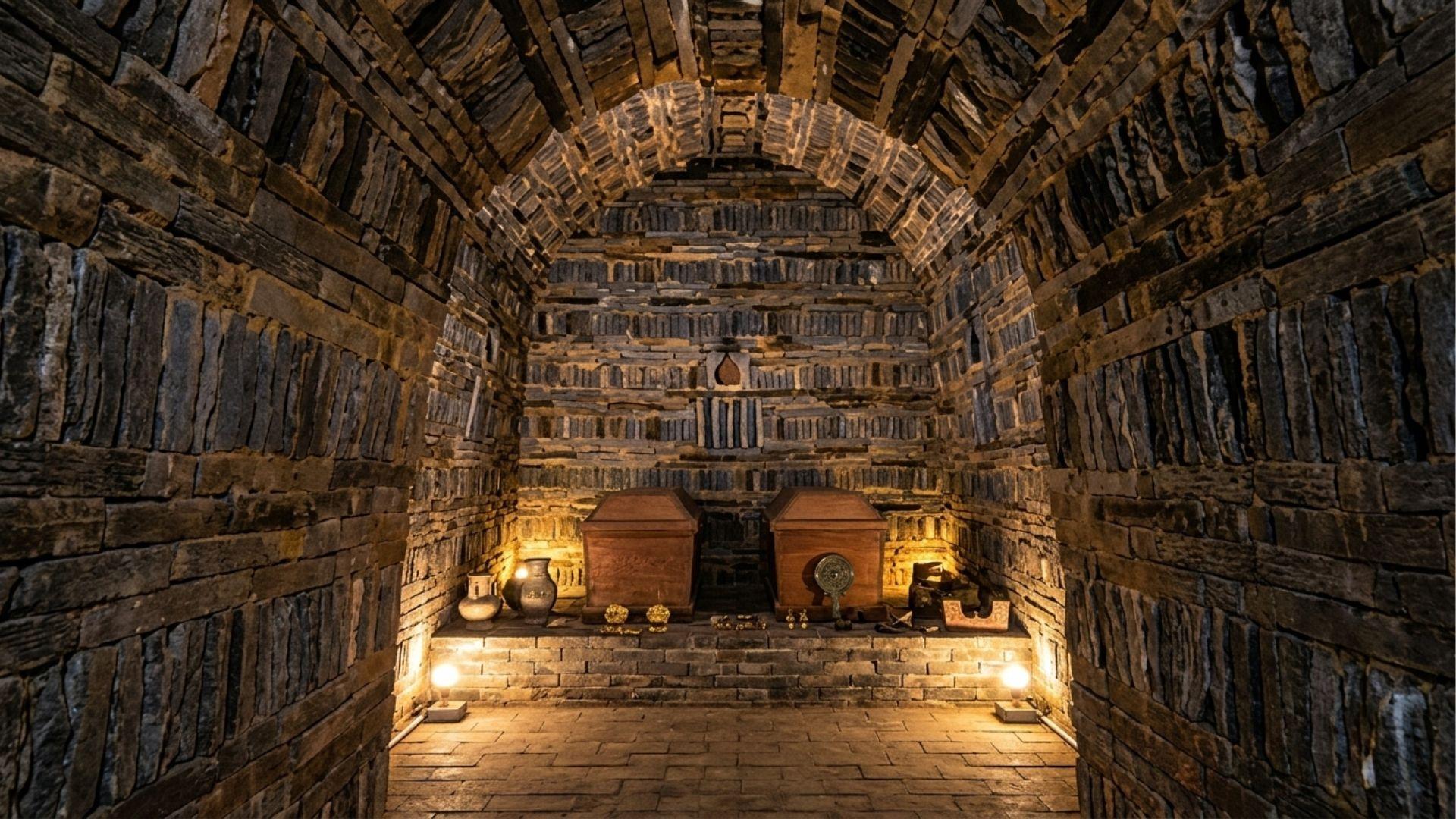
In 1971, a routine drainage repair on a hillside in Gongju, South Korea, accidentally broke through the wall of an undisturbed royal tomb sealed for over 1,400 years. What emerged was one of the most significant archaeological discoveries in Korean history: the tomb of Baekje King Muryeong and his queen, complete with over 5,000 artifacts and — crucially — a stone epitaph that identified the occupants beyond any doubt. It remains the only ancient royal tomb in East Asia whose owner has been confirmed with absolute certainty. Part of the Baekje Historic Areas designated a UNESCO World Heritage Site in 2015, the Royal Tomb of King Muryeong stands as one of the most quietly extraordinary sites on the Korean peninsula.
In This Feature
The Accidental Discovery of 1971
The Royal Tomb of King Muryeong was not found through deliberate excavation. In July 1971, workers carrying out drainage construction near the existing Songsan-ri Tumuli in Gongju inadvertently broke through a brick wall — and found themselves looking into a completely intact burial chamber. No looters had ever reached it. The air inside, sealed since 525 AD, escaped as white vapor when the entrance was first opened.
What followed was one of the most rushed and consequently imperfect excavations in Korean archaeological history. The entire tomb was cleared in just 17 hours under pressure to secure the site. Despite the haste, what was recovered was staggering: 5,232 artifacts, including 17 items later designated National Treasures, emerged from a tomb that had waited undisturbed for nearly fifteen centuries.
Why This Tomb Is Historically Unique
Among the artifacts found near the tomb entrance were two stone epitaphs — burial records inscribed with the name, reign dates, and burial information of King Muryeong and his queen. This made Muryeong's tomb something extraordinarily rare: the only ancient royal tomb in East Asia whose occupant can be identified with complete certainty. For comparison, the vast majority of royal tombs across Korea, China, and Japan — including the great Silla tumuli in Gyeongju — remain unconfirmed in terms of exactly who lies within them.
The tomb's construction also told its own story. Built in the brick-vaulted style of China's Southern Dynasties rather than the traditional Korean stone-chamber method, it provided direct physical evidence of Baekje's active diplomatic and cultural exchange with the Asian continent — a relationship previously known largely through written records alone.
What the Artifacts Reveal
The 5,232 objects recovered from the tomb paint a detailed picture of Baekje royal culture at its height. Gold crown ornaments, bronze mirrors, ceramic vessels, and intricately worked jewelry were found alongside the king and queen's wooden coffins — themselves made from Japanese timber, confirming trade links with the Japanese archipelago. Items reflecting Chinese influence sat alongside distinctly Korean craftsmanship, making the tomb a material record of Baekje's position at the crossroads of East Asian civilization.
Visiting Today
The actual tomb has been closed to the public since 1997 to prevent deterioration — a decision made after years of visitor access caused measurable damage to the interior environment. However, the site includes a full-scale replica exhibition hall where the burial chamber, the placement of the coffins, and the original artifact arrangement have been faithfully reconstructed. The experience of standing inside the reproduction conveys the tomb's intimate scale and the density of what was found within it.
The Gongju National Museum, a short distance away, houses the original artifacts from the excavation in permanent display. Together, the tomb site and the museum form a complete visit — one that traces a single remarkable discovery from the moment of unearthing to its full historical significance.