


Inside the Daily Life of a Traditional Korean Potter
The aesthetics of earth, fire, and patience. What does a day in the life of a potter look like? From the foundational work of preparing clay to the anticipation following firing, we follow the daily routine of a traditional artisan.
In This Article
The Daily Life of a Potter
A potter's day is dictated not by the clock, but by the "moisture level of the clay" and the "temperature of the kiln." Keeping their distance from the pace of modern life, traditional potters flow with the principles of nature, living a day defined by patience and devotion.
Morning: A Conversation with Clay
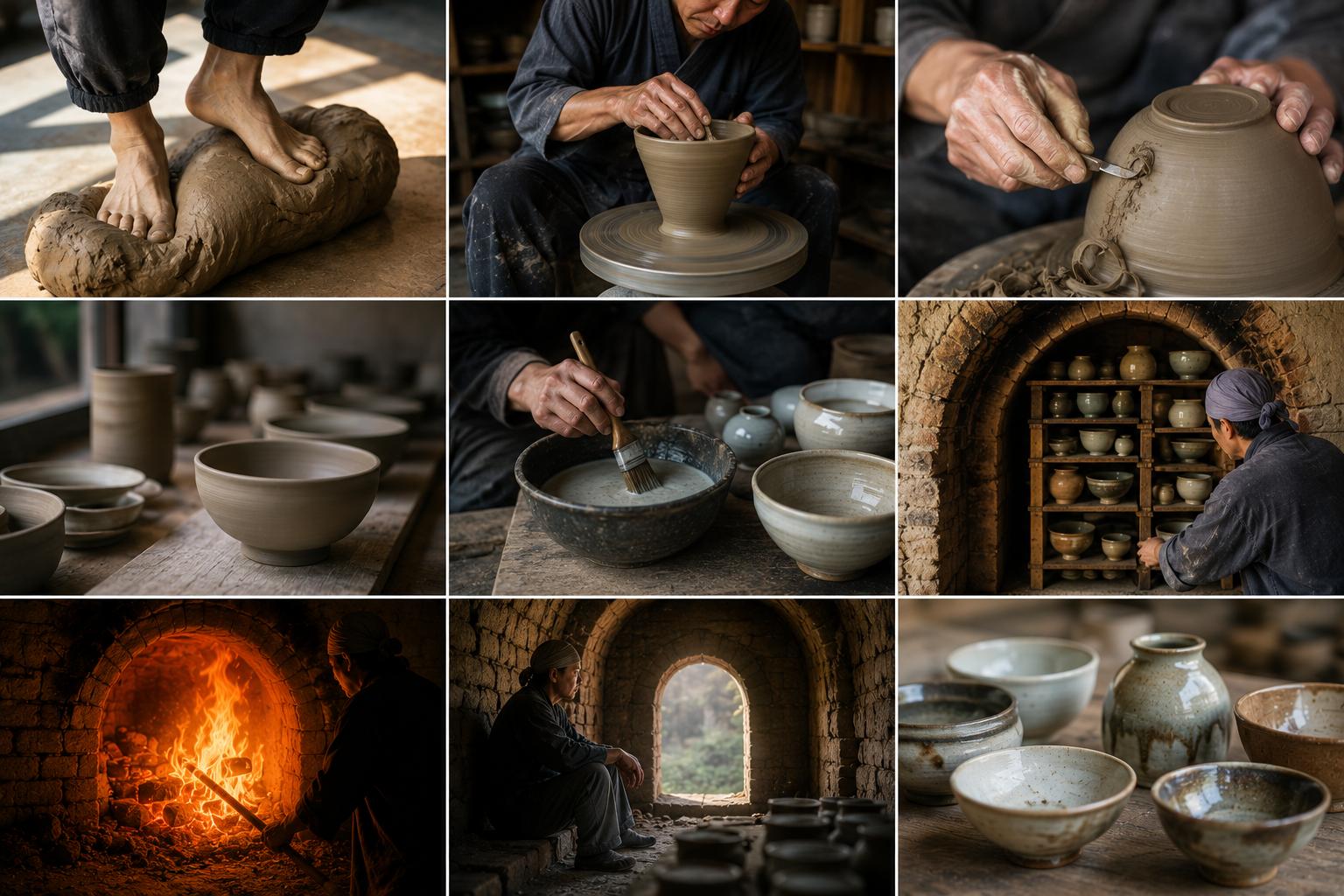
Work begins by checking and preparing the condition of the clay. "Wedging," the process of handling matured clay, is the core foundation of ceramic work. Potters knead the clay by hand or, in traditional methods, step on it with their feet to create uniform moisture and density while removing air bubbles. If this step is flawed, the pottery may burst or warp during firing, which is why potters dedicate significant time to this fundamental stage.
Morning: Throwing and Shaping
Once the clay is ready, the potter sits before the wheel. On the rotating wheel, the clay takes form under the potter's fingertips. Since even the slightest hand movement can alter the shape and thickness of the vessel, the potter exercises intense concentration, breathing life into the clay. Each curve created by the earth embodies the potter's long years of time and seasoned skill.
Afternoon: Refining and Detailing
Once shaped, the pottery undergoes a precise process of trimming the base at the optimal moment. This is followed by adding patterns or applying glazes. Some traditional potters create their own glazes by combining wood ash, feldspar, and clay. After glazing, the pieces undergo another drying stage, completing preparations for the kiln.
The Firing and Patience
On firing day, the potter's routine becomes more intense. Sitting before the firebox of the wood-fired kiln, they carefully adjust the firing conditions by observing the flame color, smoke flow, and chimney exhaust. Even after firing, the kiln cannot be opened immediately. To prevent thermal shock from sudden cooling, which could shatter the wares, they must wait several days for the temperature to drop naturally. This period of patience is as crucial to the potter as the firing itself.
Even for an experienced potter, not every piece turns out perfectly. Cracks or deformations frequently occur during the firing process. Rather than rejecting this uncertainty, potters accept it as a part of the change occurring within the principles of nature, humbly embracing the outcome.
- Wedging: The process of preparing clay by removing air and ensuring uniform density.
- Throwing: Shaping clay on a rotating potter's wheel.
- Firing: Completing the ceramic piece by baking it at high temperatures in a kiln.
- Thermal Shock: Cracking or breaking caused by rapid temperature changes.