


Why Is Jeju's Basalt Black? The Geology Behind Korea’s Volcanic Island
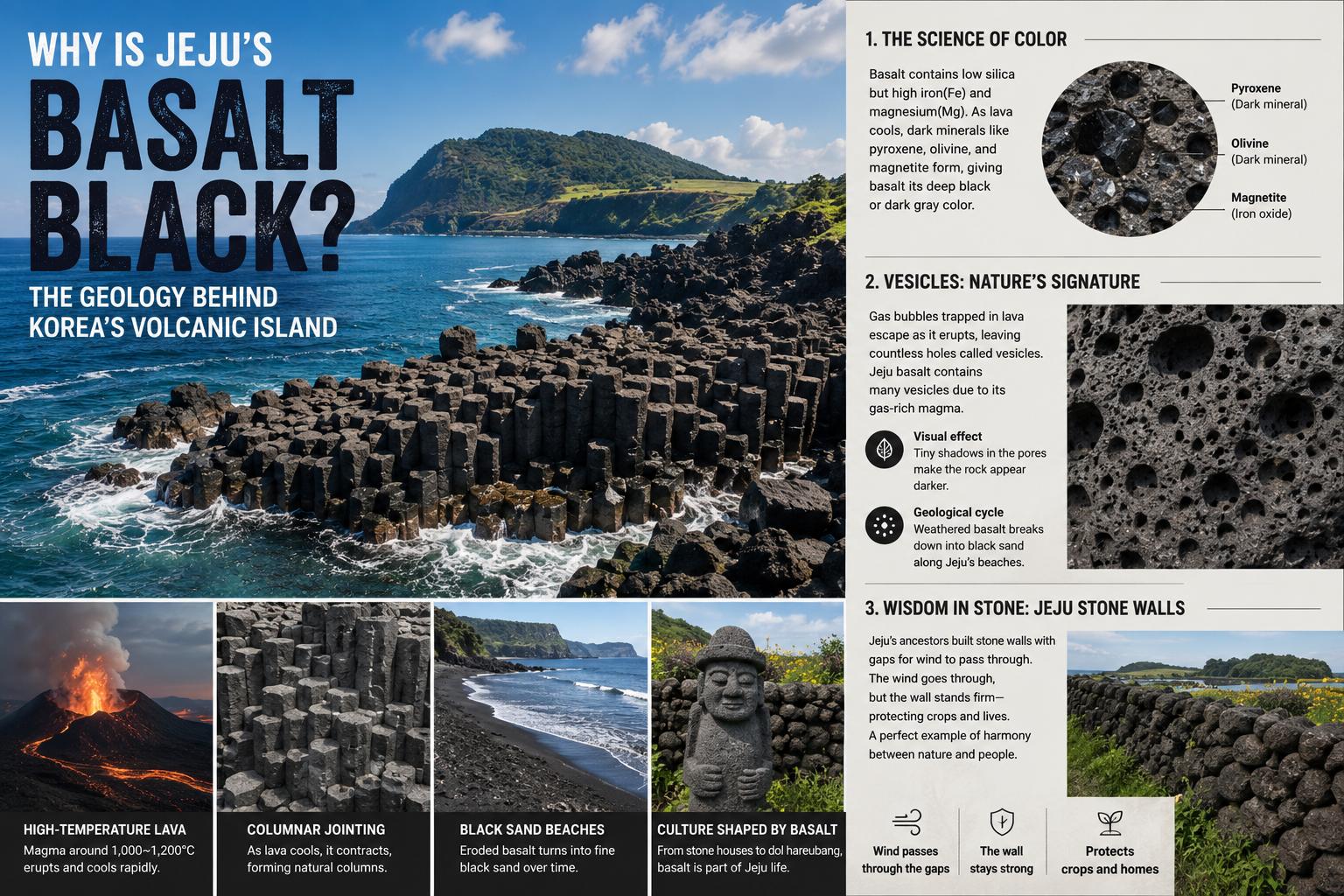
The dark basalt that defines Jeju Island is more than just a scenic element. Formed from lava cooling at temperatures of 1,000–1,200°C, this volcanic rock holds geological secrets and shaped the unique culture of the island.
In This Article
From the coast to the mid-mountain regions, black basalt covers the entirety of Jeju Island. It defines the island's landscape against the backdrop of the blue sea. The reasons behind its dark, robust nature lie in geological necessity.
The Science of Color: Iron and Magnesium
The dark color of basalt stems from its chemical composition. Basalt is a volcanic rock formed when magma—relatively low in silica ($SiO_2$) but very rich in iron (Fe) and magnesium (Mg)—erupts and solidifies on the surface. As the lava cools, minerals like pyroxene, olivine, and magnetite crystallize, giving the rock its deep black or dark gray appearance.
Vesicles and Geological Characteristics
Another defining feature of Jeju basalt is the presence of numerous 'vesicles.' When magma erupts, gases like water vapor and carbon dioxide trapped inside escape rapidly, leaving holes behind. Jeju basalt contains an exceptionally high number of these vesicles, indicating that the erupted lava was highly gas-rich.
- Visual Effect: While vesicles make the rock physically lighter, they create microscopic shadows that make the rock appear darker under natural light.
- Geological Cycle: Over long periods, weathered basalt breaks down into fine particles, contributing to the formation of black sand beaches on Jeju.
A Symbol of Wisdom: Jeju Stone Walls
Basalt has fundamentally changed life on Jeju. Ancestors gathered stones from the barren land to build 'stone walls.' These walls display remarkable geological wisdom; they are not solid, airtight barriers but are designed with gaps to allow wind to pass through. Thanks to these openings, even Jeju’s fierce winds cannot topple the walls, allowing them to serve as protective fences for crops. Held together only by friction without cement, Jeju stone walls are a perfect application of geological principles and human-nature coexistence.