


Jeong(정): The Korean Concept That Takes More Than a Word
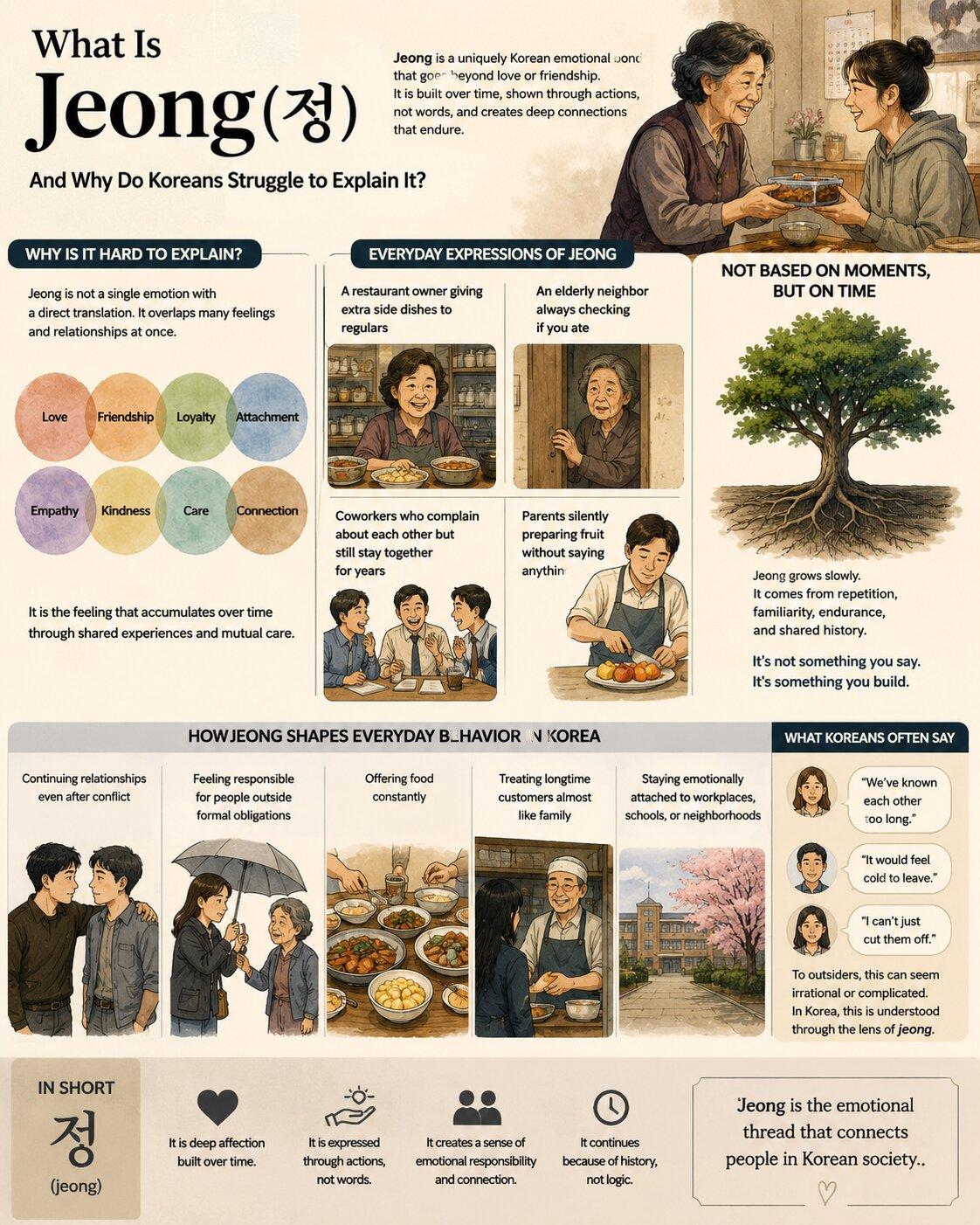
When foreigners first ask Koreans what "정(jeong)" means, the answers tend to follow a pattern: "It's kind of like affection.
In This Article
What Is Jeong — and Why Do Koreans Struggle to Explain It?
When foreigners first ask Koreans what "정(jeong)" means, the answers tend to follow a pattern: "It's kind of like affection." "It's emotional attachment." "It's caring for someone deeply."
Koreans themselves often admit that none of these explanations feel complete. That is because 정 is not a single emotion with a direct equivalent in other languages. It is a cultural relationship framework that shapes how people interact in Korean society.
Unlike emotional concepts that are often individual and explicit, 정 is typically built slowly, shown indirectly, and maintained through actions rather than words — with an expectation that it continues over long periods of time. In Korea, people may fight constantly, complain endlessly, or rarely express affection verbally — yet still feel deeply connected through 정.
Why Does a Single Word Fall Short?
The problem is not vocabulary. The problem is cultural structure. Many languages tend to separate emotions into distinct categories: love, friendship, loyalty, attachment, empathy, kindness. 정 overlaps all of them at once.
Consider these everyday situations: a restaurant owner giving extra side dishes to regular customers; an elderly neighbor constantly checking whether you ate; coworkers complaining about each other while still staying together for years; parents silently preparing fruit without saying anything affectionate.
These are not exactly "love." They are not simply "friendship" either. Koreans often describe these situations as expressions of 정 because the relationship itself has accumulated emotional weight over time. The feeling comes not from dramatic emotional expression, but from repetition, familiarity, endurance, and mutual history.
How Does Jeong Shape Everyday Behavior in Korea?
Many social behaviors in Korea are driven by 정 rather than clear situational logic. Examples include continuing relationships even after conflict, feeling responsible for people outside formal obligations, offering food constantly, treating longtime customers almost like family, and staying emotionally attached to workplaces, schools, or neighborhoods.
In many cultures, relationships are often evaluated through personal boundaries and individual choice. In Korea, relationships are frequently maintained through accumulated emotional responsibility. This is why Koreans may say: "We've known each other too long." "It would feel cold to leave." "I can't just cut them off." — even when the relationship is exhausting.
To outsiders, this can sometimes appear irrational or emotionally complicated. Inside Korean culture, however, this is understood through the lens of 정.
Does Jeong Appear in Korean Online Culture Too?
정 also appears online. Korean online communities often develop strong emotional attachment over time, even among anonymous users. People who argue constantly in the same forum may still remain loyal to that community for years.
Viewers may continue watching creators they complain about daily. Fans may criticize celebrities harshly while simultaneously defending them from outsiders. Foreign users sometimes describe this as contradictory behavior. Many Koreans, however, recognize it immediately as a form of 정.
The emotional connection survives conflict because the shared history itself becomes meaningful.
What Do Foreigners Actually Experience?
In May 2024, an American family traveling in Korea with a young child filmed their experience and shared it online. The video — showing how Koreans repeatedly stopped to engage with their child — was featured on MBC News Today and has since been viewed over 840,000 times on YouTube.
The pattern observed in the video reflects what foreign visitors frequently report: Korean warmth tends to appear suddenly, without explanation, and often without expectation of anything in return. Specific behaviors noted include remembering small details, bringing food without occasion, worrying about someone's daily routine, helping without being asked, and maintaining contact over many years.
In Korea, emotional sincerity is often measured less by words and more by consistent behavior over time. That slow accumulation is what many Koreans mean by 정.
Frontlens Note
정 is difficult to explain because it operates differently from most emotional concepts. It is not a feeling that peaks and fades — it is a bond that builds through repetition, shared time, and unspoken obligation.
As Korean culture reaches broader international audiences through K-dramas, reality programming, and online communities, concepts like 정 are increasingly encountered by people with no prior framework to understand them. It remains one of the more structurally distinct ideas in Korean social life — and one of the harder ones to explain to someone encountering it for the first time.