


The Science in the Soil: How South Korea’s "Jangdokdae" Mastered Natural Biotechnology
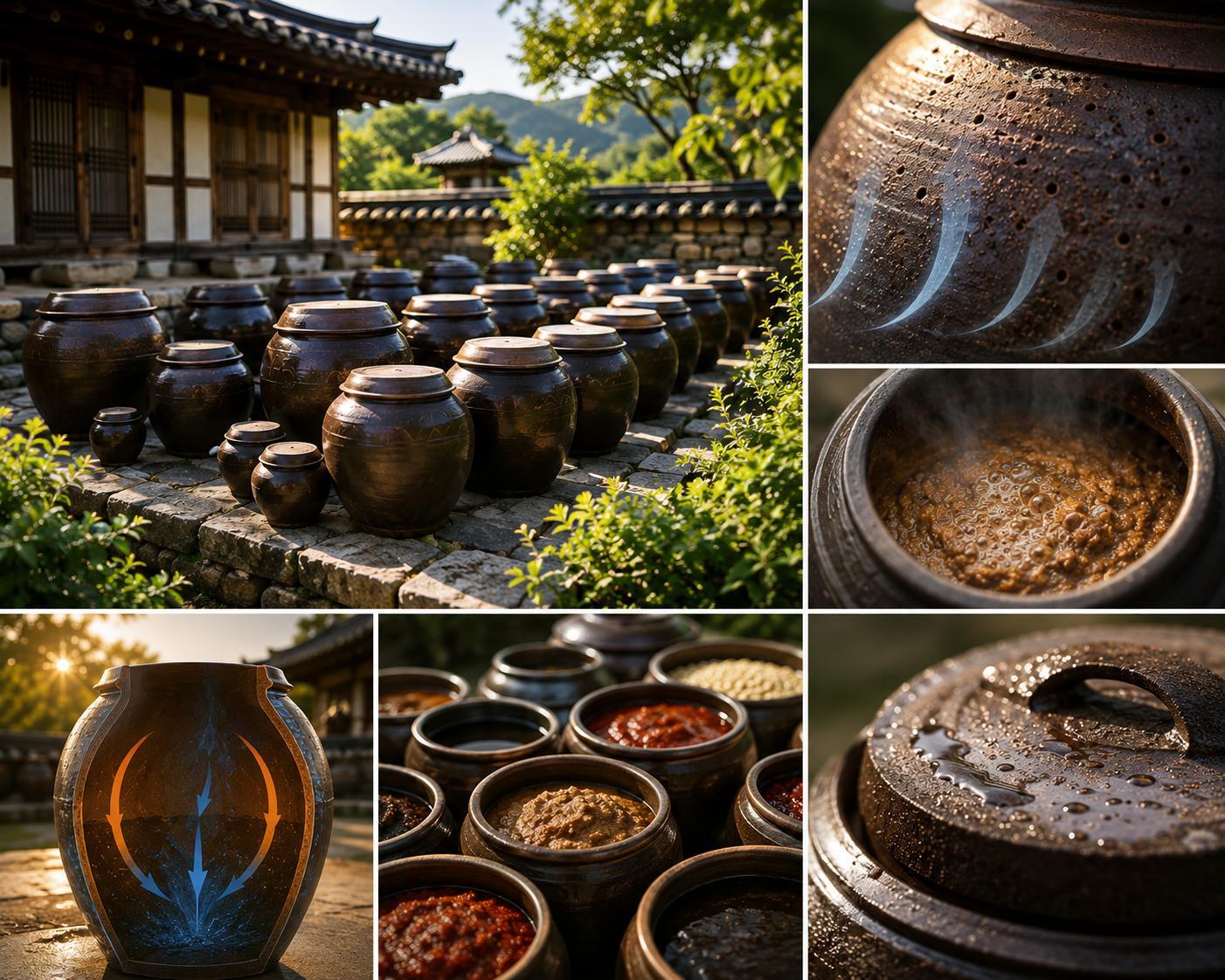
Tucked into the sun-warmed courtyards of traditional Korean homes, a row of dark earthenware jars holds the quiet secret behind Korea's legendary flavors. The jangdokdae—Korea's traditional fermentation terrace—is far more than a storage space. It is a centuries-old natural biotechnology platform, engineered with precision long before the language of science existed to describe it.
In This Article
What Is a Jangdokdae?
Visit a traditional Korean village or a hanok—a traditional Korean house—and you will likely spot a sun-drenched terrace in the corner of the courtyard, lined with earthenware jars of various sizes clustered together. This is the jangdokdae: the dedicated outdoor space where Korea's essential condiments are stored and aged.
The jars hold ganjang (soy sauce), doenjang (fermented soybean paste), gochujang (red pepper paste), and kimchi—the foundational building blocks of Korean cuisine. To foreign eyes, the scene might read as quaint and atmospheric. But viewed through the lens of biology and materials science, the jangdokdae reveals itself as an extraordinarily sophisticated natural fermentation laboratory.
In an era before refrigerators or chemical preservatives, Korean households had mastered the art of food preservation by drawing on principles of physics, thermodynamics, and microbiology—without ever naming them as such.
The Science of Breathing Jars
At the heart of the jangdokdae is the onggi—the traditional Korean earthenware jar. Unlike modern glass or plastic containers, onggi are made from sandy clay mixed with a glaze derived from natural wood ash. When fired in a kiln at temperatures exceeding 1,100°C, the moisture within the clay evaporates, leaving behind countless microscopic pores throughout the vessel walls.
The size of these pores is remarkably precise. Oxygen molecules are small enough to pass through freely, while water droplets are too large to penetrate. This means the jar effectively "breathes."
Fresh oxygen is continuously supplied to the lactic acid bacteria and beneficial microorganisms driving fermentation, while the gases produced during the fermentation process are vented outward. The result is an environment where food matures slowly and deeply, developing complex flavors without spoiling.
Climate Engineering in the Courtyard
A jangdokdae is never placed arbitrarily. It is traditionally constructed on a slightly elevated stone platform in the spot within the property that receives the most sunlight and the best airflow. Every element of its placement and design serves a functional purpose.
Sunlight as a natural disinfectant. Positioned in the open, the jangdokdae receives abundant ultraviolet light throughout the day. This exposure inhibits the growth of harmful mold and bacteria on the surface of the jars, acting as a natural sanitizing agent.
The convex jar design and thermal convection. Look closely at the shape of an onggi and you will notice its characteristic bulging midsection. This is not merely aesthetic. When sunlight heats the jar's curved outer walls, it triggers convection currents inside—warm air and liquid rise while cooler material descends. This natural circulation helps distribute heat evenly throughout the contents, promoting uniform fermentation.
Thermodynamics and Temperature Control
Fermentation is acutely sensitive to temperature. Too much heat can cause spoilage; too little, and microbial activity slows or halts entirely. The onggi's thick clay walls function as excellent thermal insulation—absorbing heat during the day and releasing it gradually through the night, maintaining a relatively stable internal temperature across the diurnal cycle.
In winter, the dense walls offer meaningful protection against sharp drops in temperature. The elevated stone platform of the jangdokdae provides an additional layer of protection, preventing ground moisture and frost from coming into direct contact with the jars.
The Modern Legacy: Kimchi Refrigerators
The principles embedded in the jangdokdae did not disappear with modernization—they were re-engineered into one of Korea's most distinctive household appliances: the kimchi refrigerator. Unlike a standard refrigerator, which loses cold air each time the door is opened, the kimchi refrigerator uses an indirect cooling system that maintains a consistent internal temperature. This design is understood to have been reverse-engineered from the thermal logic of earthenware jars buried in the ground.
As global food culture increasingly values sustainability, gut health, and natural fermentation, the jangdokdae stands as a compelling example of how architecture, materials science, and an intuitive understanding of nature can converge into something that endures across centuries. The most advanced biotechnology, it turns out, may have begun not in a sterile laboratory, but in a sunlit courtyard, a handful of earth, and the breath of the wind.