


Why Korean Refrigerators Have a Kimchi Mode
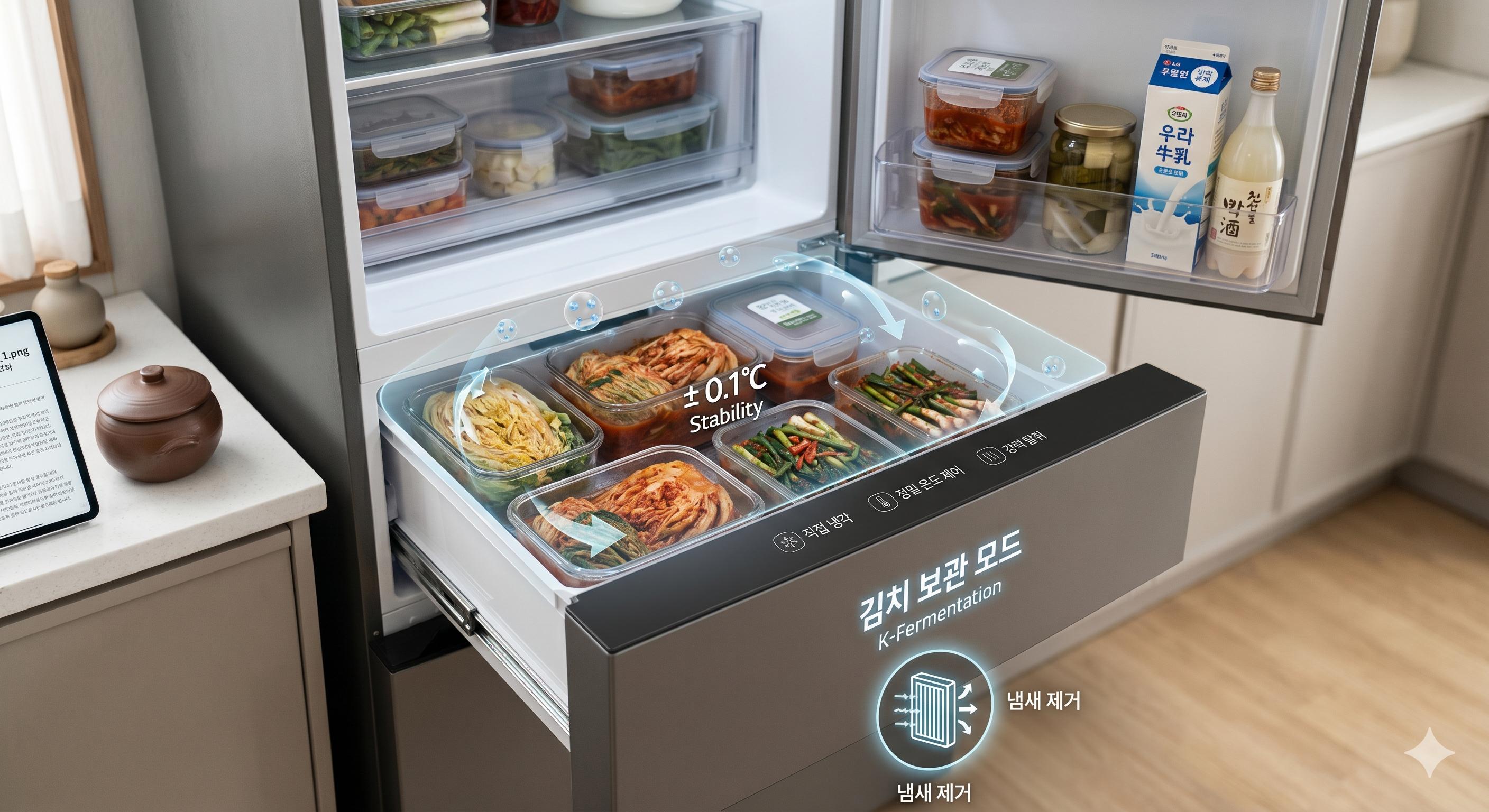
Refrigerators sold in South Korea often include a feature foreigners rarely expect to see: In many Korean households…
In This Article
Refrigerators sold in South Korea often include a feature foreigners rarely expect to see:
“Kimchi Mode.”
In many Korean households, kimchi storage is treated seriously enough to justify an entirely separate appliance dedicated almost exclusively to fermented vegetables.
To outsiders, the idea can seem excessive. To many Koreans, it feels completely normal.
What Is Kimchi Mode?
Kimchi refrigerators are designed to maintain highly specific temperature ranges optimized for fermentation and long-term storage.
Standard kimchi is usually stored between −1°C and 0°C, while water-based varieties such as dongchimi are commonly stored between 0°C and 1°C.
These temperatures are carefully chosen to slow fermentation without freezing the kimchi itself.
Maintaining this narrow temperature range helps preserve the texture, crunch, and flavor of kimchi over extended periods.
Most kimchi refrigerators also include a separate “maturation mode,” typically operating between 6°C and 15°C depending on the manufacturer. This setting allows freshly made kimchi to ferment actively before being transferred into long-term storage mode.
How Kimchi Refrigerators Differ From Standard Refrigerators
Conventional refrigerators cool food by circulating cold air throughout the compartment.
While effective for general food storage, this method creates temperature fluctuations and lowers humidity — conditions that are not ideal for fermented foods.
Kimchi refrigerators instead use a direct cooling system.
In this structure, cooling coils are embedded directly into the refrigerator walls, producing a much more stable internal environment.
The system is partially inspired by onggi (옹기), traditional Korean earthenware jars historically buried underground to store kimchi during winter.
The stable cooling environment supports lactic acid bacteria, which are responsible for kimchi’s sour flavor and evolving texture during fermentation.
Why Korea Invented the Kimchi Refrigerator
The kimchi refrigerator emerged directly from gimjang (김장), Korea’s annual tradition of preparing large quantities of kimchi before winter.
A typical Korean household often prepares between 20 kg and 40 kg of kimchi at once — equivalent to roughly 10 to 20 cabbages. Larger families may produce even more.
Historically, these large batches were stored underground inside buried earthenware jars to maintain stable winter temperatures.
However, rapid urbanization and apartment living from the 1970s onward made underground storage increasingly impractical.
The kimchi refrigerator was effectively engineered to recreate underground fermentation conditions inside modern apartment homes.
How Korean Refrigerators Handle Kimchi Odor
Kimchi contains garlic, ginger, scallions, and fermented seafood ingredients that produce strong sulfur- and ammonia-based odors.
Without proper isolation, these smells can easily spread throughout an entire refrigerator.
To prevent this, kimchi refrigerators use dedicated deodorizing systems.
Activated carbon filters physically absorb odor molecules, while platinum catalysts chemically break them down.
Most manufacturers recommend replacing these filters every 12 to 17 months depending on usage.
Major Korean electronics companies including Samsung and LG developed proprietary odor-control systems specifically for their kimchi refrigerator product lines.
Why Foreigners Are Surprised by Kimchi Refrigerators
Foreign visitors are often shocked not only by the existence of kimchi refrigerators, but by their size.
Many Korean households store enough kimchi to last months at a time, making large-capacity storage feel completely practical domestically.
To many foreigners, a refrigerator dedicated almost entirely to kimchi seems extreme.
In Korea, however, it reflects something much broader:
Kimchi is not treated as a side dish alone — but as an essential part of daily life significant enough to shape household technology itself.