


What Koreans Really Mean When They Say "Let's Eat Sometime"
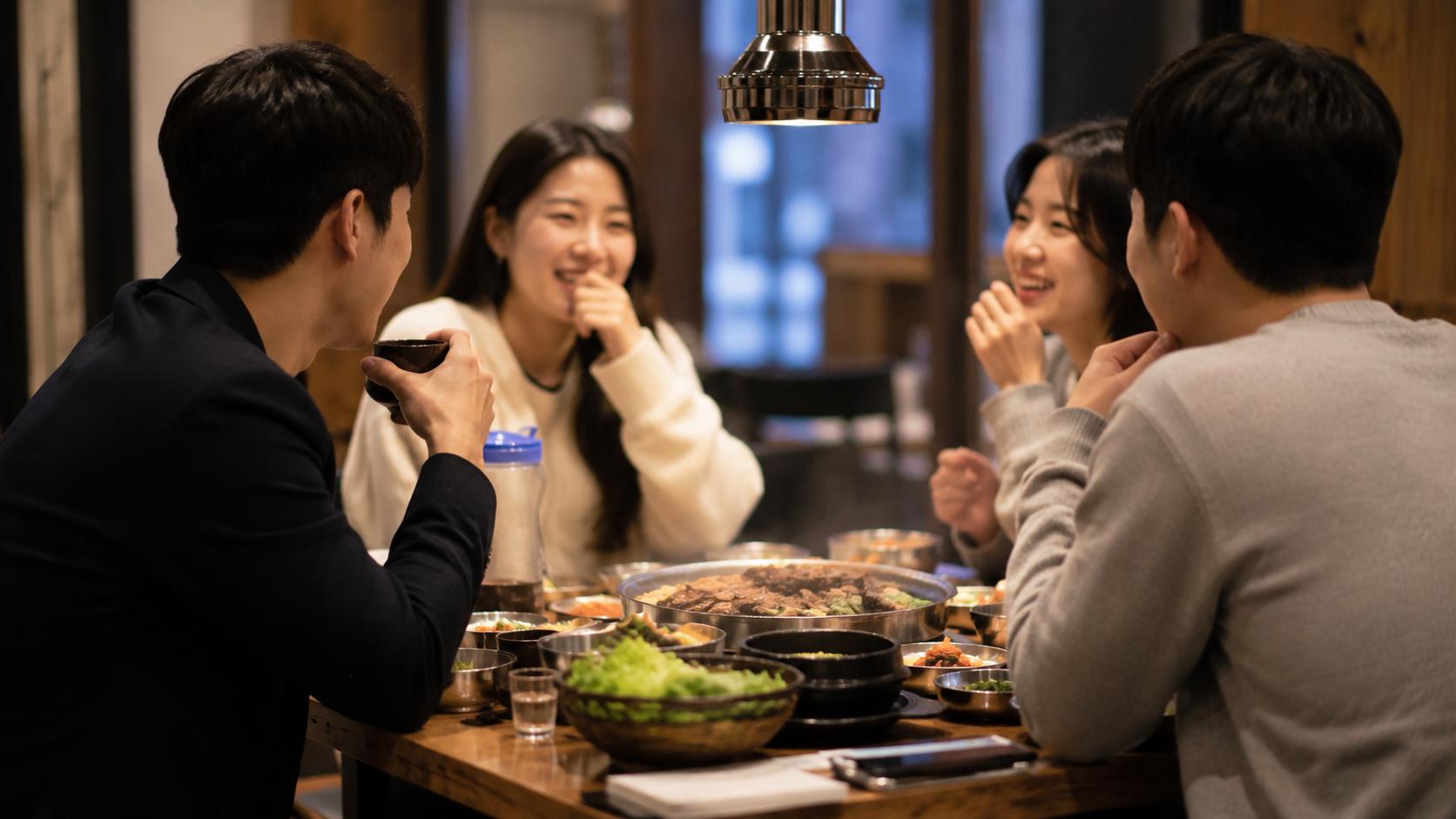
Every Korean has said it. Every Korean has heard it. "Let's eat sometime." And then — nothing. No date is set. No restaurant is chosen. The meal never happens. To outsiders, this looks like a broken promise. To Koreans, it is something else entirely: a social signal with its own grammar, its own rules, and its own kind of sincerity.
In This Article
A Phrase That Is Not an Invitation
"BAP HAN BEON MEOKJA (밥 한번 먹자)" translates literally as "Let's eat a meal together sometime." Linguistically, it looks like a proposal. Socially, it almost never is. In Korean conversational culture, this phrase occupies its own category — somewhere between a greeting, a goodbye, and a declaration of goodwill. It is not dishonesty. It is a different kind of communication entirely.
The confusion arises because the sentence has all the surface features of a concrete plan: a verb, a shared subject, an implied future. But Korean social speech operates on two levels simultaneously — the literal and the relational. "밥 한번 먹자" lives almost entirely on the relational level. What it actually communicates has almost nothing to do with scheduling a meal.
Why "Bap" Carries More Than Hunger
To understand why this phrase works the way it does, you have to understand what "bap" means in Korean culture. Bap is rice. Bap is also a meal. But in the broader social vocabulary of Korean life, bap is care. When a Korean parent texts their college-age child late at night asking "밥 먹었어?" — did you eat? — they are not asking about caloric intake. They are asking: are you okay? Is someone taking care of you?
The Korean family unit itself was historically described as "식구 (SIKGU)" — literally, "eating mouths." The people you eat with are the people you belong to. Sharing a meal in Korean culture is not just social activity. It is a declaration of closeness. This is exactly why "밥 한번 먹자" carries such weight as a social signal: invoking a shared meal is invoking the language of belonging, warmth, and mutual care.
The Real Message Inside the Words
So what is a Korean actually saying when they say "밥 한번 먹자" with no intention of booking a restaurant? The message is this: I still consider you part of my world. I do not want this moment to be a goodbye. The relationship between us is not over. It is a small flag planted in the social ground, marking that the connection is still alive and worth preserving.
In a culture where relationships are deeply hierarchical and physical distance between people carries meaning, the act of naming a future shared meal — even an imaginary one — functions as an anchor. It says: there is a version of the future where we are still connected. That version exists. The actual logistics of that meal are a secondary concern, and often irrelevant altogether.
When "Let's Eat" Actually Means Let's Eat
Here is where it gets interesting: the same phrase, spoken in a different context, with a different tone, is a real invitation. Korean speakers read the difference instinctively. The signals are subtle but consistent. A real invitation usually comes with specificity — a day, a neighborhood, a type of food. It is said at a natural pause in conversation, not at the moment of parting. And crucially, it is followed by a question: "How does Friday work for you?"
The version that means nothing is always vague. "언제 한번" — sometime, one of these days. No day. No place. The word "한번" in this context does not mean "once." It means "at some undefined, low-pressure point in the future that we both understand may never come." Every Korean hears this distinction clearly. The ambiguity is not accidental. It is the entire point.
The Unspoken Rules of Korean Social Distance
Korean social culture places enormous value on "눈치 (NUNCHI)" — the ability to read a room, to sense what another person needs without being told. "밥 한번 먹자" is a nunchi-dependent phrase. It works because both parties already know, without discussion, whether it is real or ceremonial. The speaker does not need to specify. The listener does not need to ask. Both understand.
This is not unique to Korea. English speakers say "we should hang out sometime" or "let's catch up soon" with similar intentional vagueness. But in Korean culture, the specific invocation of food gives the phrase a particular warmth that more generic phrases lack. It is a warmer non-invitation than most languages can produce, because it borrows the emotional vocabulary of care and belonging from the culture's deepest relationship with what "bap" means.
What Happens When a Foreigner Says "When?"
Foreigners who have spent time in Korea often describe the same experience. A Korean acquaintance says "밥 한번 먹자" warmly and apparently sincerely. The foreigner, treating it as a real proposal, responds: "Sure, when? How about next Tuesday?" And suddenly, the atmosphere shifts. The Korean becomes visibly uncomfortable. The conversation stalls. What went wrong?
What the foreigner did was collapse the comfortable ambiguity that the phrase depends on. By asking for a date, they forced the phrase out of the relational register and into the literal one — and the Korean now has to either commit to an actual plan they may not have wanted, or admit that the invitation was not a real invitation, which feels rude. The question "when?" is not aggressive. But it is a demand that the social signal become a logistical one, and that transition is jarring precisely because the phrase was never meant to live there.
A Signal, Not a Lie
Calling "밥 한번 먹자" a lie misses what it actually is. A lie involves intent to deceive. This phrase involves no deception between two Korean speakers — both know exactly what is and is not being offered. It is closer to a social ritual, one that performs the function of keeping a relationship warm without demanding that warmth be immediately converted into action.
In Korean social life, the relationship is the long game. Meals happen when the timing, the mood, and the proximity align naturally. Forcing a date onto a casual expression of goodwill would feel transactional, almost clinical. "밥 한번 먹자" preserves the possibility of connection without the pressure of execution. And in a culture where relationships are maintained over years and decades — not just scheduled appointments — that preservation has its own genuine value. The meal may never happen. But the warmth it signals is entirely real.